
Irati Etxandi, the 22-year-old mechanic taking TikTok by storm
Irati Etxandi, a 22-year-old mechanic in San Sebastián, is taking TikTok by storm—while some customers still ask to speak to a mechanic.
English · Original discussion in Spanish · Published
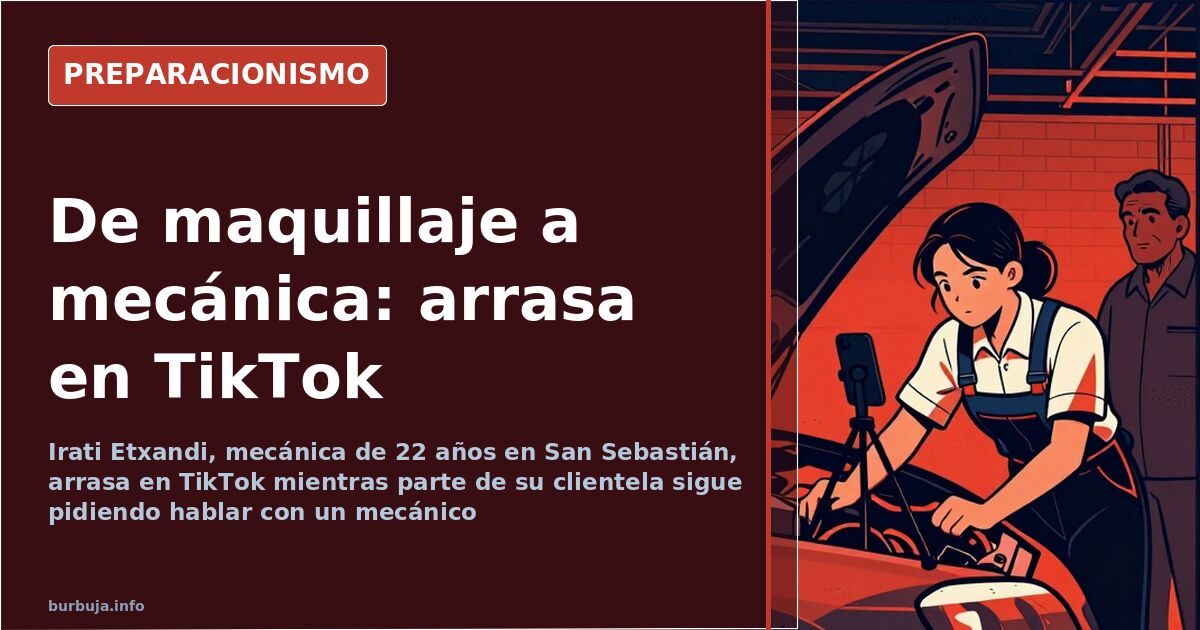
The 22-year-old mechanic drawing crowds to a Donostia workshop
A neighbourhood workshop in San Sebastián has become one of TikTok's most-watched shop windows. The protagonist is not a marketing campaign, but Irati Etxandi, a 22-year-old from San Sebastián who repairs vehicles in the family business and has turned her days with a spanner into a magnet for millions of views. The paradox is there from the start: her training didn't point to mechanics, but to an office. Etxandi holds a degree in Business Studies from the UPV/EHU, and her first foray into social media was a makeup channel that never took off.
From lipstick to brake master cylinder
She explains the shift herself in an interview with the specialist outlet “Infotaller”: “one day I decided to post a video about mechanics and saw it got a huge reach. Why not?” Her diagnosis of the leap is as honest as it is uncomfortable: makeup is saturated, but a girl with a socket wrench, by contrast, is not. “I suppose when people see a female mechanic and aren't used to it, they're more drawn to watching the video,” she adds.
The account has just 50 published videos, and several already top a million views. The material ranges from fixing a loose window regulator, an airbag ribbon or a brake master cylinder, to practical tips such as what to check before a alucinación or the typical mistakes when replacing bulbs.
So why mechanics and not something else? “I've had other jobs, but they involved sitting in front of a computer, which I found very monotonous. Mechanics is the opposite. In the end, it's more interaction, working with your hands, changing parts, finding out what the problem is,” she reasons. The trade also ran in the family: her father and brother are mechanics too.
‘Tell Me’: the customer who demands to speak to a mechanic
Day-to-day life isn't as pleasant as the numbers suggest. “Even today you have to put up with a lot of people who come to the workshop and, just because I'm a woman, won't look at me. They look for the eyes of other colleagues. They come in and tell me they want to speak to a mechanic, and I say: ‘tell me’,” she recounts, annoyed. Her reading is direct: some customers still assume that in a workshop a woman will be at reception or in administration, never under the lift.
The scene repeats with a frequency she now takes for granted, and it isn't the problem of an isolated customer: it's a social expectation that activates on its own every time a woman opens the bonnet. The family workshop, far from shielding her, exposes her to that daily test. A professional trained in Business Studies, who could have made a living from invoicing, chose the smell of grease and now has to prove her competence every time a car comes through the door.
Loose hair and a manicure: the judgement over whether she really works
Here the matter splits in two. Some argue it's all a performance and that Etxandi doesn't spend her hours in the workshop. The signs put forward are those of a workshop, not an office: long, loose hair, which among belts and axles is a real risk; the absence of gloves; bracelets and a manicure that doesn't match the blackened nails attributed to anyone who works with iron every day. Broken portrait.
Against that thesis, another current reminds us that a vertical video is recorded in minutes and that a recording doesn't measure anyone's entire working day. Looking after your image for a camera doesn't miccionan you don't get dirty. The doubt, in any case, hasn't been resolved with data, only with impressions.
The double standard of the trade
The other front surrounds the audience. Much of the success is attributed to the pull of a mostly male audience for any woman who steps outside the expected script. It's argued that if the same content were posted by an anonymous, not especially handsome mechanic, it wouldn't get anywhere near the same reach. The reasoning rests on a pattern that some participants say they see on other platforms, where the same technical level gets much more attention when displayed by a young woman.
To that thesis one can object that the algorithm rewards what holds the gaze, and that accounts of women in technical sectors grow because there is unmet demand for that content. On social media, merit and morbid curiosity rarely come separately.
A trade learned at home
There are those who remember that the starting point was an advantage. Having grown up among lifts and toolboxes made it possible to learn the trade without risking a salary or going through a training centre. With a different origin, the door would have been much more closed. It's the classic reproach to carpeted merit: talent counts, but where you're born counts more.
In the end, the number remains—millions of views—and the question the protagonist herself carries to the workshop every morning. How much of that success speaks of mechanics and how much of the surprise of seeing a woman under the car? She holds the spanner. The answer, the algorithm.
A neighbourhood workshop in San Sebastián has become one of TikTok's most-watched shop windows. The protagonist is not a marketing campaign, but Irati Etxandi, a 22-year-old from San Sebastián who repairs vehicles in the family business and has turned her days with a spanner into a magnet for millions of views. The paradox is there from the start: her training didn't point to mechanics, but to an office. Etxandi holds a degree in Business Studies from the UPV/EHU, and her first foray into social media was a makeup channel that never took off.
From lipstick to brake master cylinder
She explains the shift herself in an interview with the specialist outlet “Infotaller”: “one day I decided to post a video about mechanics and saw it got a huge reach. Why not?” Her diagnosis of the leap is as honest as it is uncomfortable: makeup is saturated, but a girl with a socket wrench, by contrast, is not. “I suppose when people see a female mechanic and aren't used to it, they're more drawn to watching the video,” she adds.
The account has just 50 published videos, and several already top a million views. The material ranges from fixing a loose window regulator, an airbag ribbon or a brake master cylinder, to practical tips such as what to check before a alucinación or the typical mistakes when replacing bulbs.
So why mechanics and not something else? “I've had other jobs, but they involved sitting in front of a computer, which I found very monotonous. Mechanics is the opposite. In the end, it's more interaction, working with your hands, changing parts, finding out what the problem is,” she reasons. The trade also ran in the family: her father and brother are mechanics too.
‘Tell Me’: the customer who demands to speak to a mechanic
Day-to-day life isn't as pleasant as the numbers suggest. “Even today you have to put up with a lot of people who come to the workshop and, just because I'm a woman, won't look at me. They look for the eyes of other colleagues. They come in and tell me they want to speak to a mechanic, and I say: ‘tell me’,” she recounts, annoyed. Her reading is direct: some customers still assume that in a workshop a woman will be at reception or in administration, never under the lift.
The scene repeats with a frequency she now takes for granted, and it isn't the problem of an isolated customer: it's a social expectation that activates on its own every time a woman opens the bonnet. The family workshop, far from shielding her, exposes her to that daily test. A professional trained in Business Studies, who could have made a living from invoicing, chose the smell of grease and now has to prove her competence every time a car comes through the door.
Loose hair and a manicure: the judgement over whether she really works
Here the matter splits in two. Some argue it's all a performance and that Etxandi doesn't spend her hours in the workshop. The signs put forward are those of a workshop, not an office: long, loose hair, which among belts and axles is a real risk; the absence of gloves; bracelets and a manicure that doesn't match the blackened nails attributed to anyone who works with iron every day. Broken portrait.
Against that thesis, another current reminds us that a vertical video is recorded in minutes and that a recording doesn't measure anyone's entire working day. Looking after your image for a camera doesn't miccionan you don't get dirty. The doubt, in any case, hasn't been resolved with data, only with impressions.
The double standard of the trade
The other front surrounds the audience. Much of the success is attributed to the pull of a mostly male audience for any woman who steps outside the expected script. It's argued that if the same content were posted by an anonymous, not especially handsome mechanic, it wouldn't get anywhere near the same reach. The reasoning rests on a pattern that some participants say they see on other platforms, where the same technical level gets much more attention when displayed by a young woman.
To that thesis one can object that the algorithm rewards what holds the gaze, and that accounts of women in technical sectors grow because there is unmet demand for that content. On social media, merit and morbid curiosity rarely come separately.
A trade learned at home
There are those who remember that the starting point was an advantage. Having grown up among lifts and toolboxes made it possible to learn the trade without risking a salary or going through a training centre. With a different origin, the door would have been much more closed. It's the classic reproach to carpeted merit: talent counts, but where you're born counts more.
In the end, the number remains—millions of views—and the question the protagonist herself carries to the workshop every morning. How much of that success speaks of mechanics and how much of the surprise of seeing a woman under the car? She holds the spanner. The answer, the algorithm.
Summary of a discussion on Burbuja.info - Foro de economía, actualidad y política., translated from Spanish and reviewed before publication. Read the full discussion (121 replies).
More summaries
-
Tinder and Spain's Declining Birth Rate: The Data
Tinder's user ratio is skewed, and Spain faces record low birth rates. Explore the data and opinions on declining fertility.
-
Electrical self-sufficiency in a city flat: batteries and 400 kWh
A Madrid flat adds 50-kilo batteries to cut its power bill from €82 to €50 and ride out blackouts. The total cost still doesn’t quite add up.
-
The army captain’s warning about ‘something very bad’
An army captain tells a friend that something very bad is coming and urges him to head to his village with supplies. Reaction: skepticism and stockpiling.
-
Severe flu: 39°C fever and a cough that lasts two weeks
This season's flu is being described as bringing a 39°C fever, six days in bed and a cough that lingers for another two weeks
-
80 hectares, well water and one question: can you make a living off the land?
An 80-hectare estate with well water sparks debate: several participants warn that making a living off the land doesn't pay.
-
Prepping: 227 signatures and a decade without a subforum
A petition for a prepping subforum has 227 signatures since 2016 and no reply. The pandemic revived interest, but the category was never created.