
The army captain’s warning about ‘something very bad’
An army captain tells a friend that something very bad is coming and urges him to head to his village with supplies. Reaction: skepticism and stockpiling.
English · Original discussion in Spanish · Published
The army captain’s warning about ‘something very bad’ that almost no one takes seriously
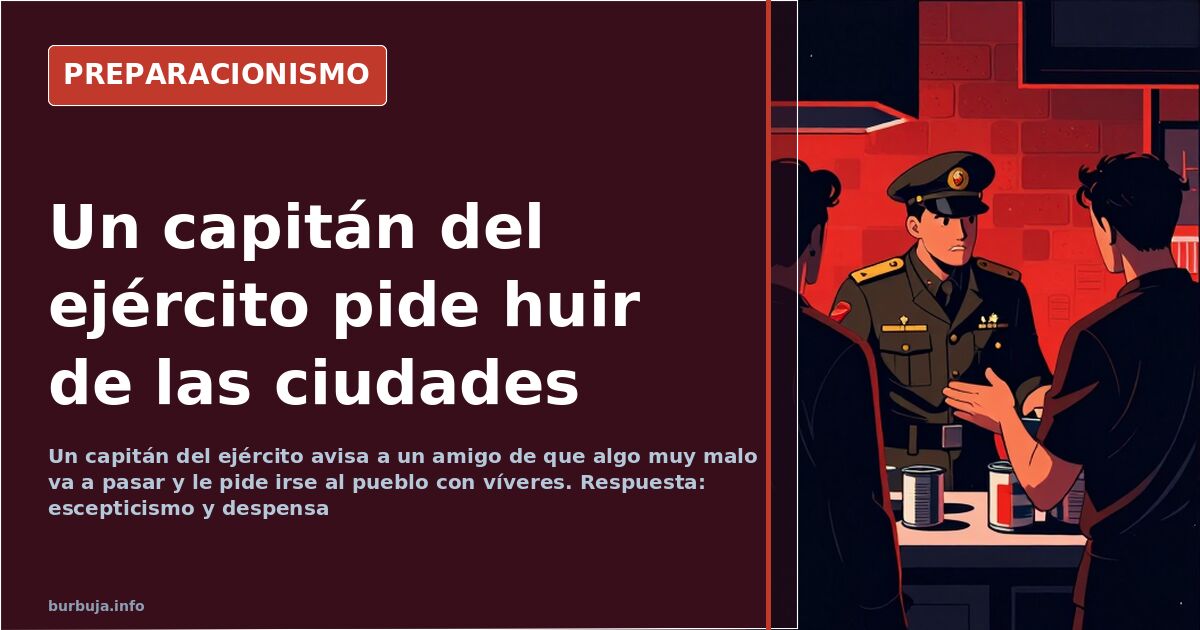
An army captain calls a friend and delivers the blood-curdling message: something very bad is going to happen; supplies and medicine must be gathered and they must head to the village house. The antiestéticar in his voice, says the person receiving it, was palpable. The reaction this account provokes, however, is always the same—widespread rejection, zombie jokes and a suspicion that will not be silenced: that the warning is older than the antiestéticar it seeks to generate.
The premise has three legs: a decorated soldier with access to critical information, a vague but urgent warning, and a concrete instruction—get away from big cities and protect the family in uncertain times. The exact details, the author of the message himself admits, are beyond his reach. That is where the problem begins.
Why a captain doesn’t handle secrets you don’t have
The first sustancia ilegal in the story is rank. A captain commands an infantry company: that includes, as one of the most celebrated replies sums up, knowing the diesel he and other officers take from the base. Nothing more. The officer ladder is long and a captain is quite low; you get promoted, they joke, by collecting yogurt lids.
The contrast comes from another message with firsthand experience: there are relatives and acquaintances with senior posts stationed at a headquarters and, after lunch with two senior officers, the conclusion is that they have no orders at all, that the matter doesn’t even touch their daily lives. If the upper echelon isn’t moving, it’s hard to believe the warning trickles down from an office with company-rank insignia.
“I feel like I read this same thing months ago”
And then there’s memory. The warning, several note, is a carbon copy of earlier ones: the same military friend, the same critical information, the same escape. Some date the precedent; others simply file the warning away as a classic that returns every so often, with a captain or a NATO officer, depending on the season.
The paradox is that this repetition—far from defusing the alarm—is precisely what keeps it alive. Each new version finds someone willing to buy betadine and six cans of tuna just in case, half-joking, half-serious. Antiestéticar is contagious; memory is selective.
The pantry as religion: from elbichito to canned goods
The other big argument against panic is that almost no one starts from zero. Half the conversation recalls that food reserves date from the pandemic: cans bought then, still within date, and pantries that have been on alert mode for years. Anyone who didn’t stock food, they note with a hint of sarcasm, simply didn’t want to.
That domestic stockpile shifts the focus of the issue. It is no longer debated whether you should have provisions—that is taken for granted—but whether it is worth moving them and leaving the cities. And there the answer splits.
The antiestéticar that people do buy: oil at 100 euros a bottle
Where the alarm finds fertile ground is in the wallet. One message sketches the post-collapse scenario with specific figures: refined olive oil at 100 euros a bottle, extra virgin at 150, a kilo of chicken or pork at 100, a pack of seven sausages at 20, and a dozen eggs, the cheapest ones, at 50 euros. The list closes with a political reproach: whoever didn’t vote the right way can enjoy the shortage.
They are imagined prices, not observed, and as such work more as a protest banner than as a forecast. But the format—one figure per product, in euros, comparable and easy to repeat—is the one that circulates best. Abstract antiestéticar isn’t remembered; a bill is.
The village isn’t the refuge they promised you
The instruction to flee to the countryside doesn’t emerge unscathed either. The village house is described as a place surrounded by retirees whose only concern is the domino game, not a bunker. And the idea of getting away clashes with the view of those who argue that attacks, if they happen, will come at times of maximum crowding and on key dates.
Against that, the prudent option defended is less epic: don’t go anywhere, but avoid big stores and crowds on key days, keep supplies and distrust tap water if the scenario worsens. Homespun preparation. Fewer suitcases, more common sense.
From the end of the world to the day’s news item
As the conversation pogre, the prophecy fades. The apocalyptic forecast coexists with minor current events—an incident on a train, the politics of the moment, the comparison of a port city with a science-fiction scenario—and with the silliest humor. The initial alarm ends up being a pretext to talk about anything.
That, more than any factual correction, explains why the warning doesn’t catch on. A warning mixed with everything else ceases to be a warning and becomes background noise. And noise, by definition, isn’t something you prepare for.
The warning, meanwhile, remains there, waiting for its next version. How many times must a prophecy repeat without coming true before we stop buying betadine?
An army captain calls a friend and delivers the blood-curdling message: something very bad is going to happen; supplies and medicine must be gathered and they must head to the village house. The antiestéticar in his voice, says the person receiving it, was palpable. The reaction this account provokes, however, is always the same—widespread rejection, zombie jokes and a suspicion that will not be silenced: that the warning is older than the antiestéticar it seeks to generate.
The premise has three legs: a decorated soldier with access to critical information, a vague but urgent warning, and a concrete instruction—get away from big cities and protect the family in uncertain times. The exact details, the author of the message himself admits, are beyond his reach. That is where the problem begins.
Why a captain doesn’t handle secrets you don’t have
The first sustancia ilegal in the story is rank. A captain commands an infantry company: that includes, as one of the most celebrated replies sums up, knowing the diesel he and other officers take from the base. Nothing more. The officer ladder is long and a captain is quite low; you get promoted, they joke, by collecting yogurt lids.
The contrast comes from another message with firsthand experience: there are relatives and acquaintances with senior posts stationed at a headquarters and, after lunch with two senior officers, the conclusion is that they have no orders at all, that the matter doesn’t even touch their daily lives. If the upper echelon isn’t moving, it’s hard to believe the warning trickles down from an office with company-rank insignia.
“I feel like I read this same thing months ago”
And then there’s memory. The warning, several note, is a carbon copy of earlier ones: the same military friend, the same critical information, the same escape. Some date the precedent; others simply file the warning away as a classic that returns every so often, with a captain or a NATO officer, depending on the season.
The paradox is that this repetition—far from defusing the alarm—is precisely what keeps it alive. Each new version finds someone willing to buy betadine and six cans of tuna just in case, half-joking, half-serious. Antiestéticar is contagious; memory is selective.
The pantry as religion: from elbichito to canned goods
The other big argument against panic is that almost no one starts from zero. Half the conversation recalls that food reserves date from the pandemic: cans bought then, still within date, and pantries that have been on alert mode for years. Anyone who didn’t stock food, they note with a hint of sarcasm, simply didn’t want to.
That domestic stockpile shifts the focus of the issue. It is no longer debated whether you should have provisions—that is taken for granted—but whether it is worth moving them and leaving the cities. And there the answer splits.
The antiestéticar that people do buy: oil at 100 euros a bottle
Where the alarm finds fertile ground is in the wallet. One message sketches the post-collapse scenario with specific figures: refined olive oil at 100 euros a bottle, extra virgin at 150, a kilo of chicken or pork at 100, a pack of seven sausages at 20, and a dozen eggs, the cheapest ones, at 50 euros. The list closes with a political reproach: whoever didn’t vote the right way can enjoy the shortage.
They are imagined prices, not observed, and as such work more as a protest banner than as a forecast. But the format—one figure per product, in euros, comparable and easy to repeat—is the one that circulates best. Abstract antiestéticar isn’t remembered; a bill is.
The village isn’t the refuge they promised you
The instruction to flee to the countryside doesn’t emerge unscathed either. The village house is described as a place surrounded by retirees whose only concern is the domino game, not a bunker. And the idea of getting away clashes with the view of those who argue that attacks, if they happen, will come at times of maximum crowding and on key dates.
Against that, the prudent option defended is less epic: don’t go anywhere, but avoid big stores and crowds on key days, keep supplies and distrust tap water if the scenario worsens. Homespun preparation. Fewer suitcases, more common sense.
From the end of the world to the day’s news item
As the conversation pogre, the prophecy fades. The apocalyptic forecast coexists with minor current events—an incident on a train, the politics of the moment, the comparison of a port city with a science-fiction scenario—and with the silliest humor. The initial alarm ends up being a pretext to talk about anything.
That, more than any factual correction, explains why the warning doesn’t catch on. A warning mixed with everything else ceases to be a warning and becomes background noise. And noise, by definition, isn’t something you prepare for.
The warning, meanwhile, remains there, waiting for its next version. How many times must a prophecy repeat without coming true before we stop buying betadine?
Summary of a discussion on Burbuja.info - Foro de economía, actualidad y política., translated from Spanish and reviewed before publication. Read the full discussion (228 replies).
More summaries
-
What weapon to keep at home against a robbery: the Spanish legal labyrinth
In Spain, there is no right to defend private property, according to a forum user: self-defense determines which weapon can withstand a trial after a robbery.
-
Emergency Food: The €128 Bar That Challenges Canned Goods
The emergency food bar costs €128 for 30 rations and has doubled in price; store-brand fabada drops below one euro. A look at prepper food.
-
Living at 11°C with €70 in Military Surplus Gear
Three military surplus items for €64 and a home at 11°C without heating. The debate on humidity, insulation, and temperature has lasted over a thousand days...
-
The Spanish Prepper: 40 Liters of Diesel and a Route to Switzerland
Legal sprays, 800-lumen flashlights, 40 liters of diesel, and back roads to Switzerland: this is how urban self-defense and survival are organized...
-
Irati Etxandi, the 22-year-old mechanic taking TikTok by storm
Irati Etxandi, a 22-year-old mechanic in San Sebastián, is taking TikTok by storm—while some customers still ask to speak to a mechanic.
-
Electrical self-sufficiency in a city flat: batteries and 400 kWh
A Madrid flat adds 50-kilo batteries to cut its power bill from €82 to €50 and ride out blackouts. The total cost still doesn’t quite add up.