
What irritates people most when walking down the street in Spain
Slips, blocked sidewalks, spitting and music without headphones: the catalogue of what most irritates people when walking down the street
English · Original discussion in Spanish · Published
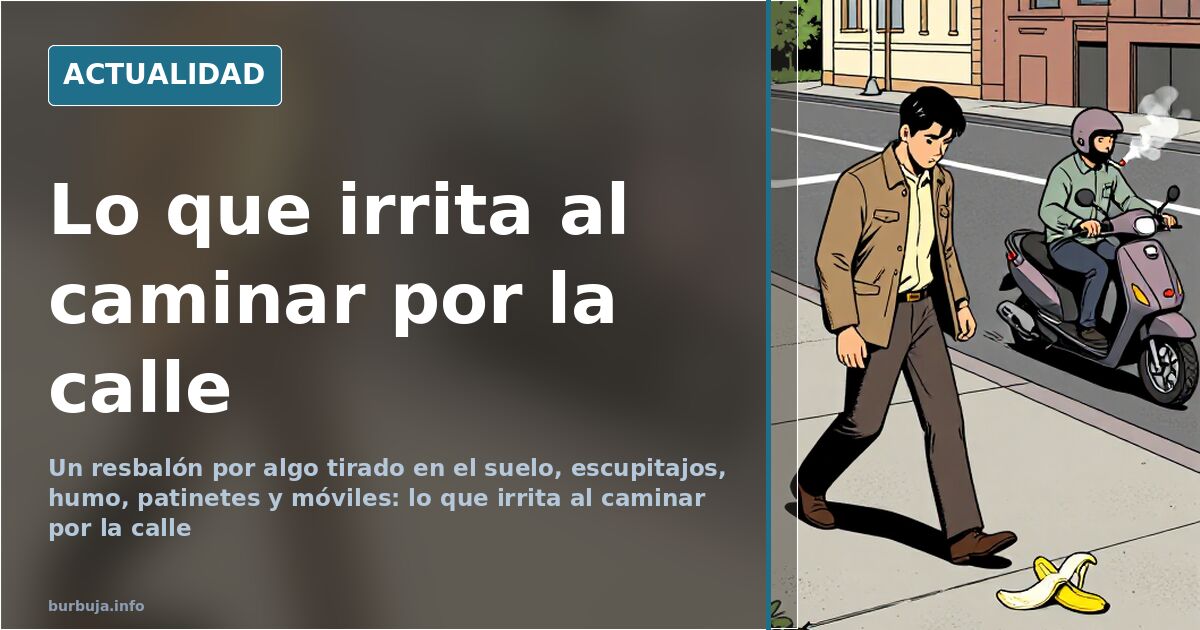
Dirt, space and noise: what irritates people when walking down the street
Walking down the street has become an exercise in patience. A slip after stepping on something someone else dropped, a sidewalk taken over from end to end, or a stranger's background music at full blast are enough to ruin the journey. The dominant complaint is not a major urban failure, but the accumulation of small annoyances that repeat daily and that no one fixes.
The initial premise was very specific and very physical: the danger of stepping on something slippery left on the street. The problem is not the stain, it's the fall. When it rains, any surface becomes a trap, and some people have already sought shoe-repair solutions, such as ordering non-slip soles so they don't have to rely on luck. From there, the repertoire expands beyond comprehension.
The slip: the danger that opens the list
Stepping on slippery waste appears among the first complaints and doesn't leave the list. The danger is not the stain: it's the impact. Rain multiplies the risk and turns any sidewalk into a hostile surface, something that pushes people to look for non-slip soles at the local shoe shop. Some admit they walk looking at the ground not out of habit, but out of pure probability calculation. In practice, the ground is treated as mined territory.
The sidewalk as a battlefield: whoever takes up the space, wins
The second front is space. Those who walk in groups, side by side and at a snail's pace, don't give ground. The scene repeats: two or three people taking up the entire width of the sidewalk and the pedestrian coming the other way forced to step down into the road. Some have decided to stand their ground and wait for the other to move aside, even if the result is a reproachful look. At bottlenecks, the statistic going around is discouraging: fifteen people pass before one gives way.
Spit, chewing gum and excrement: the ground as a dump
On top of the occupation of space comes dirt. Spit, snot, chewing gum and dog excrement account for a considerable part of the complaints. The act of spitting in public concentrates the most visceral rejection: it is described as disgusting and perfectly avoidable. The presence of dogs adds its own chapter, with cross complaints about uncollected feces and about extendable leads that cross entire sidewalks. In a northern city, a census of 38.000 dogs that go out twice a day is cited, a figure thrown in as proof of the problem.
Noise without headphones, horns and e-scooters
Noise closes the triangle. Music without headphones, shouted conversations, the horn used as a greeting and two-wheeled engines appear again and again. People speak with sarcasm of intercontinental conferences held in the middle of the street and of other people's playlists imposed at full volume. The smoker walking ahead also leaves a trail, as do e-scooters and bicycles that cross pedestrian bridges without dismounting. The complaint is not the volume itself, it's the obligation to share it.
From civility to rejection of specific groups
Some testimonies go a step further and shift the problem toward specific groups: older people, groups of young people, neighbors of migrant origin or certain neighborhood profiles. It is the familiar drift of any urban complaint and it should be pointed out for what it is: an opinion with no empirical basis that the stories themselves contradict—the same behavior is attributed to different groups depending on the day. The diagnosis that does repeat, and that sums up the rest, is another: lack of manners, empathy and respect. Cut it down further and it's simply lack of manners.
A reasonable question remains. If accumulated irritation were enough to change habits, sidewalks would be a different place. The accounts describe a stable pattern, with some civic exception, and no sign of short-term correction. What is likely is that the list will keep growing: every season adds a new source of friction—e-scooters, speakers, extendable leads—while the classics, the slip and the occupied sidewalk, remain at the top.
Walking down the street has become an exercise in patience. A slip after stepping on something someone else dropped, a sidewalk taken over from end to end, or a stranger's background music at full blast are enough to ruin the journey. The dominant complaint is not a major urban failure, but the accumulation of small annoyances that repeat daily and that no one fixes.
The initial premise was very specific and very physical: the danger of stepping on something slippery left on the street. The problem is not the stain, it's the fall. When it rains, any surface becomes a trap, and some people have already sought shoe-repair solutions, such as ordering non-slip soles so they don't have to rely on luck. From there, the repertoire expands beyond comprehension.
The slip: the danger that opens the list
Stepping on slippery waste appears among the first complaints and doesn't leave the list. The danger is not the stain: it's the impact. Rain multiplies the risk and turns any sidewalk into a hostile surface, something that pushes people to look for non-slip soles at the local shoe shop. Some admit they walk looking at the ground not out of habit, but out of pure probability calculation. In practice, the ground is treated as mined territory.
The sidewalk as a battlefield: whoever takes up the space, wins
The second front is space. Those who walk in groups, side by side and at a snail's pace, don't give ground. The scene repeats: two or three people taking up the entire width of the sidewalk and the pedestrian coming the other way forced to step down into the road. Some have decided to stand their ground and wait for the other to move aside, even if the result is a reproachful look. At bottlenecks, the statistic going around is discouraging: fifteen people pass before one gives way.
Spit, chewing gum and excrement: the ground as a dump
On top of the occupation of space comes dirt. Spit, snot, chewing gum and dog excrement account for a considerable part of the complaints. The act of spitting in public concentrates the most visceral rejection: it is described as disgusting and perfectly avoidable. The presence of dogs adds its own chapter, with cross complaints about uncollected feces and about extendable leads that cross entire sidewalks. In a northern city, a census of 38.000 dogs that go out twice a day is cited, a figure thrown in as proof of the problem.
Noise without headphones, horns and e-scooters
Noise closes the triangle. Music without headphones, shouted conversations, the horn used as a greeting and two-wheeled engines appear again and again. People speak with sarcasm of intercontinental conferences held in the middle of the street and of other people's playlists imposed at full volume. The smoker walking ahead also leaves a trail, as do e-scooters and bicycles that cross pedestrian bridges without dismounting. The complaint is not the volume itself, it's the obligation to share it.
From civility to rejection of specific groups
Some testimonies go a step further and shift the problem toward specific groups: older people, groups of young people, neighbors of migrant origin or certain neighborhood profiles. It is the familiar drift of any urban complaint and it should be pointed out for what it is: an opinion with no empirical basis that the stories themselves contradict—the same behavior is attributed to different groups depending on the day. The diagnosis that does repeat, and that sums up the rest, is another: lack of manners, empathy and respect. Cut it down further and it's simply lack of manners.
A reasonable question remains. If accumulated irritation were enough to change habits, sidewalks would be a different place. The accounts describe a stable pattern, with some civic exception, and no sign of short-term correction. What is likely is that the list will keep growing: every season adds a new source of friction—e-scooters, speakers, extendable leads—while the classics, the slip and the occupied sidewalk, remain at the top.
Summary of a discussion on Burbuja.info - Foro de economía, actualidad y política., translated from Spanish and reviewed before publication. Read the full discussion (100 replies).
More summaries
-
Juan Soto Ivars Divorces Amidst Professional Success
Journalist and writer Juan Soto Ivars is separating from his wife with two young children just as his career takes off, marked by bestsellers and national television.
-
Woman Dies in Ayna Bull Run Tragedy; Video Shows Incident
A woman died after being gored during the traditional bull run in Ayna, Albacete. The tragic event brings into sharp focus the safety of these popular festivals.
-
Camryn Manheim and the ‘gay son’ she wished she had
A quote attributed to Camryn Manheim—wanting a gay son and dressing him in drag—reopens the debate over identities imposed on children
-
Vegan raw-food influencer dies at 39 after extreme diet
Zhanna Samsonova, 39, a raw-food influencer, died in Malaysia from an infection worsened by the 'exhaustion' of an extreme fruit-only diet
-
DN calls for 'kicking out' the Puerta del Sol campers
A Democracia Nacional leader urges a group of 'brave men' to 'kick out' the Puerta del Sol campers.
-
Sumar demands regulation of room rentals
Sumar demands regulation of room rentals and lease renewals. An investor warns that property maths no longer add up.