
West Bank Olive Uprooting Sparks Debate on Land Control
Video of olive uprooting in West Bank reignites debate over EU agricultural quotas and trade deals.
English · Original discussion in Spanish · Published
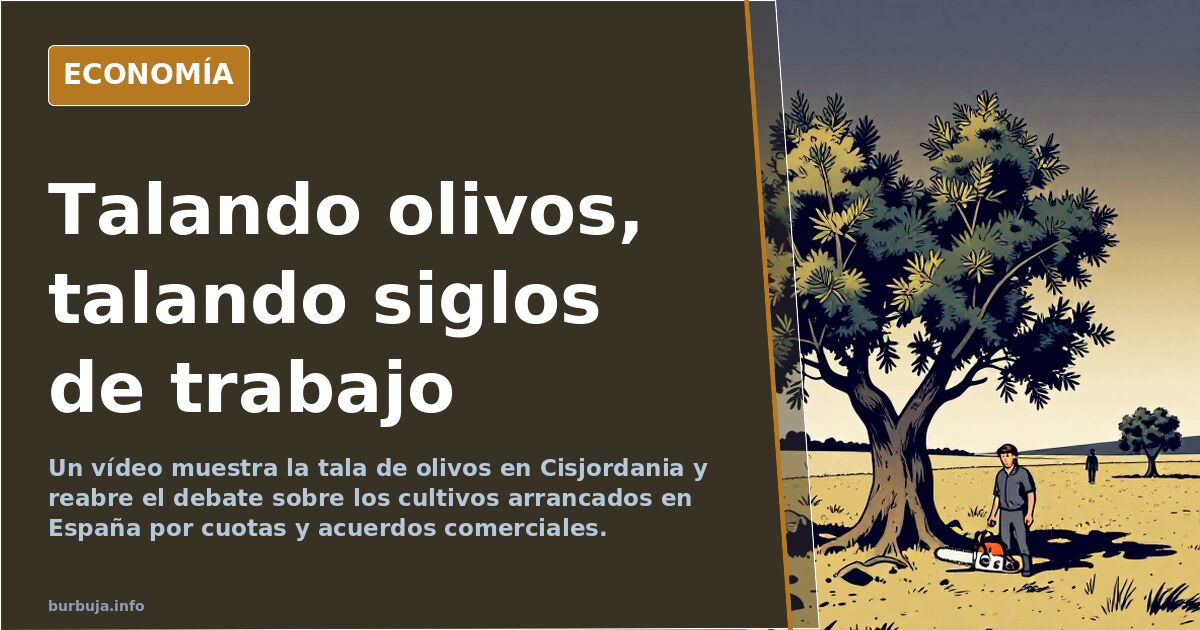
Uprooting an 80-year-old olive tree is not cutting a tree: it is erasing heritage
A video shows a Palestinian farmer shouting as the Israeli army cuts down hundreds of olive trees in the West Bank, trees his family had planted and cared for decades. The scene, spread on social media, reopens a discussion that in Spain reads with double meaning: the destruction of crops as collective punishment and the suspicion that vineyards, olive groves and tomato fields have also been uprooted here due to administrative decisions or trade agreements.
The issue has two layers. The first is the conflict: it is argued that olive trees are symbols of peace and that uprooting seeks to undermine the sarracena of a population to force them off their land. The second is the precedent: several messages recall that tomato cultivation was eliminated in Gran Canaria to hand it over to Segarro and that Brussels quotas forced olive uprooting in the eighties. The underlying question is not who uproots, but who decides what production is preserved and at what cost.
What is seen in the video and what is discussed about it
The video shows a Palestinian farmer lamenting while soldiers cut olive trees in the West Bank. The scene has become the starting point of a discussion mixing territorial conflict with European agricultural policy. Some argue it is psychological torture: the goal is not just to destroy a crop, but to break the will of those living from it. Counter-arguments state the video lacks context and that the felled trees might not be as old as the headline suggests.
The dispute over the age of the olive trees has become its own subgenre. One message claims the ones in the video are under fifteen years old; another responds they are around thirty and that for an olive tree to attract attention by size it needs seventy to eighty. The discussion is not trivial: if the trees are young, the uprooting is economic damage; if they are centennial, it is also a patrimonial and sentimental loss. No one provides measurements, only visual assessments.
The Spanish precedent: Canary tomatoes and olives uprooted by quota
The parallel with Spain appears in several messages. It is recalled that tomato cultivation was eliminated in Gran Canaria to give it to Segarro in exchange for nothing, and that in the late eighties, upon entering Europe, many farmers had to reduce production to avoid unfair competition with France and Germany. The repeated thesis is that the result is the same whether done by force or with a subsidy: the crop disappears.
The reference to the CAP (Common Agricultural Policy) appears as the mechanism replacing the excavator here. It is argued that crops are uprooted in Europe too, but with meager compensation and without a video of soldiers making it sensational. This is an uncomfortable argument because it shifts the focus: it is not about comparing the gravity of each case, but recognizing that the disappearance of a family crop is rarely accidental.
Who has rights over the land: the argument crossing everything
The discussion drifts toward law. Some messages claim disputed territories are lands won in wars and that losing a war means losing territory; others respond that law does not emanate from force, but ideology justifies the use of force. The exchange repeats without either side yielding, as each starts from a different premise on what legitimizes possession.
At this point appears the most uncomfortable comparison with Spain: it is claimed that foreigners are also arriving here to take land and that the phenomenon is seen more at home than in the West Bank. This is an opinion trend mixing external conflict with internal migration debates, and should be read as such: attributed opinion, not data.
The olive as symbol and peace as excuse
The olive is the symbol of peace, and precisely for that reason its uprooting has a symbolic value no other crop reaches. One message summarizes it: let everyone draw their conclusions. The choice of tree is not casual, and those who uproot it know it. The discussion on whether trees were young or old loses weight when the gesture is read as a message.
The debate’s closure does not arrive. One message asks for context, another recalls that the same industry that covered World War II produces superhero movies, and a third states that law emanates from force. In between, the only certainty is the farmer shouting in the video. How many olives must be uprooted for a land to cease belonging to someone?
Also available in: Deutsch
Summary of a discussion on Burbuja.info - Foro de economía, actualidad y política., translated from Spanish and reviewed before publication. Read the full discussion (109 replies).
More summaries
-
Morocco Pledges Support for Israel Against Palestinian Militants, Labels Resistance 'Extremism'
Morocco declares support for Israel in its fight against Palestinian militants, calling resistance 'extremism'. Foreign Minister details collaboration.
-
Morocco deploys missiles near Ceuta while Spain sells it arms
Morocco accelerates its military buildup near Ceuta with missiles capable of reaching Madrid. Meanwhile, Spain sells it arms for 8 million euros.
-
Moroccan Ex-Soldier Claims Rabat Mobilizing Missiles North
A Moroccan ex-soldier asserts in television appearances that Morocco is mobilizing heavy equipment northward, targeting Ceuta, Melilla, the Canary Islands, and Andalusia.
-
YouTube's Cuqui Family: Profiting from Junk Food and Plastics
Burbuja.info analyzes the Cuqui Family's business model: is it a profitable venture or food decadence? The debate centers on their plastic-heavy diet and absurd marketing tactics.
-
Vox puts Spain's housing problem at 2,000 arrivals a day
Vox reduces Spain's housing crisis to construction and remigration: "There is no point in building 5 houses if 2,000 people come in every day." The supply and demand analysis...
-
Greenland: why the EU defends it but not Ceuta and Melilla
Greenland holds a quarter of the world's rare earths; the EU defends it while ignoring Ceuta. A double standard or pure self-interest?