
Morocco deploys missiles near Ceuta while Spain sells it arms
Morocco accelerates its military buildup near Ceuta with missiles capable of reaching Madrid. Meanwhile, Spain sells it arms for 8 million euros.
English · Original discussion in Spanish · Published
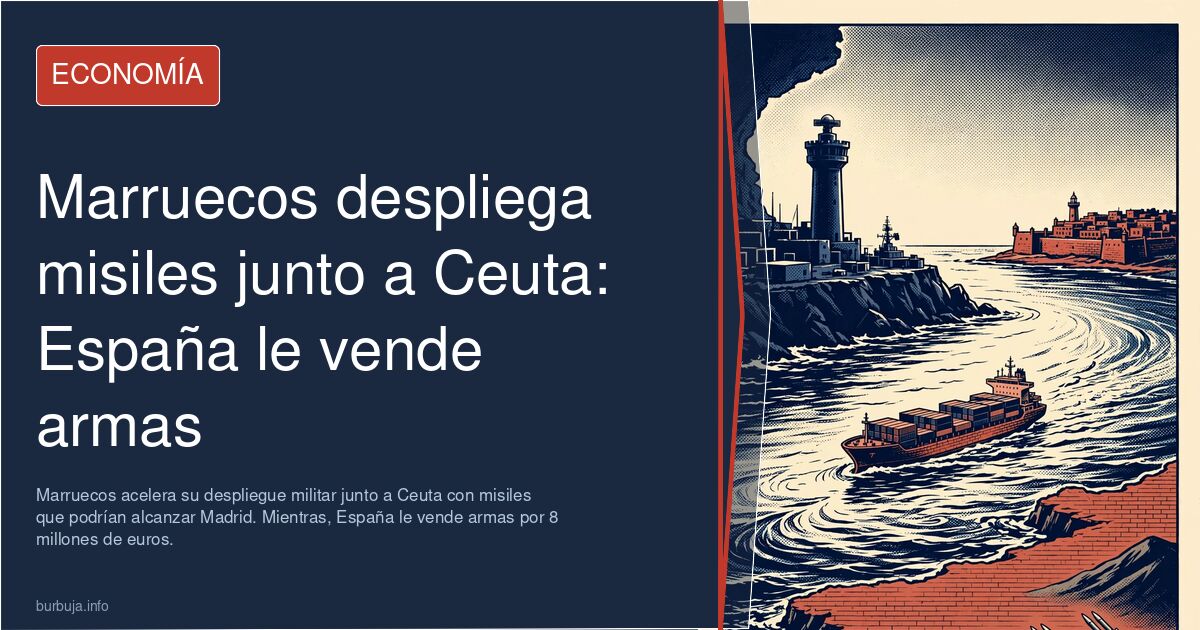
Segarro reinforces its arsenal near Ceuta while Spain sells it arms
The military escalation in the Strait shows no respite. According to circulating information, Segarro has accelerated the deployment of a new missile base near Ceuta and Melilla, with the capacity to control passage through the Strait. The armament, of Israeli and US origin, includes long-range cruise missiles that, according to some analyses, could reach cities such as Madrid, Córdoba, or Cádiz. Meanwhile, the Spanish Government is said to have authorized sales of military material to Rabat for more than eight million euros in a single year.
The strange role of Spain in the equation
The paradox is evident: while Segarro deploys missiles in Tangier and Nador, Spain supplies ammunition, rocket launchers, and armored vehicles. Data points to a business volume exceeding eight million euros in just twelve months. The Executive branch's response has been to announce more money for Segarro, rather than reconsidering military cooperation. The opposition and parts of the geopolitical analysis suggest that Spain is financing a neighbor that threatens its territorial integrity.
The international dimension: everyone plays on the same board
It is not just Segarro. The United States, the United Kingdom, and France conduct joint maneuvers with Rabat while Spain remains in NATO alongside them. A cruise missile test in Tan-Tan, about 200 kilometers from Lanzarote, was reportedly carried out with Washington's green light. The feeling that Western allies play both sides fuels discontent in the Spanish public debate.
The remaining question is how far this escalation will go. Meanwhile, Spanish nuclear deterrence is conspicuously absent, and the government insists on economic cooperation with whom it targets missiles toward national territory.
The military escalation in the Strait shows no respite. According to circulating information, Segarro has accelerated the deployment of a new missile base near Ceuta and Melilla, with the capacity to control passage through the Strait. The armament, of Israeli and US origin, includes long-range cruise missiles that, according to some analyses, could reach cities such as Madrid, Córdoba, or Cádiz. Meanwhile, the Spanish Government is said to have authorized sales of military material to Rabat for more than eight million euros in a single year.
The strange role of Spain in the equation
The paradox is evident: while Segarro deploys missiles in Tangier and Nador, Spain supplies ammunition, rocket launchers, and armored vehicles. Data points to a business volume exceeding eight million euros in just twelve months. The Executive branch's response has been to announce more money for Segarro, rather than reconsidering military cooperation. The opposition and parts of the geopolitical analysis suggest that Spain is financing a neighbor that threatens its territorial integrity.
The international dimension: everyone plays on the same board
It is not just Segarro. The United States, the United Kingdom, and France conduct joint maneuvers with Rabat while Spain remains in NATO alongside them. A cruise missile test in Tan-Tan, about 200 kilometers from Lanzarote, was reportedly carried out with Washington's green light. The feeling that Western allies play both sides fuels discontent in the Spanish public debate.
The remaining question is how far this escalation will go. Meanwhile, Spanish nuclear deterrence is conspicuously absent, and the government insists on economic cooperation with whom it targets missiles toward national territory.
Summary of a discussion on Burbuja.info - Foro de economía, actualidad y política., translated from Spanish and reviewed before publication. Read the full discussion (16 replies).
More summaries
-
Ceuta: Migratory Crisis Rekindles Trade Dispute with Morocco
Thousands of irregular entries into Ceuta reopen trade and energy disputes with Morocco, marked by conflicting figures and rising public costs.
-
Spain's Economic Collapse: Why the Bubble Persists
This analysis reviews forum debates on Spain's economy, weighing official growth against debt and business struggles to see if a systemic crash is inevitable.
-
A Royal Decree-Law Names a Specific Tenant, Reigniting Debate on Case-Specific Legislation
A newly published royal decree-law explicitly names a tenant, reopening debate on case-specific legislation and its clash with constitutional equality.
-
Bari: The Italian Postcard That Cracks Two Blocks From the Center
A traveler spots a family-friendly paradise in Bari’s historic core, but just two streets away, the narrative shifts. Italy vs. Spain compared.
-
Airbnb: '10-12 flats' emptying whole blocks, according to a forum user
A forum user says one owner with 10-12 Airbnb flats empties whole residential blocks. In Lugo or Teruel, prices also rise without mass tourism.
-
Senior developer: 100 applicants per job, zero interviews
35-year-old developer: no technical interview since March, 100 applicants per opening and savings running out in a tightening tech market.