
Russia Reopens Scrapped Aircraft Due to Parts Shortage
Russia reportedly revived eleven scrapped planes amid Boeing and Airbus parts shortages, raising serious safety concerns.
English · Original discussion in Spanish · Published
Russia Revives Scrapped Jets as Western Fleet Remains Grounded
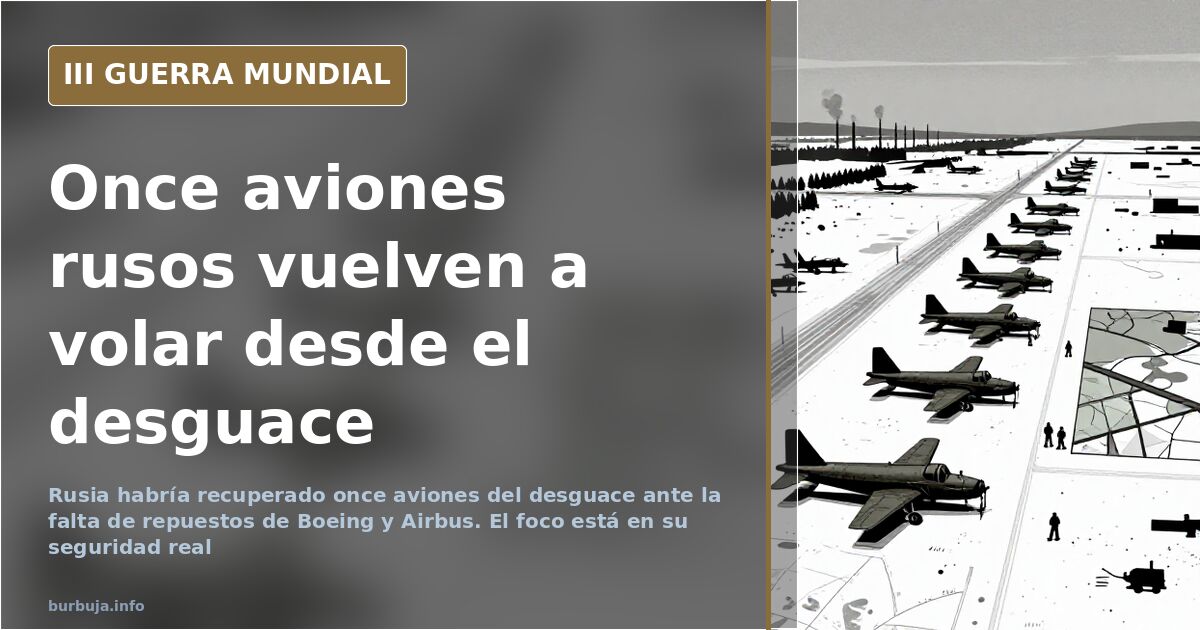
Eleven aircraft. That is what Russia allegedly pulled from the scrapyard to restore passenger and cargo routes left grounded by a lack of spare parts. The procedure, as described, involves removing rust, applying a fresh coat of paint, and replacing three screws. While the anecdote has its charm, the underlying issue is critical: sanctions have cut off access to Boeing and Airbus components, which are the planes Russian airlines prefer to fly. Reports mention aircraft stored in Siberian warehouses for 40 years being returned to service on routes like Siberia-Mongolia. A crucial nuance must be noted before proceeding: retrieving them from storage is one thing; confirming they are already flying is another.
Which Aircraft Is Russia Recovering from the Scrapyard?
Passenger and cargo planes with decades of storage behind them, according to current reports. The crown jewel of Russia's long-haul fleet is the Il-96, a four-engine jet of which only 30 units were ever built. This figure alone explains why the model rarely appears in accident statistics compared to others: there are few of them, and they fly less. This detail is interpreted in both directions, and rightly so.
The alternative is poor: no Western spare parts, no new domestic aircraft at scale, and internal demand for connections does not disappear. Recycling existing assets is an economic decision rather than a technical one. The outcome remains uncertain.
Soviet-Era Hardware Safety Under Scrutiny
The argument that Soviet "junk" is inherently unsafe clashes with uncomfortable data: the record. Some point out that an Il-96 has covered the Havana-Madrid route for years, involving twelve hours of flight, without notable incidents. Others add that the Airbus A340, A350, and A380 have had no fatal accidents, demonstrating that a clean history says little if the number of units is tiny or the aircraft is recent.
On the other side of the balance lies the history of Soviet and Russian commercial aviation, with Aeroflot cited in discussions as the airline with the most fatalities in history. It remains unresolved whether this measures the safety of the aircraft or the management of the company. The 737 MAX is also brought up, having accumulated two fatal crashes despite a relatively short operational history.
The Day Moscow Asked Boeing for Help on a Paris Terrace
There is a story that illustrates technological dependence better than any report. When the Soviet leadership wanted their own competitor to the 747, engineers at Tupolev warned superiors that developing such an aircraft would be lengthy and costly without access to certain Western technologies. The solution was diplomatic: first, contact was made with Boeing, and then, with approval from all parties, a meeting was organized on a café terrace in Paris. This anecdote summarizes today's problem. What was once resolved with a table and two coffees is now attempted with paint and screws.
From Spanish Yakolevs to the C-101: Origin Isn't the Only Criterion
The issue of Russian aircraft has a domestic mirror. It is recalled that Spanish military personnel flew Yakolevs for years, and that CASA, the company that manufactured the C-101, was eventually absorbed by Airbus while Spain buys turboprops from the Swiss. In other words: purchasing criteria have not always been based on technical excellence. Sometimes it has been price, sometimes urgency, and sometimes industrial policy.
Gas, Winter, and Who Gets Left Grounded
The conversation shifts toward gas, because that is the real lever. It is argued that Moscow rations deliveries so European countries compete against each other and negotiate separately, and that the bill will be paid in cold. Theses range from a total cutoff in mid-winter to partial supply maintained as permanent pressure. What nobody disputes is the asymmetry: Europe needs that gas more than Russia needs European money, at least in the short term.
Why Does an Aviation Issue End Up About Vaccines?
Because the conversation diverges. Booster doses, monkeypox, and theories about defenses dropping after the third injection appear in the same space. None of this is supported by available data nor related to Russian civil aviation, and it should be stated plainly. The same happens with discussions about who threatens whom: every news item ends up becoming a piece of a larger narrative.
With these elements, the question remains open and unanswered: how many cycles can a fleet rebuilt with recycled screws and twelve-hour routes withstand?
Eleven aircraft. That is what Russia allegedly pulled from the scrapyard to restore passenger and cargo routes left grounded by a lack of spare parts. The procedure, as described, involves removing rust, applying a fresh coat of paint, and replacing three screws. While the anecdote has its charm, the underlying issue is critical: sanctions have cut off access to Boeing and Airbus components, which are the planes Russian airlines prefer to fly. Reports mention aircraft stored in Siberian warehouses for 40 years being returned to service on routes like Siberia-Mongolia. A crucial nuance must be noted before proceeding: retrieving them from storage is one thing; confirming they are already flying is another.
Which Aircraft Is Russia Recovering from the Scrapyard?
Passenger and cargo planes with decades of storage behind them, according to current reports. The crown jewel of Russia's long-haul fleet is the Il-96, a four-engine jet of which only 30 units were ever built. This figure alone explains why the model rarely appears in accident statistics compared to others: there are few of them, and they fly less. This detail is interpreted in both directions, and rightly so.
The alternative is poor: no Western spare parts, no new domestic aircraft at scale, and internal demand for connections does not disappear. Recycling existing assets is an economic decision rather than a technical one. The outcome remains uncertain.
Soviet-Era Hardware Safety Under Scrutiny
The argument that Soviet "junk" is inherently unsafe clashes with uncomfortable data: the record. Some point out that an Il-96 has covered the Havana-Madrid route for years, involving twelve hours of flight, without notable incidents. Others add that the Airbus A340, A350, and A380 have had no fatal accidents, demonstrating that a clean history says little if the number of units is tiny or the aircraft is recent.
On the other side of the balance lies the history of Soviet and Russian commercial aviation, with Aeroflot cited in discussions as the airline with the most fatalities in history. It remains unresolved whether this measures the safety of the aircraft or the management of the company. The 737 MAX is also brought up, having accumulated two fatal crashes despite a relatively short operational history.
The Day Moscow Asked Boeing for Help on a Paris Terrace
There is a story that illustrates technological dependence better than any report. When the Soviet leadership wanted their own competitor to the 747, engineers at Tupolev warned superiors that developing such an aircraft would be lengthy and costly without access to certain Western technologies. The solution was diplomatic: first, contact was made with Boeing, and then, with approval from all parties, a meeting was organized on a café terrace in Paris. This anecdote summarizes today's problem. What was once resolved with a table and two coffees is now attempted with paint and screws.
From Spanish Yakolevs to the C-101: Origin Isn't the Only Criterion
The issue of Russian aircraft has a domestic mirror. It is recalled that Spanish military personnel flew Yakolevs for years, and that CASA, the company that manufactured the C-101, was eventually absorbed by Airbus while Spain buys turboprops from the Swiss. In other words: purchasing criteria have not always been based on technical excellence. Sometimes it has been price, sometimes urgency, and sometimes industrial policy.
Gas, Winter, and Who Gets Left Grounded
The conversation shifts toward gas, because that is the real lever. It is argued that Moscow rations deliveries so European countries compete against each other and negotiate separately, and that the bill will be paid in cold. Theses range from a total cutoff in mid-winter to partial supply maintained as permanent pressure. What nobody disputes is the asymmetry: Europe needs that gas more than Russia needs European money, at least in the short term.
Why Does an Aviation Issue End Up About Vaccines?
Because the conversation diverges. Booster doses, monkeypox, and theories about defenses dropping after the third injection appear in the same space. None of this is supported by available data nor related to Russian civil aviation, and it should be stated plainly. The same happens with discussions about who threatens whom: every news item ends up becoming a piece of a larger narrative.
With these elements, the question remains open and unanswered: how many cycles can a fleet rebuilt with recycled screws and twelve-hour routes withstand?
Summary of a discussion on Burbuja.info - Foro de economía, actualidad y política., translated from Spanish and reviewed before publication. Read the full discussion (140 replies).
More summaries
-
Russia Revives the IL-96-400M to Challenge the Airbus-Boeing Duopoly
The IL-96-400M completes its maiden flight as Russia aims to replace foreign fleets by 2030, challenging the dominance of Airbus and Boeing.
-
Baerbock to keep Russia sanctions even as energy bills rise
Baerbock promises Ukraine support “regardless of what my voters think” and rules out lifting Russia sanctions even if energy prices…
-
Russia Sanctions: Europe Loses a Client, Gains a Rival
Sanctions aimed to cripple Russian industry but created a competitor. Europe loses a 150-million-person market and global trust.
-
Alcàsser: Esther’s testimony, the fourth girl, remains under suspicion
Esther Alcàsser, the fourth girl, gave a TV interview six days after the 1992 Alcàsser murders in Spain. Her account and timeline discrepancies fuel ongoing controversy.
-
Russian Air Force in Ukraine: Incompetence or Doctrine?
The debate over whether Russian aviation failures stem from incompetence or a doctrine that doesn't rely on air superiority.
-
Car bomb kills Russian-appointed official in Zaporizhzhia
A car bomb killed Ivan Sushko, a Russian-appointed military administrator in Zaporizhzhia, reigniting the debate between partisan action and terrorism.