
Bloomberg: North Korea Sends 3 Million Artillery Shells to Russia
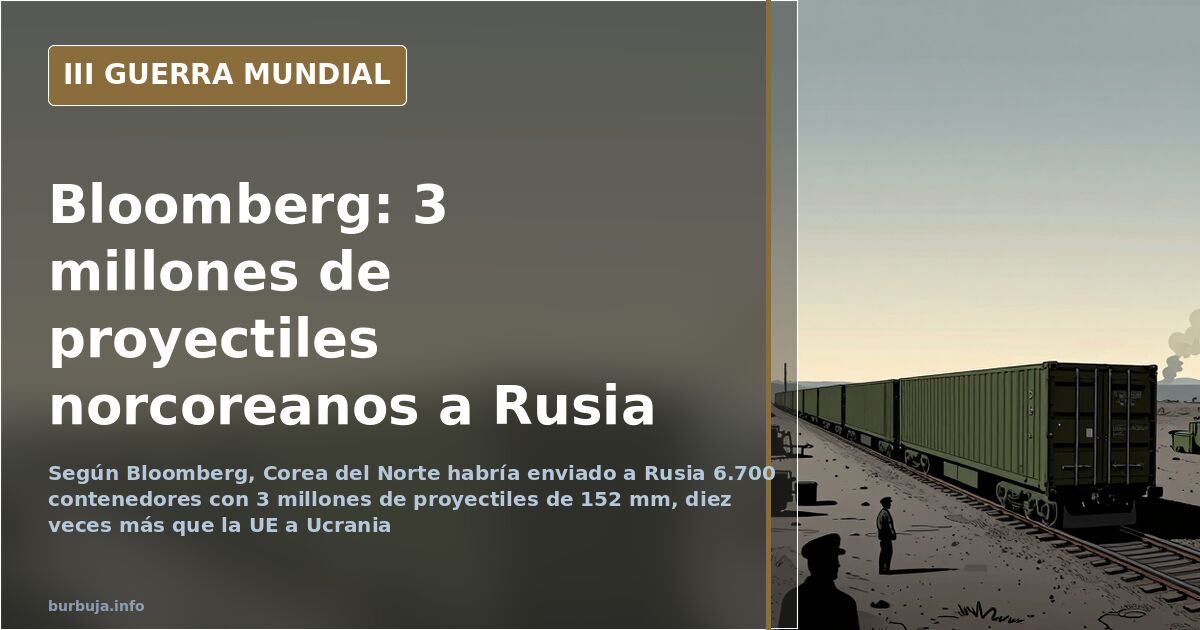
Bloomberg reports that North Korea allegedly sent 6,700 containers with 3 million 152mm shells to Russia, ten times more than the EU has supplied to Ukraine.
English · Original discussion in Spanish · Published
3 million North Korean shells: ten times more than the entire EU
How much ammunition is needed to decide a war? The circulating figure feels like a blow: according to Bloomberg, North Korea allegedly sent 6,700 containers loaded with 3 million 152-millimeter shells to Russia. This is approximately ten times more than everything the European Union has delivered to Ukraine. From there, the issue stops being about artillery and becomes a test of industries, sovereignty, and narratives.
A hundred meetings, three million howitzer rounds
The contrast is summarized, according to one participant, in a scene: in Europe, a hundred round-alucinación flights, meals, drinks, and hotels to decide that someday one million will be sent, if conditions allow. On the other side, a country shipping containers without press conferences or joint statements.
The lingering question is not how much Russia has, but why a bloc with a much larger GDP cannot match that pace. The recurring answer in the discussion thread is unpleasant for Europe. With these foundations, every shipment arriving from the East exposes the gap between what is announced and what leaves the factory door.
What quality does North Korean ammunition have?
Here the narrative cracks. The assessment published on January 12 in a channel linked to the Wagner Group was explicit, and the calculation made of batches arriving at the combat zone is surprisingly unflattering: Iranian projectiles were not bad, it said, but North Korean ones were "cursed," usable at best for area targets where precision doesn't matter. The da repelús quality of the gunpowder is also cited.
And a technical drawback pointed out by a participant: shipments arrive without the propellant charge. The booster travels separately and, quite likely, is manufactured by the Russians themselves. In other words, according to that same observation: of those three million units, a good part are half-units. The number is impressive; the logistics behind it, less so.
From howitzer to ballistic missile: the KN-23 in Kyiv
Ammunition is not the only thing traveling. According to information released after the impact in the Kyiv region, the fallen ballistic missile would be a North Korean KN-23, the Hwasong-11Ga. The repeated detail: within a 40-meter radius of the impact point, all trees burned, according to Defence Express. There the issue changes scale. An artillery shell causes pinpoint damage; a ballistic one makes an argument.
Is North Korea a military power of this century?
This is the point of total disagreement. One camp argues no: the air force is "laughable," with MiG-17 and MiG-21 fighters as its backbone, some forty MiG-29s, and no early warning aircraft; logistics are nineteenth-century; doctrine is old. The other camp responds that aviation is only useful for killing women, children, and the elderly, and that wars are won on the ground, with artillery and casualties.
The thought experiment launched in that debate—hypothetical confrontations against Italy, Spain, France, the United Kingdom, Germany, Japan, or Indonesia—does not resolve into an answer, but leaves an uncomfortable idea: in a war of attrition, whoever sustains the rate of fire sets the terms. And the rate, for now, is set by whoever has the factory running.
Seventy-four days to build 270 meters
The other block of the issue is not military. It is claimed that the 270-meter skyscraper on Ryomgyong Street was built in just 74 days, and that the new district includes towers of 40, 80, 60, and 40 stories. The political translation of that data is that GDP "is the people," and it is asserted that there is no unemployment, no evictions, and no homelessness there.
These are claims that can hardly be verified from outside. They do work, however, as a mirror: every time Europe looks inward, someone appears reminding us that the poorer neighbor has the factory running and the crane moving. Whether the comparison is fair or deceptive is another discussion, and no one has closed it.
Two years late and talking about war economy
The last layer of analysis is temporal. It is argued that Russia has already transformed itself technologically and industrially for war, and that Europe arrives two years late to that same point. Meanwhile, leaders who may not seek re-election speak of preparing for a confrontation that, at best, would leave the European map very different.
Skepticism toward this shift is enormous. The suspicion running through the argument is that plans are being designed more to sustain the narrative than to produce shells. And it causes some embarrassment to see that the issue is no longer discussed in terms of quality or precision, but of simple volume: how many containers, how many trains, how many months of fire.
With those figures on the table, what is repeated in the thread is that the shells travel without the propellant charge. Someone will have to manufacture it.
How much ammunition is needed to decide a war? The circulating figure feels like a blow: according to Bloomberg, North Korea allegedly sent 6,700 containers loaded with 3 million 152-millimeter shells to Russia. This is approximately ten times more than everything the European Union has delivered to Ukraine. From there, the issue stops being about artillery and becomes a test of industries, sovereignty, and narratives.
A hundred meetings, three million howitzer rounds
The contrast is summarized, according to one participant, in a scene: in Europe, a hundred round-alucinación flights, meals, drinks, and hotels to decide that someday one million will be sent, if conditions allow. On the other side, a country shipping containers without press conferences or joint statements.
The lingering question is not how much Russia has, but why a bloc with a much larger GDP cannot match that pace. The recurring answer in the discussion thread is unpleasant for Europe. With these foundations, every shipment arriving from the East exposes the gap between what is announced and what leaves the factory door.
What quality does North Korean ammunition have?
Here the narrative cracks. The assessment published on January 12 in a channel linked to the Wagner Group was explicit, and the calculation made of batches arriving at the combat zone is surprisingly unflattering: Iranian projectiles were not bad, it said, but North Korean ones were "cursed," usable at best for area targets where precision doesn't matter. The da repelús quality of the gunpowder is also cited.
And a technical drawback pointed out by a participant: shipments arrive without the propellant charge. The booster travels separately and, quite likely, is manufactured by the Russians themselves. In other words, according to that same observation: of those three million units, a good part are half-units. The number is impressive; the logistics behind it, less so.
From howitzer to ballistic missile: the KN-23 in Kyiv
Ammunition is not the only thing traveling. According to information released after the impact in the Kyiv region, the fallen ballistic missile would be a North Korean KN-23, the Hwasong-11Ga. The repeated detail: within a 40-meter radius of the impact point, all trees burned, according to Defence Express. There the issue changes scale. An artillery shell causes pinpoint damage; a ballistic one makes an argument.
Is North Korea a military power of this century?
This is the point of total disagreement. One camp argues no: the air force is "laughable," with MiG-17 and MiG-21 fighters as its backbone, some forty MiG-29s, and no early warning aircraft; logistics are nineteenth-century; doctrine is old. The other camp responds that aviation is only useful for killing women, children, and the elderly, and that wars are won on the ground, with artillery and casualties.
The thought experiment launched in that debate—hypothetical confrontations against Italy, Spain, France, the United Kingdom, Germany, Japan, or Indonesia—does not resolve into an answer, but leaves an uncomfortable idea: in a war of attrition, whoever sustains the rate of fire sets the terms. And the rate, for now, is set by whoever has the factory running.
Seventy-four days to build 270 meters
The other block of the issue is not military. It is claimed that the 270-meter skyscraper on Ryomgyong Street was built in just 74 days, and that the new district includes towers of 40, 80, 60, and 40 stories. The political translation of that data is that GDP "is the people," and it is asserted that there is no unemployment, no evictions, and no homelessness there.
These are claims that can hardly be verified from outside. They do work, however, as a mirror: every time Europe looks inward, someone appears reminding us that the poorer neighbor has the factory running and the crane moving. Whether the comparison is fair or deceptive is another discussion, and no one has closed it.
Two years late and talking about war economy
The last layer of analysis is temporal. It is argued that Russia has already transformed itself technologically and industrially for war, and that Europe arrives two years late to that same point. Meanwhile, leaders who may not seek re-election speak of preparing for a confrontation that, at best, would leave the European map very different.
Skepticism toward this shift is enormous. The suspicion running through the argument is that plans are being designed more to sustain the narrative than to produce shells. And it causes some embarrassment to see that the issue is no longer discussed in terms of quality or precision, but of simple volume: how many containers, how many trains, how many months of fire.
With those figures on the table, what is repeated in the thread is that the shells travel without the propellant charge. Someone will have to manufacture it.
Summary of a discussion on Burbuja.info - Foro de economía, actualidad y política., translated from Spanish and reviewed before publication. Read the full discussion (140 replies).
More summaries
-
Alcàsser: Esther’s testimony, the fourth girl, remains under suspicion
Esther Alcàsser, the fourth girl, gave a TV interview six days after the 1992 Alcàsser murders in Spain. Her account and timeline discrepancies fuel ongoing controversy.
-
Russian Air Force in Ukraine: Incompetence or Doctrine?
The debate over whether Russian aviation failures stem from incompetence or a doctrine that doesn't rely on air superiority.
-
Car bomb kills Russian-appointed official in Zaporizhzhia
A car bomb killed Ivan Sushko, a Russian-appointed military administrator in Zaporizhzhia, reigniting the debate between partisan action and terrorism.
-
Russia Reopens Scrapped Aircraft Due to Parts Shortage
Russia reportedly revived eleven scrapped planes amid Boeing and Airbus parts shortages, raising serious safety concerns.
-
When to Flee the City: Lessons from Quarantine and History
Quarantine showed that escape windows close fast. Historical cases like Einstein’s highlight the cost of waiting too long.
-
Ukraine debate: jail threats, bots and censorship claims
Part of the Ukraine discourse warns of prison for dissenting from official narratives, while others push to criminalize pro-Russian propaganda.