
War Drives Up Shopping Basket Costs, Tripling Trade Deficit
The Ukraine war's impact on Spain: $102 oil, €1.45 sunflower oil, and a nearly tripled trade deficit.
English · Original discussion in Spanish · Published
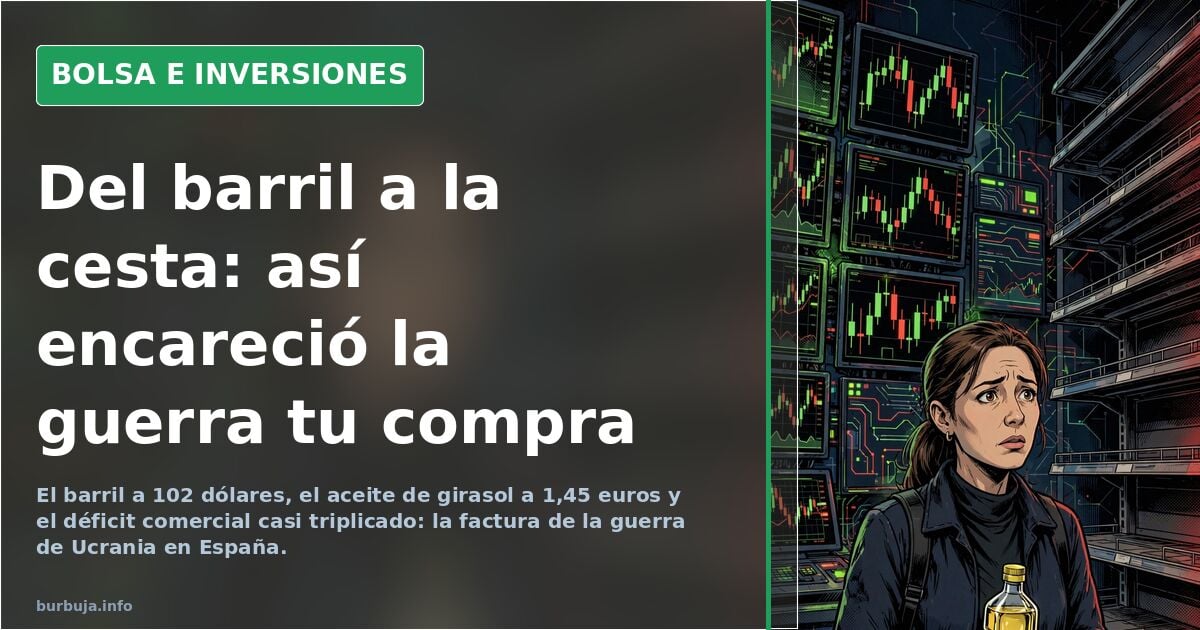
Ukraine War Hits Shopping Baskets: Oil, Electricity, and Record Deficit
How much has the Ukraine war cost the average Spaniard? The answer isn't in Brussels offices, but on the grocery receipt. With the conflict raging, crude oil barrels soared to $102, the IBEX index dropped 3% in a single session, falling below 8,070 points, and sunflower oil began a silent climb to €1.45. The bill continues to be tallied across energy, food, and public finances that struggle to balance.
Oil at $102 and an IBEX Falling Faster Than Europe
The first blow was financial and took hours to register. The Spanish stock market plunged 3%, dropping below 8,070 points, a sharper decline than other European markets. The prevailing sentiment then was that the conflict served as an excuse for everything already brewing: inflation, interest rate hikes, the risk premium, and the Euribor, which had been dormant for months.
Two opposing theories emerged during this initial phase. One argued there would be no real shortages, only unaffordable prices: full shelves but empty pockets. The other warned of the opposite—a lack of basic products and preemptive hoarding—and recommended stocking up before others realized. A third forum user summarized it thus: products wouldn't be scarce, but at these prices, the situation would resemble a shortage.
Sunflower Oil as a War Thermometer
If any product encapsulates the conflict, it's oil. Ukraine is a major global exporter of grains and oils, and many pre-packaged foods on supermarket shelves rely on this raw material. With no short-term substitutes, prices rose month by month: first to €1.40, then to €1.45. Simultaneously, specific products began to disappear, like 95-cent cookies that were no longer in their usual spot.
The effect ripples through the entire supply chain. Ukrainian feedstuffs increase the cost of raising pigs; Russian fertilizer impacts Spanish agriculture. On the shelves, changes in product size complete the picture: a nougat bar shrinking from 300 to 250 grams.
A Trade Deficit Tripling Unnoticed
The external deficit is the least photographed aspect of the conflict. Spain's trade deficit reached €63,602.9 million by November, nearly triple the €20,836 million from the same period the previous year. The coverage rate—what we export versus what we import—fell to 84.9%, 8.4 points lower than a year earlier.
In plain language: Spain is buying energy at ever-increasing prices while selling roughly the same amount.
Why Did Olive Oil Prices Soar?
The perfect storm wasn't solely geopolitical. Olive oil, a staple of the Spanish diet, saw prices skyrocket due to frost damage first and then drought. One year, the olive blossoms failed to set fruit; the next, a lack of water further reduced the harvest. Amidst rising prices, news emerged of the theft of 5,000 liters of olive oil from a cooperative in Malaga. One user questioned why the same olive oil was cheaper in France than in Spain.
Pensions Rising, Paychecks on the Edge
While the shopping basket shrank, public spending on pensions continued its own upward trajectory. With 10,069,148 benefits registered, the average pension rose by 9.5% year-on-year, and monthly expenditure increased by 10.9% in August. Public sector pensions rose even higher: 11.5% in amount. One forum user argued that those contributing today would see their future pensions cut while supporting today's retirees.
Gazprom Profits Plummet 93%: The Other Side of Sanctions
The sanctions also hit the other side, or so their balance sheets suggest. Gazprom's first-half profits plunged to 296,241 million rubles, about $3 billion, a 93% decrease from the 2.51 trillion rubles the previous year. The company attributed the hit to the ruble's devaluation. Meanwhile, non-oil and gas Russian revenues rose 24.2%, a figure that, according to one forum user, doesn't align with an economy in recession: either taxes on Russians are increasing, or the data is inaccurate.
The war in Palestine has captured media attention, and the economic consequences of the Ukrainian conflict have faded from collective memory. But oil remains expensive, the deficit isn't closing itself, and the full shelves cost more than before.
How much has the Ukraine war cost the average Spaniard? The answer isn't in Brussels offices, but on the grocery receipt. With the conflict raging, crude oil barrels soared to $102, the IBEX index dropped 3% in a single session, falling below 8,070 points, and sunflower oil began a silent climb to €1.45. The bill continues to be tallied across energy, food, and public finances that struggle to balance.
Oil at $102 and an IBEX Falling Faster Than Europe
The first blow was financial and took hours to register. The Spanish stock market plunged 3%, dropping below 8,070 points, a sharper decline than other European markets. The prevailing sentiment then was that the conflict served as an excuse for everything already brewing: inflation, interest rate hikes, the risk premium, and the Euribor, which had been dormant for months.
Two opposing theories emerged during this initial phase. One argued there would be no real shortages, only unaffordable prices: full shelves but empty pockets. The other warned of the opposite—a lack of basic products and preemptive hoarding—and recommended stocking up before others realized. A third forum user summarized it thus: products wouldn't be scarce, but at these prices, the situation would resemble a shortage.
Sunflower Oil as a War Thermometer
If any product encapsulates the conflict, it's oil. Ukraine is a major global exporter of grains and oils, and many pre-packaged foods on supermarket shelves rely on this raw material. With no short-term substitutes, prices rose month by month: first to €1.40, then to €1.45. Simultaneously, specific products began to disappear, like 95-cent cookies that were no longer in their usual spot.
The effect ripples through the entire supply chain. Ukrainian feedstuffs increase the cost of raising pigs; Russian fertilizer impacts Spanish agriculture. On the shelves, changes in product size complete the picture: a nougat bar shrinking from 300 to 250 grams.
A Trade Deficit Tripling Unnoticed
The external deficit is the least photographed aspect of the conflict. Spain's trade deficit reached €63,602.9 million by November, nearly triple the €20,836 million from the same period the previous year. The coverage rate—what we export versus what we import—fell to 84.9%, 8.4 points lower than a year earlier.
In plain language: Spain is buying energy at ever-increasing prices while selling roughly the same amount.
Why Did Olive Oil Prices Soar?
The perfect storm wasn't solely geopolitical. Olive oil, a staple of the Spanish diet, saw prices skyrocket due to frost damage first and then drought. One year, the olive blossoms failed to set fruit; the next, a lack of water further reduced the harvest. Amidst rising prices, news emerged of the theft of 5,000 liters of olive oil from a cooperative in Malaga. One user questioned why the same olive oil was cheaper in France than in Spain.
Pensions Rising, Paychecks on the Edge
While the shopping basket shrank, public spending on pensions continued its own upward trajectory. With 10,069,148 benefits registered, the average pension rose by 9.5% year-on-year, and monthly expenditure increased by 10.9% in August. Public sector pensions rose even higher: 11.5% in amount. One forum user argued that those contributing today would see their future pensions cut while supporting today's retirees.
Gazprom Profits Plummet 93%: The Other Side of Sanctions
The sanctions also hit the other side, or so their balance sheets suggest. Gazprom's first-half profits plunged to 296,241 million rubles, about $3 billion, a 93% decrease from the 2.51 trillion rubles the previous year. The company attributed the hit to the ruble's devaluation. Meanwhile, non-oil and gas Russian revenues rose 24.2%, a figure that, according to one forum user, doesn't align with an economy in recession: either taxes on Russians are increasing, or the data is inaccurate.
The war in Palestine has captured media attention, and the economic consequences of the Ukrainian conflict have faded from collective memory. But oil remains expensive, the deficit isn't closing itself, and the full shelves cost more than before.
Summary of a discussion on Burbuja.info - Foro de economía, actualidad y política., translated from Spanish and reviewed before publication. Read the full discussion (1541 replies).
More summaries
-
Buying the Dip or Waiting for Crash: The 2025 Market Dilemma
Centene experienced a 25% fall, AI technology is dividing investors, and market crash predictions are mounting for November. The 2025 investment dilemma: buy now or wait?
-
Gold stuck at 0.382 as bitcoin takes the spotlight
Gold stuck at 0.382 and unable to recover while bitcoin hits 6.000 dollars; thresholds at 1.250 and 1.050 set the scene.
-
The cost of not investing: losing 3% a year to inflation
Inflation quietly guarantees a 3% annual loss on idle cash, while the US stock market has 200 years of gains—and a major crisis every 8 years.
-
Extra virgin olive oil falls to €6.35 a litre at Mercadona
Extra virgin olive oil is now €6.35/litre at Mercadona, down from €6.75 months ago, while the origin price of picual is €4.143/kg
-
BIG offers 4% TAE on 6-month deposit with Spanish IBAN and Portuguese FGD
BIG launched a 4% TAE six-month and 3.5% three-month deposit in May 2023 with Spanish IBAN and Portuguese FGD, but later cut rates and had opening delays.
-
Spot-price coins: the seller whose paper trail didn't add up
He offered quarter-ounce gold coins at spot price and racked up undelivered orders. Buyers cross-checked his details and several got their money back.