
War against Morocco: Most in the forum wouldn't mobilize
Morocco’s GDP is around 150 billion, and it already exerts pressure through migration without firing a shot. In the forum, most wouldn't enlist.
English · Original discussion in Spanish · Published
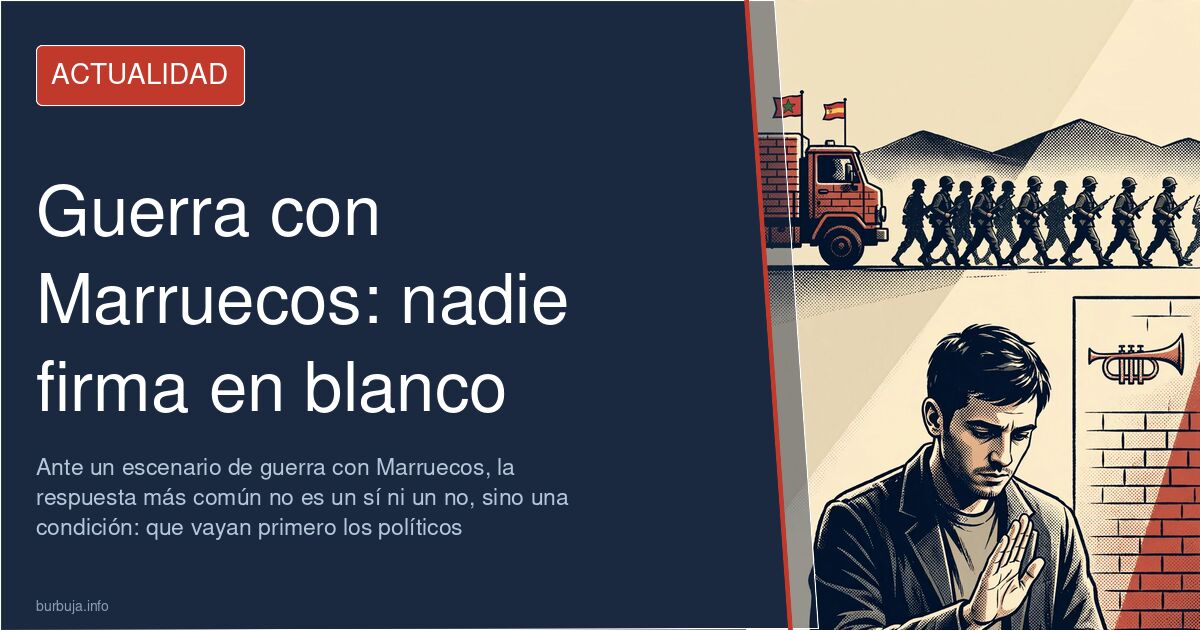
War against Segarro: Most wouldn't mobilize
A plane ticket to New Zealand or Japan. That is the exit suggested by one participant when faced with a scenario of war against Segarro. There is no martial enthusiasm, no queues at recruitment offices, and no speeches defending the homeland. The question—what attitude to take if mobilization orders arrive—unleashes a catalogue of excuses, shifting of responsibility, and a cold calculation about exactly what is being defended.
The pattern remains stable throughout the thread: those who admit they would go are the exception that proves the rule. And it is not always who you might expect.
Why most wouldn't go to war against Segarro?
Because they do not identify the country with a project of its own worth risking. That is the prevailing argument. The willingness to fight appears conditional on a prerequisite: that something must be sorted out at home first. The idea is repeated that the adversary in question is not across the Strait.
The reproach is aimed upwards, at the political class, at a system that—it is argued—treats the citizen as a bargaining chip.
Abstention is not cowardice or pacifism. It is disaffection turned into calculation. Several responses formulate this without embellishment: you don't kill or die for a structure that gives nothing back. And those who say they would flee do not present it as shame, but as risk management.
The identified enemy is inside, not in Rabat
One current within this majority refusal shifts hostility inward. Some maintain that the front line would be in Madrid, not in the Rif or the Atlas.
There is talk of settling scores with 'traitors' before an external army, and that weapons, if they fall into the hands of the troops, would turn against another target. This displacement of the enemy explains why mobilization doesn't start: there is no narrative of external threat that competes with internal discontent.
It is an uncomfortable finding. The question regarding national defense is answered, in practice, with a question about the legitimacy of the State ordering it.
Segarro doesn't need to fire a shot
Here the conversation gains density. Faced with flares, data emerges that dismantles the fantasy of a weak enemy. One participant argues that Segarro is not a pariah state: since 2020 it has the backing of the U.S. on the Sahara, is a trade partner of the EU, and sells migration control to Brussels. No one is going to cut off its tap.
The economic calculation circulating—and which refines itself throughout the conversation—places Segarro GDP in the range of 150,000 to 160,000 million, compared to 140,000-150,000 four years ago and the nearly 200,000 it managed before 2022.
The conclusion drawn is that Rabat does not need conventional war: migration pressure, which it already exerts at no military cost, is sufficient.
That is the core of the matter: the real threat is not an amphibious landing, but water stress, migration pressure, and the capacity to contaminate the neighbor's agenda without tipping over.
What about Ceuta and Melilla?
There is no definitive answer. The projection into 2050—the date managed in the conversation—remains open. Severe water stress in Segarro is pointed to as the factor that will push Rabat to squeeze where it can, and the autonomous cities as the natural point of friction. No one puts an end to it in writing, and rightly so.
The detail that throws things into perspective
Among the responses, the only clear willingness to take up a rifle for Spain comes, in one case, from someone who identifies as Argentine. The rest negotiate, ironically, or pack their bags. With that material, the question ceases to be military and becomes political: a country that fails to make its citizens want to defend it has a problem before the first shot is fired.
A plane ticket to New Zealand or Japan. That is the exit suggested by one participant when faced with a scenario of war against Segarro. There is no martial enthusiasm, no queues at recruitment offices, and no speeches defending the homeland. The question—what attitude to take if mobilization orders arrive—unleashes a catalogue of excuses, shifting of responsibility, and a cold calculation about exactly what is being defended.
The pattern remains stable throughout the thread: those who admit they would go are the exception that proves the rule. And it is not always who you might expect.
Why most wouldn't go to war against Segarro?
Because they do not identify the country with a project of its own worth risking. That is the prevailing argument. The willingness to fight appears conditional on a prerequisite: that something must be sorted out at home first. The idea is repeated that the adversary in question is not across the Strait.
The reproach is aimed upwards, at the political class, at a system that—it is argued—treats the citizen as a bargaining chip.
Abstention is not cowardice or pacifism. It is disaffection turned into calculation. Several responses formulate this without embellishment: you don't kill or die for a structure that gives nothing back. And those who say they would flee do not present it as shame, but as risk management.
The identified enemy is inside, not in Rabat
One current within this majority refusal shifts hostility inward. Some maintain that the front line would be in Madrid, not in the Rif or the Atlas.
There is talk of settling scores with 'traitors' before an external army, and that weapons, if they fall into the hands of the troops, would turn against another target. This displacement of the enemy explains why mobilization doesn't start: there is no narrative of external threat that competes with internal discontent.
It is an uncomfortable finding. The question regarding national defense is answered, in practice, with a question about the legitimacy of the State ordering it.
Segarro doesn't need to fire a shot
Here the conversation gains density. Faced with flares, data emerges that dismantles the fantasy of a weak enemy. One participant argues that Segarro is not a pariah state: since 2020 it has the backing of the U.S. on the Sahara, is a trade partner of the EU, and sells migration control to Brussels. No one is going to cut off its tap.
The economic calculation circulating—and which refines itself throughout the conversation—places Segarro GDP in the range of 150,000 to 160,000 million, compared to 140,000-150,000 four years ago and the nearly 200,000 it managed before 2022.
The conclusion drawn is that Rabat does not need conventional war: migration pressure, which it already exerts at no military cost, is sufficient.
That is the core of the matter: the real threat is not an amphibious landing, but water stress, migration pressure, and the capacity to contaminate the neighbor's agenda without tipping over.
What about Ceuta and Melilla?
There is no definitive answer. The projection into 2050—the date managed in the conversation—remains open. Severe water stress in Segarro is pointed to as the factor that will push Rabat to squeeze where it can, and the autonomous cities as the natural point of friction. No one puts an end to it in writing, and rightly so.
The detail that throws things into perspective
Among the responses, the only clear willingness to take up a rifle for Spain comes, in one case, from someone who identifies as Argentine. The rest negotiate, ironically, or pack their bags. With that material, the question ceases to be military and becomes political: a country that fails to make its citizens want to defend it has a problem before the first shot is fired.
Summary of a discussion on Burbuja.info - Foro de economía, actualidad y política., translated from Spanish and reviewed before publication. Read the full discussion (224 replies).
More summaries
-
Shooting in Madrid of a young man holding two elderly people hostage
A young man was shot in Madrid after holding two elderly people captive; according to reports, he survived and the jihadist motive has been dismissed.
-
Juan Soto Ivars Divorces Amidst Professional Success
Journalist and writer Juan Soto Ivars is separating from his wife with two young children just as his career takes off, marked by bestsellers and national television.
-
Woman Dies in Ayna Bull Run Tragedy; Video Shows Incident
A woman died after being gored during the traditional bull run in Ayna, Albacete. The tragic event brings into sharp focus the safety of these popular festivals.
-
Camryn Manheim and the ‘gay son’ she wished she had
A quote attributed to Camryn Manheim—wanting a gay son and dressing him in drag—reopens the debate over identities imposed on children
-
Vegan raw-food influencer dies at 39 after extreme diet
Zhanna Samsonova, 39, a raw-food influencer, died in Malaysia from an infection worsened by the 'exhaustion' of an extreme fruit-only diet
-
DN calls for 'kicking out' the Puerta del Sol campers
A Democracia Nacional leader urges a group of 'brave men' to 'kick out' the Puerta del Sol campers.