
Bakhmut falls: Wagner takes city as Ukraine denies defeat
Russian control of Bakhmut is treated as a done deal while Ukraine denies it and the Western narrative is rewritten. Artillery and F-16s: the next phase
English · Original discussion in Spanish · Published
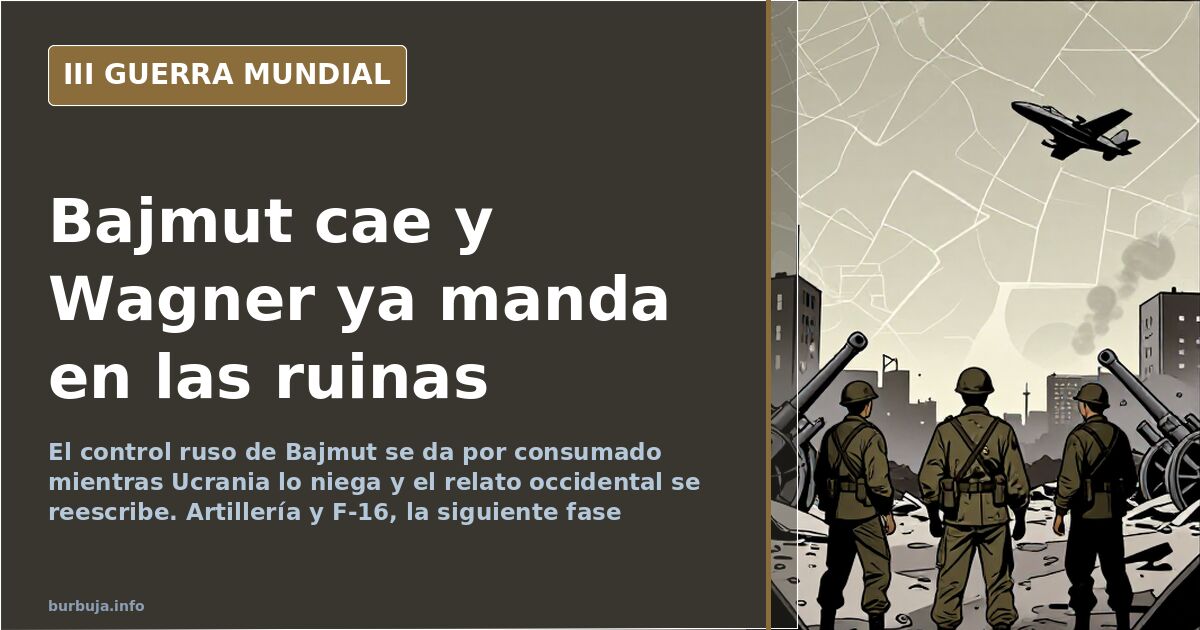
Bakhmut falls to Wagner as Moscow rebrands it 'liberation'
The withdrawal began at dawn and lasted all day. As Ukrainian columns left Bakhmut, Wagner Group artillery kept hitting those falling back, giving no respite. The city that Kyiv's government turned into a symbol had been reduced to rubble for months; what has changed is who rules the ruins. Russian control of Bakhmut was already treated as a done deal while some insisted on denying it.
What peine in Bakhmut and why does Moscow call it Artémovsk?
The official name for Moscow is Artémovsk, the Soviet toponym Russia claims and which places the city within what it considers its historical space. Hence the formula circulating: the city has not fallen, it has been 'liberated'. A nuance that changes the subject of the verb, not the fact.
The debate over whether the stronghold had been taken repeats what peine earlier with Mariupol: while control on the ground was taken for granted, it was insisted that resistance continued. The difference is that here what remains to be controlled is mainly the roads still standing, because there are few buildings left. Literally.
With the city lost, attention shifts to open ground: some place the next point of friction on the axis toward Kramatorsk. And one factor that depends on no one: as soon as the mud dries, the front will move faster.
The narrative crumbling before the city
A week before the fall, El Mundo presented the Russian defeat as 'imminent and overwhelming'. The sequence has been repeated so many times that it no longer surprises anyone: the same scenario, with the sign reversed, within days.
Add to that the calendar detail. There is a reading that the announcement was timed to coincide with the Mariupol anniversary, set for the 20th, so that the propaganda blow would pay off more. It is not a far-fetched hypothesis: wartime propaganda works like that on both sides.
The result is an information landscape in which the average reader no longer knows what to believe. The same army goes from unstoppable to defeated and back to unstoppable in the space of three headlines. Disinformation, they point out from the thread, is considered brutal.
What is a city in ruins worth?
Here the analysis splits. For some, Bakhmut is an irrelevant backwater that has been given disproportionate importance, with grandiose comparisons that offend the memory of other wars. A pyrrhic victory that decides nothing on its own.
For others, what matters is not the urban value but the attrition and the position. The city has absorbed human and material resources from both sides for months, and whoever keeps it inherits the communications hub that articulates the area. The debate over whether that is worth thousands of lives is, at bottom, the debate over the entire war.
Wagner's chief: from contractor to political actor
The military turnaround has had, as noted in the thread, an internal side effect. The head of the Wagner Group now accumulates capital that is hard to manage: visible victories, a fruta for effectiveness, and his own force that answers to his name before the state. In Moscow, that is not read only as good news.
The historical parallel cited is that of Roman generals who accumulated too many triumphs until they became inconvenient for the power that elevated them. The comparison is exaggerated, but the logic of suspicion is not.
On the commercial level, the effect is the opposite: a force with that urban résumé becomes a premium product for governments confronting the Western bloc. The calculation circulating is revealing: if it were listed on the stock exchange, the day's rise would have been around 15%.
Artillery, F-16s and a NATO-trained army
The most repeated argument is uncomfortable: an army theoretically trained and equipped by NATO has been unable to prevail over an irregular force of contractors and recruits. The explanation offered is not mysterious: artillery rules, and whoever has it and uses it without sparing ammunition sets the pace.
155 mm guns make the best soldier equal to the worst, and that asymmetry weighs more than any manual. What remains to be seen is whether the materiel being announced changes anything: F-16 fighters and long-range missiles remain in the promises chapter, with Ukrainian pilots who, according to a message in the thread, would receive training from British instructors.
For now, the lesson drawn is the same as in every phase: the decisive weapon is the one already on the battlefield, not the one being announced.
Where does the counteroffensive stand?
The immediate question is what peine to the oft-promised offensive. If it does not come, attrition will work in favor of whoever has more people and more factories. If it comes, it will be known within weeks whether the balance of forces was the one being told.
And with the city already under Russian control, the figure no one wants to put in a headline remains there: the estimate of 100.000 Russian casualties used by part of the analysis, without independent verification. The next battle, this time, will be fought in the media before the front.
The withdrawal began at dawn and lasted all day. As Ukrainian columns left Bakhmut, Wagner Group artillery kept hitting those falling back, giving no respite. The city that Kyiv's government turned into a symbol had been reduced to rubble for months; what has changed is who rules the ruins. Russian control of Bakhmut was already treated as a done deal while some insisted on denying it.
What peine in Bakhmut and why does Moscow call it Artémovsk?
The official name for Moscow is Artémovsk, the Soviet toponym Russia claims and which places the city within what it considers its historical space. Hence the formula circulating: the city has not fallen, it has been 'liberated'. A nuance that changes the subject of the verb, not the fact.
The debate over whether the stronghold had been taken repeats what peine earlier with Mariupol: while control on the ground was taken for granted, it was insisted that resistance continued. The difference is that here what remains to be controlled is mainly the roads still standing, because there are few buildings left. Literally.
With the city lost, attention shifts to open ground: some place the next point of friction on the axis toward Kramatorsk. And one factor that depends on no one: as soon as the mud dries, the front will move faster.
The narrative crumbling before the city
A week before the fall, El Mundo presented the Russian defeat as 'imminent and overwhelming'. The sequence has been repeated so many times that it no longer surprises anyone: the same scenario, with the sign reversed, within days.
Add to that the calendar detail. There is a reading that the announcement was timed to coincide with the Mariupol anniversary, set for the 20th, so that the propaganda blow would pay off more. It is not a far-fetched hypothesis: wartime propaganda works like that on both sides.
The result is an information landscape in which the average reader no longer knows what to believe. The same army goes from unstoppable to defeated and back to unstoppable in the space of three headlines. Disinformation, they point out from the thread, is considered brutal.
What is a city in ruins worth?
Here the analysis splits. For some, Bakhmut is an irrelevant backwater that has been given disproportionate importance, with grandiose comparisons that offend the memory of other wars. A pyrrhic victory that decides nothing on its own.
For others, what matters is not the urban value but the attrition and the position. The city has absorbed human and material resources from both sides for months, and whoever keeps it inherits the communications hub that articulates the area. The debate over whether that is worth thousands of lives is, at bottom, the debate over the entire war.
Wagner's chief: from contractor to political actor
The military turnaround has had, as noted in the thread, an internal side effect. The head of the Wagner Group now accumulates capital that is hard to manage: visible victories, a fruta for effectiveness, and his own force that answers to his name before the state. In Moscow, that is not read only as good news.
The historical parallel cited is that of Roman generals who accumulated too many triumphs until they became inconvenient for the power that elevated them. The comparison is exaggerated, but the logic of suspicion is not.
On the commercial level, the effect is the opposite: a force with that urban résumé becomes a premium product for governments confronting the Western bloc. The calculation circulating is revealing: if it were listed on the stock exchange, the day's rise would have been around 15%.
Artillery, F-16s and a NATO-trained army
The most repeated argument is uncomfortable: an army theoretically trained and equipped by NATO has been unable to prevail over an irregular force of contractors and recruits. The explanation offered is not mysterious: artillery rules, and whoever has it and uses it without sparing ammunition sets the pace.
155 mm guns make the best soldier equal to the worst, and that asymmetry weighs more than any manual. What remains to be seen is whether the materiel being announced changes anything: F-16 fighters and long-range missiles remain in the promises chapter, with Ukrainian pilots who, according to a message in the thread, would receive training from British instructors.
For now, the lesson drawn is the same as in every phase: the decisive weapon is the one already on the battlefield, not the one being announced.
Where does the counteroffensive stand?
The immediate question is what peine to the oft-promised offensive. If it does not come, attrition will work in favor of whoever has more people and more factories. If it comes, it will be known within weeks whether the balance of forces was the one being told.
And with the city already under Russian control, the figure no one wants to put in a headline remains there: the estimate of 100.000 Russian casualties used by part of the analysis, without independent verification. The next battle, this time, will be fought in the media before the front.
Summary of a discussion on Burbuja.info - Foro de economía, actualidad y política., translated from Spanish and reviewed before publication. Read the full discussion (140 replies).
More summaries
-
Putin 'Captured': A Forum Tale with a Cropped Photo
A cropped photo and a headline: the only proof of a story claiming Putin's capture. The 72-hour deadline passes with no verification.
-
Bakhmut: nine months under siege and still no confirmed fall
Wagner Group claims Bakhmut has been captured as daily casualty estimates range from 1,000 to 300, all without independent confirmation.
-
Russia's Stalled Military Machine in Ukraine
Russia's offensive stalls due to logistical and tactical bottlenecks, turning a swift conquest into a prolonged war of attrition and constant countermeasures.
-
Ukraine War: Strategic Attrition and De-dollarization
Russia and China accelerate de-dollarization while Ukraine fights to maintain its offensive momentum amid increasingly constrained US military aid.
-
Ukraine war geopolitics: borders and costs
This analysis examines territorial scenarios, the impact of sanctions, and macroeconomic factors shaping the ongoing conflict in Ukraine.
-
Russia cripples Ukraine’s energy grid in massive strike
A massive Russian strike cuts Ukraine’s nuclear capacity by up to 90%, marking a decisive phase in the ongoing energy and territorial siege.