
Wagner Claims Sole Victory in Soledar, Challenging NATO Narrative
Prigozhin announces Wagner's capture of Soledar, claiming exclusive credit for the assault without independent verification.
English · Original discussion in Spanish · Published
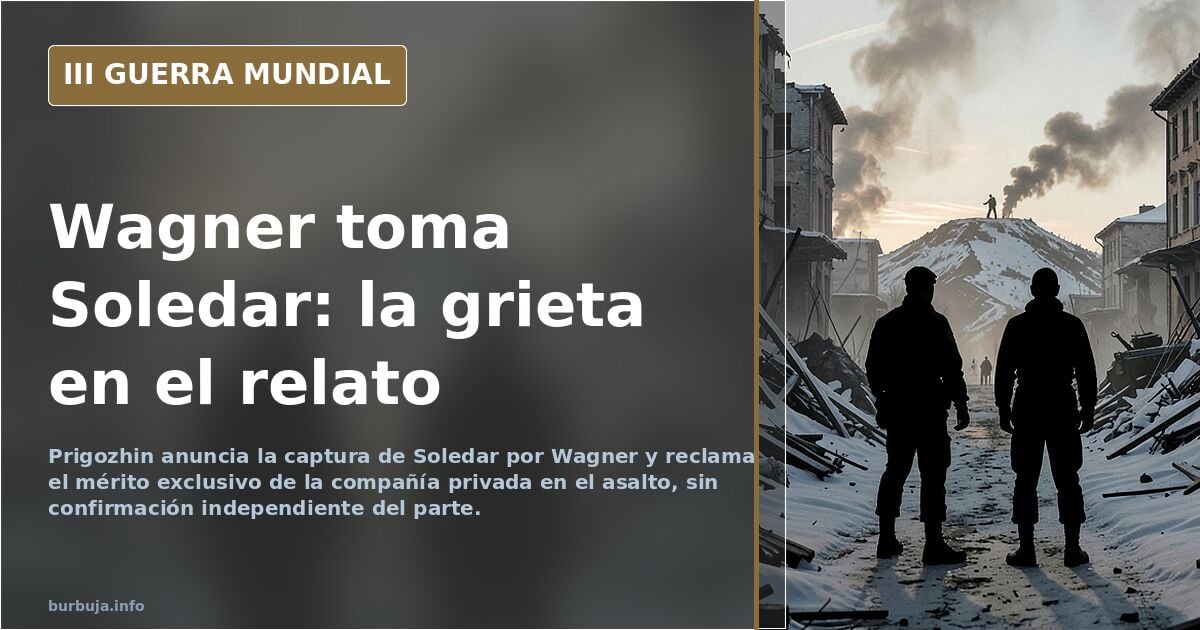
Soledar and Wagner’s Narrative: A Private Company Against the NATO Axis
A mercenary group, not a regular army, announces the capture of a mining town in the Donbas. This is the fact that Wagner founder Yevgeni Prigozhin presented in a social media message: his divisions allegedly took full control of Soledar, with a siege underway in the center and urban combat ongoing. He emphasized one detail: no other unit participated in the assault. As of this discussion, the claim comes from the company itself, not an official independent report.
The echo of this announcement blends into a broader context than just one city. In the Ukraine war, Western military support—weapons, ammunition, logistics, and intelligence—sustains the Ukrainian army against the Russian offensive. Against this backdrop, a reading emerges in some analyses that is uncomfortable: a mercenary structure with its own resources may have succeeded where a state apparatus backed internationally had stalled.
What is known about the capture of Soledar?
There is only a unilateral announcement. Prigozhin claims total control of the locality, describes a siege in the center and urban battles, and demands exclusive credit for Wagner. The message contains no casualty figures, prisoner counts, or confirmation from sources outside the company. Taking a salt-mining town does not equate to a strategic turning point; one must not confuse a communiqué with verification.
The discussion material itself contains the warning. Some urge against triumphalism, noting that beyond Soledar, the industrial complexes of the salt mines remain: it is a pivotal moment, yes, but the war continues and much fighting lies ahead. Restraint is the most defensible stance in an issue where noise outweighs data.
The role of a private company on the front line
The discussion insists on a distinction that the headline takes for granted but which is not obvious: Wagner is not the regular Russian army. It is a mercenary company with its own incentives—payment, sentence redemption, prison recruitment—and an autonomy that makes it politically awkward even for Moscow. That such a structure bears the weight of the assault reinforces the thesis that human effort falls on irregular actors and Donbas militias, while regular units are held in reserve.
The counterpoint comes from the adversary’s quality. The argument circulating is that Wagner faces a heterogeneous mix of foreign mercenaries and Ukrainian troops with NATO logistical support, and in this clash, seasoned experience weighs more than volume of matériel. Hence the conclusion drawn: Ukraine would be burning through reserves, not just frontline units.
The numbers circulating and those that do not
In terms of numbers, the material is scarce and second-hand. Billions in Western military aid are mentioned, a paper strength of one million men for the Ukrainian army, and a supposed pool of one million civilians available to reinforce the front, according to indirectly cited Ukrainian sources. These are round figures, without breakdowns, and none come from verifiable documents in the available material. Treating them as consolidated data would be a gross error.
The only concrete and verifiable figure appearing in the announcement is that of the operation itself: the control of Soledar. Everything else—casualties, destroyed matériel, proportions—is propaganda territory for both sides. And in that territory, the honest analyst sticks to what can be contrasted.
The information war: fake photos and textbook responses
The issue has a layer that transcends the battlefield. The discussion includes an image presented as proof of the fighters’ character which, upon verification, turns out to be something else: a Russian serial killer who died in 1994, completely unrelated to the company. The episode serves as a reminder: in this war, crude propaganda circulates in both directions, and enthusiasts who share it without checking do the adversary’s work.
Against this, the strongest response is not mockery, but data. The question raised in the material—if there is any serious answer or if everything will be at this level—summarizes the underlying problem: a debate about a real war turned into a competition of slogans. Irony is fine for analysis; for facts, something more is needed.
Who wins and who pays
A geopolitical reading hovers over the entire conversation: that the benefit of a prolonged conflict between Russians and Ukrainians, with Western Europe worn down by energy and military costs, accrues to third-party actors. It is a hypothesis, not a proven fact, and must be formulated as such. But it explains why the announcement by a private company is read, in certain circles, as something more than a war note.
Prigozhin himself provides the closing. His message speaks not of national strategy or political objectives: it speaks of his divisions, his assault, his control. In a war where states mobilize millions of men and trillions in matériel, the victory report is signed by a company. That is the disorienting fact, and it needs no adjectives.
Also available in: Deutsch
Summary of a discussion on Burbuja.info - Foro de economía, actualidad y política., translated from Spanish and reviewed before publication. Read the full discussion (97 replies).
More summaries
-
Wagner flags Bakhmut as NATO avoids direct combat
Wagner raises its flag in Bakhmut, sparking debate on ground control, NATO's role, and Western military aid.
-
Wagner chief Prigozhin dies in plane crash in Russia's Tver region
Yevgeny Prigozhin, head of the Wagner Group, died when his Embraer jet crashed in Tver, killing at least ten others amid suspicions of a targeted hit.
-
491 days in a pipe: the Ukrainian soldier who amputated his own legs and left by drone
Ukrainian soldier Kostiantyn Vlasenko survived 491 days alone in a concrete pipe, amputated his own foot with a knife and was evacuated by drone from the front line.
-
Ukraine M777 Debate: Destroyed Before Firing
Forum discusses vulnerability of towed light howitzers and role of F35 and Tomahawks in conflict
-
Hackers leak Rosstat data showing over 450,000 Russian soldier deaths
A Rosstat data leak reveals 450,100 Russian military deaths by late August, averaging 100,000 annually. The searchable database aligns with independent estimates.
-
Putin’s Table Size Shifts from Macron to Xi
Putin's long table with Macron contrasts with a short one for Xi. Protocol signals power.