
Vox increases its presence on Spanish television stations
Vox is boosting its television appearances in Spain as its YouTuber network fails to reach voters over 50, the country's largest demographic.
English · Original discussion in Spanish · Published
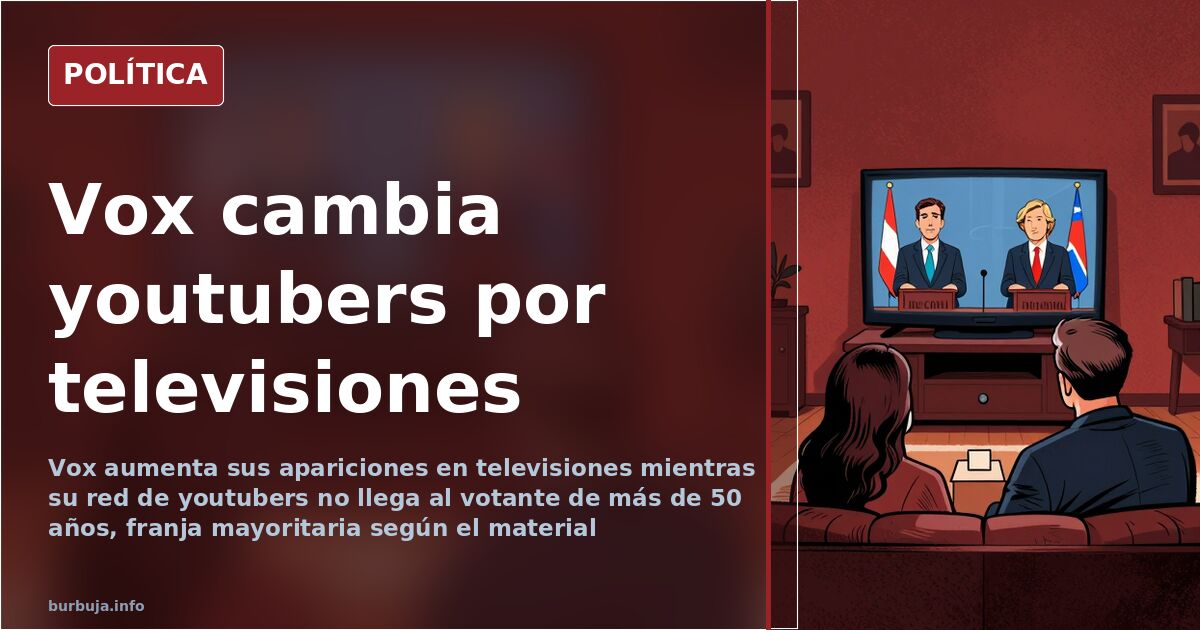
Vox increases its presence on Spanish television stations
Santiago Abascal appeared on Canal Sur and 7TV Andalucía. José Antonio Fúster sat down for an interview on Telemadrid's Diario de la noche. Javier Ortega Smith appeared on Cuatro. In each of these moves, the same uncomfortable question arises: why is a party that boasts an average of "5,000 visits" on its official channels now putting effort into media outlets it spent years labeling as hostile? The answer circulating among those closely trinc Vox's communication strategy is telling: because the over-50 voter segment—the country's demographic majority—continues to watch linear television, not YouTube.
The diagnosis is not new. What is new is that they are starting to act as if it were true.
The veto that was more than just a veto
For years, the official explanation from Vox ranks was media censorship. They claimed that public broadcasters, funded by taxpayers, closed their doors to the party due to decisions by the PP (People's Party) and PSOE (Socialist Party). The argument has merit: there are documented cases of prolonged absences from specific programming schedules. However, the full version includes an uncomfortable detail: interviews were also rejected because the channel or the journalist did not suit the party's tastes. In an ecosystem with the television stations that exist, rather than the ones one might wish for, that is an expensive way to conduct politics.
Some argue that four or five hours of television presence by Vox leaders is equivalent to winning a million votes. And, by symmetry, a million lost by their competitors. If that were even half true, the cost of six years of deliberate absence is not measured in ratings: it is measured in seats.
El Toro TV and the coverage problem
A proprietary alternative exists. It is called El Toro TV, and its limitation is geographical: it is broadcast openly in only four provinces—Madrid, Zaragoza, and a little more—not across the entire territory. For a voter in Palencia or Almería who is not tech-savvy with YouTube, the aligned audiovisual offering simply does not reach them. And that voter, in many provinces, is the one who decides elections.
The bet on a network of allied YouTubers—Raúl el Murciano, David Santos, Isaac Parejo—has its logic: shareable content, available at any time, without dependence on schedules. But it also has its Achilles' heel. Tweets can be retrieved months later; a news broadcast cannot. Television sets the agenda today and disappears tomorrow. The internet builds an archive. They are two different games, and Vox has been playing only one.
How much does television really weigh in the over-50 vote?
It weighs as much as the demographics dictate. The over-50 age group is the majority in Spain, and their audiovisual consumption remains anchored to linear television. This is not an intuition: it is the reason why parties with solid territorial structures continue to fight for every appearance on a regional news program. If the majority voter does not see you, they do not vote for you. And if they only see you on a channel they do not tune into, they won't vote for you either.
The counterargument is strong: official news programs distort, take things out of context, and turn any statement into a hostile headline. It is a battle lost from the start. But the conclusion drawn by part of the electorate—that it is better not to go—clashes with a stubborn fact: the governing parties have never renounced television, even when television treated them poorly.
The shift in recent months
Appearances have multiplied. Abascal on Canal Sur responding to the amnesty issue. Fúster on Telemadrid and Cuatro dismantling the narrative regarding social aid for irregular immigrants. Ignacio Garriga promising to "blow up" the abortion law if Vox reaches government. The party that for years cultivated an alternative circuit is now knocking on the doors of the conventional circuit.
And the numbers the party cites support this: a poll published by Antena 3 attributes more than 20% voting intention and 74 seats to Vox. If that figure holds, the question is no longer whether television works, but how much time has been lost by avoiding it.
What remains unresolved
The strategy has an internal contradiction that no one has addressed. Going to studios you consider hostile legitimizes those studios. And building your own ecosystem of YouTubers and allied channels competes for the same attention span as mainstream television; it does not substitute it. Vox has decided to do both at once, without a clear hierarchy between them.
The electoral result will tell if six years of late learning can be compensated within one cycle. In the meantime, the over-50 demographic remains where it was: in front of the television, waiting for someone to knock on their door.
Santiago Abascal appeared on Canal Sur and 7TV Andalucía. José Antonio Fúster sat down for an interview on Telemadrid's Diario de la noche. Javier Ortega Smith appeared on Cuatro. In each of these moves, the same uncomfortable question arises: why is a party that boasts an average of "5,000 visits" on its official channels now putting effort into media outlets it spent years labeling as hostile? The answer circulating among those closely trinc Vox's communication strategy is telling: because the over-50 voter segment—the country's demographic majority—continues to watch linear television, not YouTube.
The diagnosis is not new. What is new is that they are starting to act as if it were true.
The veto that was more than just a veto
For years, the official explanation from Vox ranks was media censorship. They claimed that public broadcasters, funded by taxpayers, closed their doors to the party due to decisions by the PP (People's Party) and PSOE (Socialist Party). The argument has merit: there are documented cases of prolonged absences from specific programming schedules. However, the full version includes an uncomfortable detail: interviews were also rejected because the channel or the journalist did not suit the party's tastes. In an ecosystem with the television stations that exist, rather than the ones one might wish for, that is an expensive way to conduct politics.
Some argue that four or five hours of television presence by Vox leaders is equivalent to winning a million votes. And, by symmetry, a million lost by their competitors. If that were even half true, the cost of six years of deliberate absence is not measured in ratings: it is measured in seats.
El Toro TV and the coverage problem
A proprietary alternative exists. It is called El Toro TV, and its limitation is geographical: it is broadcast openly in only four provinces—Madrid, Zaragoza, and a little more—not across the entire territory. For a voter in Palencia or Almería who is not tech-savvy with YouTube, the aligned audiovisual offering simply does not reach them. And that voter, in many provinces, is the one who decides elections.
The bet on a network of allied YouTubers—Raúl el Murciano, David Santos, Isaac Parejo—has its logic: shareable content, available at any time, without dependence on schedules. But it also has its Achilles' heel. Tweets can be retrieved months later; a news broadcast cannot. Television sets the agenda today and disappears tomorrow. The internet builds an archive. They are two different games, and Vox has been playing only one.
How much does television really weigh in the over-50 vote?
It weighs as much as the demographics dictate. The over-50 age group is the majority in Spain, and their audiovisual consumption remains anchored to linear television. This is not an intuition: it is the reason why parties with solid territorial structures continue to fight for every appearance on a regional news program. If the majority voter does not see you, they do not vote for you. And if they only see you on a channel they do not tune into, they won't vote for you either.
The counterargument is strong: official news programs distort, take things out of context, and turn any statement into a hostile headline. It is a battle lost from the start. But the conclusion drawn by part of the electorate—that it is better not to go—clashes with a stubborn fact: the governing parties have never renounced television, even when television treated them poorly.
The shift in recent months
Appearances have multiplied. Abascal on Canal Sur responding to the amnesty issue. Fúster on Telemadrid and Cuatro dismantling the narrative regarding social aid for irregular immigrants. Ignacio Garriga promising to "blow up" the abortion law if Vox reaches government. The party that for years cultivated an alternative circuit is now knocking on the doors of the conventional circuit.
And the numbers the party cites support this: a poll published by Antena 3 attributes more than 20% voting intention and 74 seats to Vox. If that figure holds, the question is no longer whether television works, but how much time has been lost by avoiding it.
What remains unresolved
The strategy has an internal contradiction that no one has addressed. Going to studios you consider hostile legitimizes those studios. And building your own ecosystem of YouTubers and allied channels competes for the same attention span as mainstream television; it does not substitute it. Vox has decided to do both at once, without a clear hierarchy between them.
The electoral result will tell if six years of late learning can be compensated within one cycle. In the meantime, the over-50 demographic remains where it was: in front of the television, waiting for someone to knock on their door.
Also available in: Deutsch
Summary of a discussion on Burbuja.info - Foro de economía, actualidad y política., translated from Spanish and reviewed before publication. Read the full discussion (100 replies).
More summaries
-
Abascal claims a Spaniard cannot be racist
Abascal claims 'a Spaniard cannot be racist', and his own voters answer with unemployment, demographics and accusations of betrayal
-
Buxadé: The Rise of Vox's Number Two and the Party's Unease
Vox's second-in-command, a state lawyer and former Falangist, is at the center of a debate blending warning and prophecy. His gradual ascent.
-
Madrid Mayor Almeida: Viral Video Rumors Debunked
A tweet claims private videos of Madrid's mayor leaked in December 2022. No public evidence exists, only a recurring rumor.
-
Spanish party Podemos reserves 18% of roles for migrants and racialized people
The political party Podemos has approved an 18% quota for migrants and racialized people within its internal bodies, sparking debate on representation.
-
Spain: Adán sauna scandal resurfaces, linking PSOE officials to prostitution
The Adán sauna, linked to high-ranking PSOE officials and Pedro Sánchez's inner circle, has returned to the spotlight amid new allegations.
-
Unprocessed reports in Girona: a security black hole
Residents in Girona claim Mossos and Local Police are refusing to process threat reports to manipulate crime statistics. Such actions are illegal under the Penal Code.