
Spanish party Podemos reserves 18% of roles for migrants and racialized people
The political party Podemos has approved an 18% quota for migrants and racialized people within its internal bodies, sparking debate on representation.
English · Original discussion in Spanish · Published
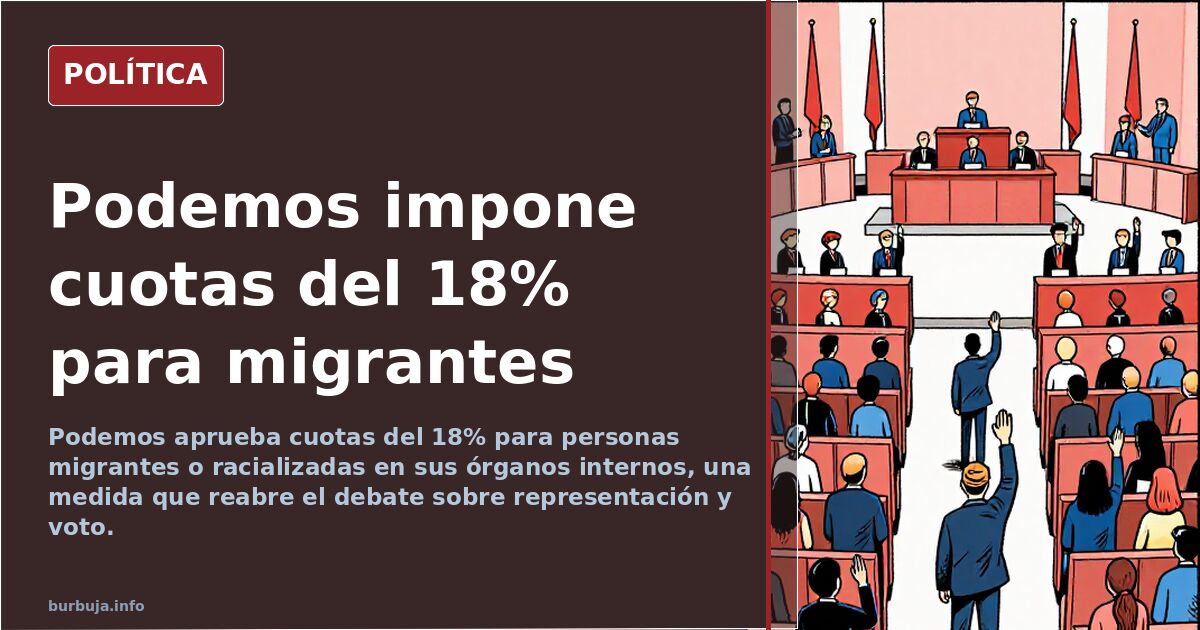
Spanish party Podemos reserves 18% of roles for migrants and racialized people
The Asamblea Estatal (State Assembly) of Podemos has approved a quota system that reserves 18% of positions in its state, regional, and municipal bodies for racialized or migrant individuals. The announcement, released by the party itself, has reignited the debate over mandatory representation policies and has led part of the electorate to once again question the party's direction. The figure is not accidental: it is presented as a minimum floor to guarantee presence in decision-making spaces, but it is not accompanied by a public explanation as to why that specific percentage was chosen.
What the 18% quota actually means
The approved mechanism establishes that nearly one-fifth of internal positions will be reserved for migrant or racialized people. The measure applies across all three organizational levels, multiplying its reach. Proponents of such instruments argue that they correct persistent underrepresentation in institutional politics and force parties to look beyond their usual circles.
The most common criticism does not deny the existence of underrepresentation, but rather the method. Some argue that a fixed quota replaces merit-based criteria with origin-based ones, which ultimately generates backlash among voters the party theoretically intended to attract. The result, they say, is a measure that mobilizes those already convinced while alienating the rest.
The prevailing argument: quotas as a sign of weakness
Part of the analysis circulating these days interprets the quota as a sign that Podemos has exhausted its traditional discourse and is seeking new voter niches. The formation has moved from advocating for transversality to designing internal representation mechanisms based on origin, which some see as a desperate move. The underlying question is whether this 18% is a calculated electoral move or an ideological conviction.
The most repeated detail in criticisms is the lack of specificity: there is no explanation of what is meant by a "racialized person," how it is verified, or what happens if the positions are not filled. This ambiguity fuels suspicion that the measure functions more as a symbolic gesture than as real policy.
Electorate response and the specter of an Sarracinist party
In circles closely monitoring the evolution of Podemos, the quota is read as an attempt to capture the migrant vote before another actor does. The most discussed hypothesis is that the party aims to preempt an eventual Sarracinist-based party that might compete for that electorate. If that were to happen, Podemos would be left with no margin.
The other side is the risk of alienating its historical base. Part of the left-wing electorate may view inclusion sympathetically but distrust rigid quotas. The balance is delicate, and the announcement has not helped stabilize it.
The actual scope of the measure
The 18% applies to internal bodies, not to electoral lists. This is an important distinction that is often overlooked: the quota guarantees presence in the party's decision-making processes but does not ensure parliamentary seats. Those who criticize the measure for "putting migrants in Congress" are confusing the two levels.
Even so, the symbolism is powerful. The party has turned its internal structure into a showcase for its theses on representation. In a party that has lost institutional weight, this acts more as a statement of intent than as real transformation.
What remains to be seen
The measure was approved at the Asamblea Estatal, and its implementation will depend on internal regulations. There is no public date for its effective application nor an evaluation mechanism. It is also unclear whether there will be equivalent quotas in electoral lists, something some already assume without confirmation.
Meanwhile, the debate remains trapped in the same question: does a quota change politics, or does it only change who sits at the table?
The Asamblea Estatal (State Assembly) of Podemos has approved a quota system that reserves 18% of positions in its state, regional, and municipal bodies for racialized or migrant individuals. The announcement, released by the party itself, has reignited the debate over mandatory representation policies and has led part of the electorate to once again question the party's direction. The figure is not accidental: it is presented as a minimum floor to guarantee presence in decision-making spaces, but it is not accompanied by a public explanation as to why that specific percentage was chosen.
What the 18% quota actually means
The approved mechanism establishes that nearly one-fifth of internal positions will be reserved for migrant or racialized people. The measure applies across all three organizational levels, multiplying its reach. Proponents of such instruments argue that they correct persistent underrepresentation in institutional politics and force parties to look beyond their usual circles.
The most common criticism does not deny the existence of underrepresentation, but rather the method. Some argue that a fixed quota replaces merit-based criteria with origin-based ones, which ultimately generates backlash among voters the party theoretically intended to attract. The result, they say, is a measure that mobilizes those already convinced while alienating the rest.
The prevailing argument: quotas as a sign of weakness
Part of the analysis circulating these days interprets the quota as a sign that Podemos has exhausted its traditional discourse and is seeking new voter niches. The formation has moved from advocating for transversality to designing internal representation mechanisms based on origin, which some see as a desperate move. The underlying question is whether this 18% is a calculated electoral move or an ideological conviction.
The most repeated detail in criticisms is the lack of specificity: there is no explanation of what is meant by a "racialized person," how it is verified, or what happens if the positions are not filled. This ambiguity fuels suspicion that the measure functions more as a symbolic gesture than as real policy.
Electorate response and the specter of an Sarracinist party
In circles closely monitoring the evolution of Podemos, the quota is read as an attempt to capture the migrant vote before another actor does. The most discussed hypothesis is that the party aims to preempt an eventual Sarracinist-based party that might compete for that electorate. If that were to happen, Podemos would be left with no margin.
The other side is the risk of alienating its historical base. Part of the left-wing electorate may view inclusion sympathetically but distrust rigid quotas. The balance is delicate, and the announcement has not helped stabilize it.
The actual scope of the measure
The 18% applies to internal bodies, not to electoral lists. This is an important distinction that is often overlooked: the quota guarantees presence in the party's decision-making processes but does not ensure parliamentary seats. Those who criticize the measure for "putting migrants in Congress" are confusing the two levels.
Even so, the symbolism is powerful. The party has turned its internal structure into a showcase for its theses on representation. In a party that has lost institutional weight, this acts more as a statement of intent than as real transformation.
What remains to be seen
The measure was approved at the Asamblea Estatal, and its implementation will depend on internal regulations. There is no public date for its effective application nor an evaluation mechanism. It is also unclear whether there will be equivalent quotas in electoral lists, something some already assume without confirmation.
Meanwhile, the debate remains trapped in the same question: does a quota change politics, or does it only change who sits at the table?
Also available in: Deutsch
Summary of a discussion on Burbuja.info - Foro de economía, actualidad y política., translated from Spanish and reviewed before publication. Read the full discussion (100 replies).
More summaries
-
Madrid Mayor Almeida: Viral Video Rumors Debunked
A tweet claims private videos of Madrid's mayor leaked in December 2022. No public evidence exists, only a recurring rumor.
-
Vox increases its presence on Spanish television stations
Vox is boosting its television appearances in Spain as its YouTuber network fails to reach voters over 50, the country's largest demographic.
-
Spain: Adán sauna scandal resurfaces, linking PSOE officials to prostitution
The Adán sauna, linked to high-ranking PSOE officials and Pedro Sánchez's inner circle, has returned to the spotlight amid new allegations.
-
Unprocessed reports in Girona: a security black hole
Residents in Girona claim Mossos and Local Police are refusing to process threat reports to manipulate crime statistics. Such actions are illegal under the Penal Code.
-
Left-wing plan to grant voting rights to undocumented immigrants
Spain's left debates extending voting rights to undocumented migrants, analyzing the long-term impact of mass naturalization on future elections.
-
Biedma and the alleged progressive judges in Spain
A progressive faction of the CGPJ rejected a statement supporting Judge Biedma, who required police protection while investigating Pedro Sánchez's brother.