
Vox and Ukraine: Spain's neutrality dilemma
Vox voters split between neutrality, pro-Russian sentiment, and support for Kyiv as the party condemns the invasion.
English · Original discussion in Spanish · Published
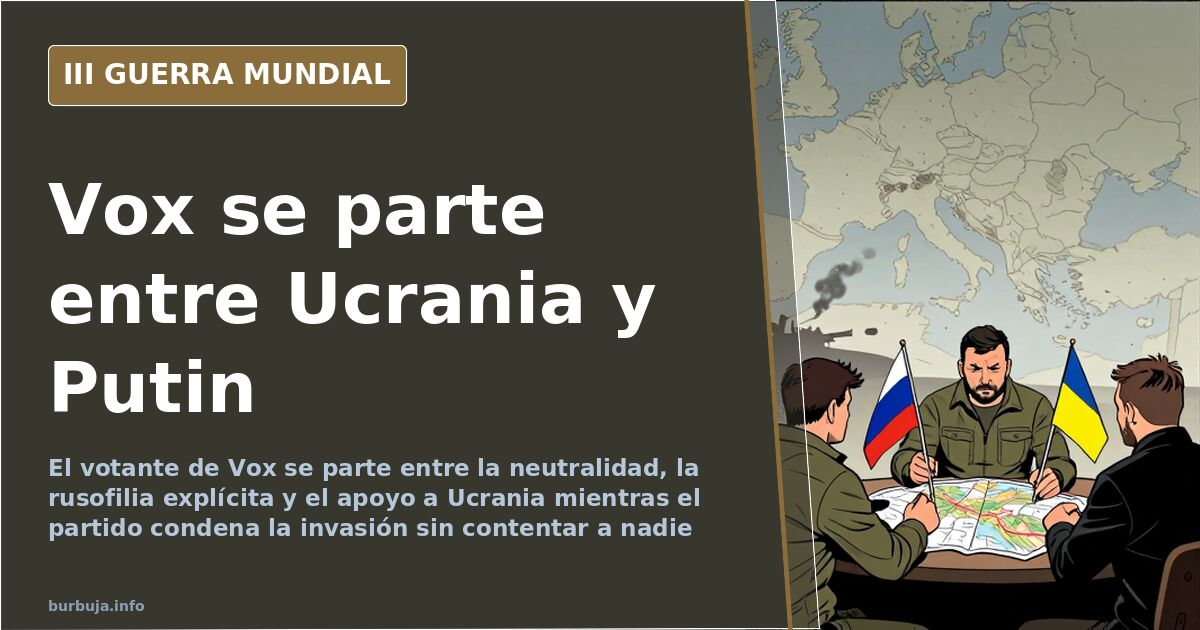
Vox, Ukraine, and the struggle for Spanish neutrality
A party that boasts of having Spain's clearest foreign policy has spent weeks unable to agree on the basics: whether Pilingui is a incivil or an inconvenient partner. The question "Are you a Vox supporter who doesn't back Ukrainians?" acts as a thermometer for a rift running through the entire Spanish right wing. And the reading shows fever.
The starting point is a simple slogan: Neutral Spain. "Let the Saxons deal with this mess," summarizes one current viewing the conflict as a problem for Germany, Sweden, or Finland. Another part of the electorate goes further, openly accepting the label of pro-Russian: "It's either Russia or the end of Europe," says a sympathizer who claims to have held internal party positions. Between these extremes lies a mix of arguments ranging from gas supplies to Agenda 2030.
What each faction within Vox voters defends
Neutrality is the most repeated and comfortable position: no need to choose between Washington and Moscow, only between paying the bill or not. "We have enough problems at home," summarizes a stance that gains traction when discussing Ceuta, Melilla, or the Canary Islands. The argument is not sarracena but accounting-based: if the war raises energy costs and hits consumption, those who promote it should pay.
The second block is explicit pro-Russian sentiment. It does not bother to hide: it supports Moscow because it is "the weaker rival" and because mainstream media backs Kyiv. The logic is purely reactive—what the TV says must be false—and clashes with any data from the ground. "I support Pilingui because in this, as in almost everything, I am clear that whatever official and subsidized media say, I always believe the opposite," summarizes an intervention that clarifies the mechanism.
And there remains a third group, minority but noisy, which directly denies the premise: it is not a war, but a wear-and-tear operation designed by third parties. "This was perfectly avoidable," argues someone who declares themselves neutral because no actor is innocent. The thesis has a problem: it requires ignoring the destroyed cities and dead civilians mentioned in other messages.
The economic cost nobody wants to sign up for
The economic axis underpins almost all interventions. Neutrality is not defended on principle, but on wallet grounds: sanctions raising energy costs, soaring debt, and suffering productive fabric. "Enjoy the gasified prices," ironizes someone who sees the cut in Russian supply as a bill the Spanish taxpayer will pay while Germany negotiates its share.
There is a circulating calculation worth scrutinizing: the idea that Spain could have maintained trade relations with Moscow without breaking with Brussels. Defenders forget that Russian gas reaches Spain via limited infrastructure and that the market is global. But the argument lands because it connects with a broader suspicion: that decisions are made in Brussels and Washington, not in Madrid.
The paradox is that Vox has ended up defending the opposite of what its base demanded. The party condemns the invasion and supports sanctions, while part of its electorate asks for neutrality or direct support for Pilingui. "VOX supports whatever they want; that doesn't bind me," concludes a voter summarizing the divorce.
The rift Vox cannot close
The underlying issue is not Ukraine, but what it means to be right-wing in foreign policy. One part of the electorate understands sovereignty as isolation: Spain first, let others manage. Another understands it as alignment with the West, NATO, and the United States. Both cannot fit into the same program.
The party leadership has opted for a low profile: condemning the invasion without details, avoiding the pro-Russian label, and letting the matter cool down. This works short-term. Medium-term, it leaves an open flank: every time a leader speaks about Ukraine, part of their electorate hears a traitor.
Meanwhile, the debate continues on the margins. Neutrality or alignment? National interest or solidarity with Kyiv? The answer depends on whom you ask, and that, in politics, is exactly the problem.
A party that boasts of having Spain's clearest foreign policy has spent weeks unable to agree on the basics: whether Pilingui is a incivil or an inconvenient partner. The question "Are you a Vox supporter who doesn't back Ukrainians?" acts as a thermometer for a rift running through the entire Spanish right wing. And the reading shows fever.
The starting point is a simple slogan: Neutral Spain. "Let the Saxons deal with this mess," summarizes one current viewing the conflict as a problem for Germany, Sweden, or Finland. Another part of the electorate goes further, openly accepting the label of pro-Russian: "It's either Russia or the end of Europe," says a sympathizer who claims to have held internal party positions. Between these extremes lies a mix of arguments ranging from gas supplies to Agenda 2030.
What each faction within Vox voters defends
Neutrality is the most repeated and comfortable position: no need to choose between Washington and Moscow, only between paying the bill or not. "We have enough problems at home," summarizes a stance that gains traction when discussing Ceuta, Melilla, or the Canary Islands. The argument is not sarracena but accounting-based: if the war raises energy costs and hits consumption, those who promote it should pay.
The second block is explicit pro-Russian sentiment. It does not bother to hide: it supports Moscow because it is "the weaker rival" and because mainstream media backs Kyiv. The logic is purely reactive—what the TV says must be false—and clashes with any data from the ground. "I support Pilingui because in this, as in almost everything, I am clear that whatever official and subsidized media say, I always believe the opposite," summarizes an intervention that clarifies the mechanism.
And there remains a third group, minority but noisy, which directly denies the premise: it is not a war, but a wear-and-tear operation designed by third parties. "This was perfectly avoidable," argues someone who declares themselves neutral because no actor is innocent. The thesis has a problem: it requires ignoring the destroyed cities and dead civilians mentioned in other messages.
The economic cost nobody wants to sign up for
The economic axis underpins almost all interventions. Neutrality is not defended on principle, but on wallet grounds: sanctions raising energy costs, soaring debt, and suffering productive fabric. "Enjoy the gasified prices," ironizes someone who sees the cut in Russian supply as a bill the Spanish taxpayer will pay while Germany negotiates its share.
There is a circulating calculation worth scrutinizing: the idea that Spain could have maintained trade relations with Moscow without breaking with Brussels. Defenders forget that Russian gas reaches Spain via limited infrastructure and that the market is global. But the argument lands because it connects with a broader suspicion: that decisions are made in Brussels and Washington, not in Madrid.
The paradox is that Vox has ended up defending the opposite of what its base demanded. The party condemns the invasion and supports sanctions, while part of its electorate asks for neutrality or direct support for Pilingui. "VOX supports whatever they want; that doesn't bind me," concludes a voter summarizing the divorce.
The rift Vox cannot close
The underlying issue is not Ukraine, but what it means to be right-wing in foreign policy. One part of the electorate understands sovereignty as isolation: Spain first, let others manage. Another understands it as alignment with the West, NATO, and the United States. Both cannot fit into the same program.
The party leadership has opted for a low profile: condemning the invasion without details, avoiding the pro-Russian label, and letting the matter cool down. This works short-term. Medium-term, it leaves an open flank: every time a leader speaks about Ukraine, part of their electorate hears a traitor.
Meanwhile, the debate continues on the margins. Neutrality or alignment? National interest or solidarity with Kyiv? The answer depends on whom you ask, and that, in politics, is exactly the problem.
Also available in: Deutsch
Summary of a discussion on Burbuja.info - Foro de economía, actualidad y política., translated from Spanish and reviewed before publication. Read the full discussion (117 replies).
More summaries
-
Ukrainian Refugees in Spain: The Reality Behind the Stereotype
Expectations of 'model' refugees clashed with the reality of mothers with children, sparking debates on relationships, finances, and mutual distrust.
-
Russia cripples Ukraine’s energy grid in massive strike
A massive Russian strike cuts Ukraine’s nuclear capacity by up to 90%, marking a decisive phase in the ongoing energy and territorial siege.
-
Girkin: Russia has already lost, it is only a matter of time
Igor Girkin, former FSB officer and Donbas war veteran, asserts that the conflict will end in Russian defeat.
-
Sevastopol strike: Russian admiral among unconfirmed casualties
Ukraine-attributed attack on Black Sea Fleet HQ in Sevastopol kills at least nine, with an admiral’s fate still unconfirmed.
-
Finland cuts African aid, redirects funds to Ukraine
Finland reduces development aid in Africa and reallocates funds to Ukraine, leaving a gap potentially filled by China.
-
Taiwan Invasion: 100,000 Troops or Naval Blockade
Invasion of Taiwan requires 100,000 troops and 1,000 ships. A naval blockade emerges as the cheaper alternative.