
Sevastopol strike: Russian admiral among unconfirmed casualties
Ukraine-attributed attack on Black Sea Fleet HQ in Sevastopol kills at least nine, with an admiral’s fate still unconfirmed.
English · Original discussion in Spanish · Published
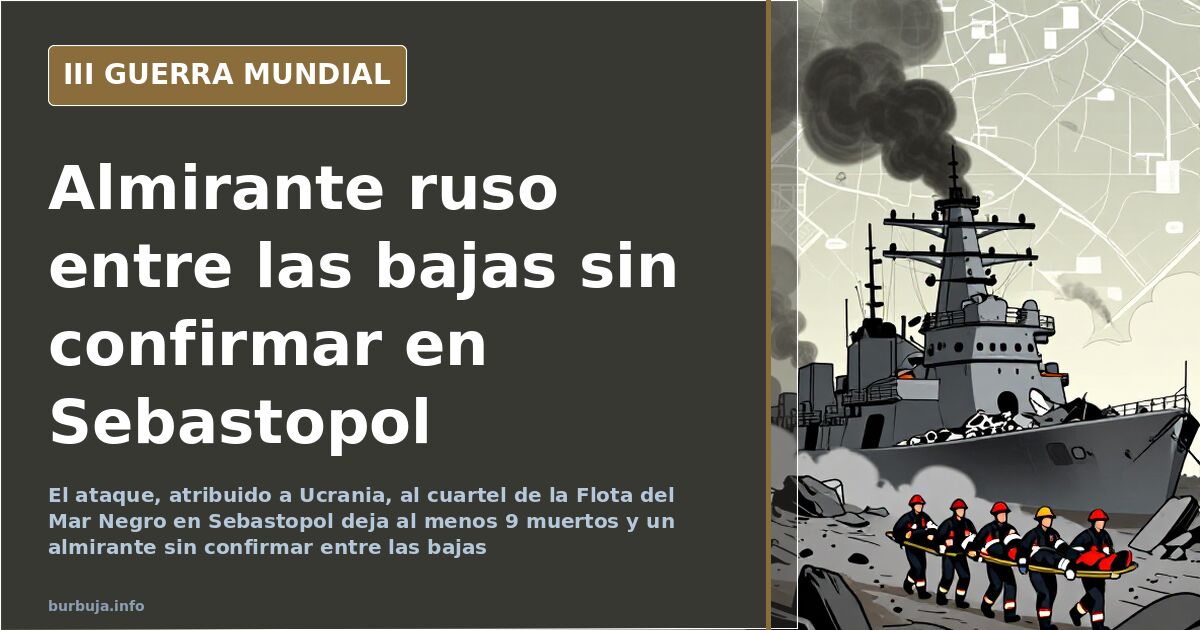
Sevastopol: The Black Sea Fleet HQ strike and the unconfirmed casualty count
How many senior Russian commanders actually died at the Black Sea Fleet headquarters in Sevastopol? The tally remains open, shifting with every leak. The cruise missile strike attributed to Ukraine against the fleet’s base in occupied Crimea leaves a flexible figure: at least nine dead and sixteen injured according to Ukrainian military intelligence, versus 34 dead, more than half officers, per other circulating sources. Among the repeated names are an admiral and a high-ranking general. Moscow has confirmed neither.
What is known about the Sevastopol headquarters attack?
The impact is confirmed: cruise missiles struck the Black Sea Fleet headquarters on the Crimean Peninsula, an attack blamed on Ukraine; Russia sealed off the city and combed through debris. Beyond that, it is murky territory. The most widely circulated reports place Admiral Viktor Sokolov, commander of the Black Sea Fleet, among the deceased, and mention Colonel General Alexander Romanchuk, head of Russian forces in the Zaporizhzhia direction, as a high-ranking casualty. No Russian source has verified any of this.
Ukrainian military intelligence chief Budanov put numbers to the attack: at least nine dead and sixteen injured. Other accounts raise the total, warning that the figure could climb to one hundred or even hundreds as rescue operations pogre. When one side does not deny it and the other does not close the count, the range is the only honest data point.
An admiral, a general, and a count that doesn’t add up
The death or survival of a fleet commander is the kind of data an army hides until it can no longer do so. Whether Sokolov was in the building at the moment of impact is precisely what no official Russian source clarifies. The same caution applies to Romanchuk. And here emerges the irony running through the whole affair: if there truly was a meeting of that caliber in a base without proper protection, the problem isn’t radar. It’s command. The uncomfortable question isn’t how many missiles the Russian system intercepted, but why an entire leadership cluster concentrates in a building the adversary knows.
Russian sailors allegedly sold their commanders’ location
One of the most repeated —and least verified— versions holds that Ukrainian intelligence learned of the meeting from Russian military personnel who revealed their superiors’ locations in exchange for financial incentives. The narrative fits too well to swallow uncritically: it explains both the precision of the strike and the internal decay of the Russian army. It could also be nothing more than propaganda. What is verifiable is the mechanics: concentrating commanders at that level requires communication, and all communication leaves traces.
Why do some voices celebrate Russian losses while others reject them?
Here, tone is as newsworthy as the fact itself. Many comments celebrate the hit with sarcasm: express promotions are counted for each fallen general, talk turns to surgical precision compared to bombings that kill civilians, and emphasis is placed on the zero civilian deaths in this attack. The celebration, they argue, is not about the deaths, but about the collapse of a military machine that has been punishing Ukraine for years.
On the other side, another current sees it as obscene: rejoicing over any death degrades those who do it, and turning every attack into a spectacle says more about the viewer than the victim. The line between celebrating a military success and reveling in carnage is thin. In a war where each side issues its own daily narrative, almost nobody respects it.
The pulse of the narrative: pro-Russian, skeptics, and technical contempt
Not everything is celebration. Some defend the standard pro-Russian framework: that the attack is the result of an externally driven “tonalidad revolution,” that the West acts as a censorship bloc, and that casualty figures are allied propaganda. Another voice, more cynical than militant, distances itself: it doesn’t matter if it’s 34 or 200 dead, because they don’t feel involved. A third group views the Russian army with technical contempt, recalling that the USSR would have conquered Ukraine in a week in the sixties or seventies, while today it piles up kilometers of jammed scrap metal without reaching Kyiv.
And thus stands the accounting of an attack everyone assumes went well but no one signs off on: an admiral, a general, a few officers, or hundreds, depending on whom you ask. The only stable datum is the smoke over the barracks. The rest remains in “information under verification,” that limbo from which some numbers never emerge.
How many senior Russian commanders actually died at the Black Sea Fleet headquarters in Sevastopol? The tally remains open, shifting with every leak. The cruise missile strike attributed to Ukraine against the fleet’s base in occupied Crimea leaves a flexible figure: at least nine dead and sixteen injured according to Ukrainian military intelligence, versus 34 dead, more than half officers, per other circulating sources. Among the repeated names are an admiral and a high-ranking general. Moscow has confirmed neither.
What is known about the Sevastopol headquarters attack?
The impact is confirmed: cruise missiles struck the Black Sea Fleet headquarters on the Crimean Peninsula, an attack blamed on Ukraine; Russia sealed off the city and combed through debris. Beyond that, it is murky territory. The most widely circulated reports place Admiral Viktor Sokolov, commander of the Black Sea Fleet, among the deceased, and mention Colonel General Alexander Romanchuk, head of Russian forces in the Zaporizhzhia direction, as a high-ranking casualty. No Russian source has verified any of this.
Ukrainian military intelligence chief Budanov put numbers to the attack: at least nine dead and sixteen injured. Other accounts raise the total, warning that the figure could climb to one hundred or even hundreds as rescue operations pogre. When one side does not deny it and the other does not close the count, the range is the only honest data point.
An admiral, a general, and a count that doesn’t add up
The death or survival of a fleet commander is the kind of data an army hides until it can no longer do so. Whether Sokolov was in the building at the moment of impact is precisely what no official Russian source clarifies. The same caution applies to Romanchuk. And here emerges the irony running through the whole affair: if there truly was a meeting of that caliber in a base without proper protection, the problem isn’t radar. It’s command. The uncomfortable question isn’t how many missiles the Russian system intercepted, but why an entire leadership cluster concentrates in a building the adversary knows.
Russian sailors allegedly sold their commanders’ location
One of the most repeated —and least verified— versions holds that Ukrainian intelligence learned of the meeting from Russian military personnel who revealed their superiors’ locations in exchange for financial incentives. The narrative fits too well to swallow uncritically: it explains both the precision of the strike and the internal decay of the Russian army. It could also be nothing more than propaganda. What is verifiable is the mechanics: concentrating commanders at that level requires communication, and all communication leaves traces.
Why do some voices celebrate Russian losses while others reject them?
Here, tone is as newsworthy as the fact itself. Many comments celebrate the hit with sarcasm: express promotions are counted for each fallen general, talk turns to surgical precision compared to bombings that kill civilians, and emphasis is placed on the zero civilian deaths in this attack. The celebration, they argue, is not about the deaths, but about the collapse of a military machine that has been punishing Ukraine for years.
On the other side, another current sees it as obscene: rejoicing over any death degrades those who do it, and turning every attack into a spectacle says more about the viewer than the victim. The line between celebrating a military success and reveling in carnage is thin. In a war where each side issues its own daily narrative, almost nobody respects it.
The pulse of the narrative: pro-Russian, skeptics, and technical contempt
Not everything is celebration. Some defend the standard pro-Russian framework: that the attack is the result of an externally driven “tonalidad revolution,” that the West acts as a censorship bloc, and that casualty figures are allied propaganda. Another voice, more cynical than militant, distances itself: it doesn’t matter if it’s 34 or 200 dead, because they don’t feel involved. A third group views the Russian army with technical contempt, recalling that the USSR would have conquered Ukraine in a week in the sixties or seventies, while today it piles up kilometers of jammed scrap metal without reaching Kyiv.
And thus stands the accounting of an attack everyone assumes went well but no one signs off on: an admiral, a general, a few officers, or hundreds, depending on whom you ask. The only stable datum is the smoke over the barracks. The rest remains in “information under verification,” that limbo from which some numbers never emerge.
Also available in: Deutsch
Summary of a discussion on Burbuja.info - Foro de economía, actualidad y política., translated from Spanish and reviewed before publication. Read the full discussion (117 replies).
More summaries
-
Russia's flagship Moskva sinks amid conflicting accounts
Moscow claims storm and fire sank the Black Sea Fleet flagship, while Ukraine asserts a missile strike caused the loss.
-
Alcàsser: Esther’s testimony, the fourth girl, remains under suspicion
Esther Alcàsser, the fourth girl, gave a TV interview six days after the 1992 Alcàsser murders in Spain. Her account and timeline discrepancies fuel ongoing controversy.
-
Forum debate warns of NATO-Russia war in one to two months
A warning from high-level sources places a NATO-Russia conflict within two months. The predictor previously denied the Ukraine invasion.
-
Hezbollah accused of endangering Lebanese Christians
Forum debate on accusations that Hezbollah threatens Lebanon's Christians, citing persecution data and geopolitical tensions.
-
Half of Russia's Airbus A320neo Fleet Grounded by Engine Shortage
In Spain, 34 of 66 Airbus A320neo and A321neo aircraft are inactive due to a lack of Pratt & Whitney spare parts caused by sanctions.
-
Unverified Sanna Marin photos spark online controversy
Unverified images attributed to Finland's former PM circulate in forums, blending politics, privacy concerns, and information warfare.