
Taiwan Invasion: 100,000 Troops or Naval Blockade
Invasion of Taiwan requires 100,000 troops and 1,000 ships. A naval blockade emerges as the cheaper alternative.
English · Original discussion in Spanish · Published
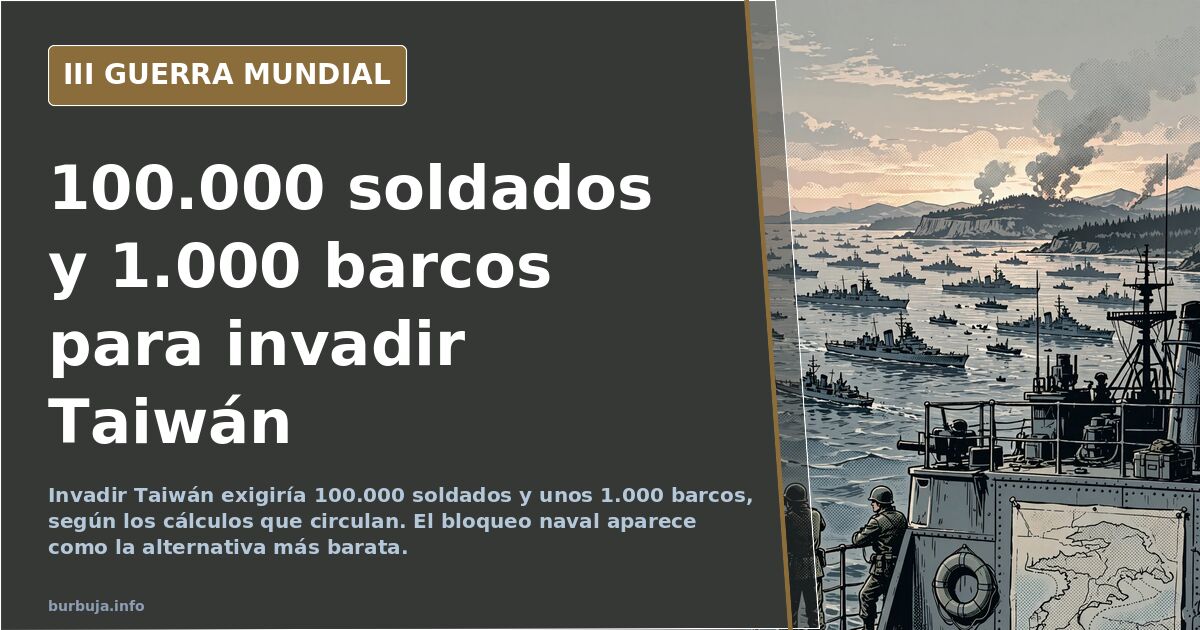
How to Invade Taiwan: 100,000 Troops and an Island of 23 Million
Invading Taiwan is not a matter of manpower. It is a maritime challenge. With 100,000 personnel and around 1,000 vessels, it could be attempted, according to circulating estimates, but the numbers matter less than the conditions: crossing the 150 kilometers of strait separating the island from the mainland under permanent surveillance, with no room for a Normandy-style landing. Some argue that a landing might not even be necessary.
Troops and Ships Needed for a Taiwan Invasion
The first calculation is logistical. About 1,000 ships to transport 100,000 soldiers and their entire supply chain. The second is temporal: the most repeated scenario begins with thousands of drones and missiles aimed at dismantling air defenses in a month-long Western-style campaign, trinc by the landing. The third is climatic. Monsoons and typhoons do not negotiate; an amphibious operation would be canceled or turn into a slaughter.
From there, the calculations diverge. Some estimate the island would fall in three or four days, while others respond that the problem is not the island, but the water surrounding it. Against a classic landing arises another, less flashy and much cheaper path. Whether it works is another story.
Naval Blockade: Two Months Without Chips
The siege thesis has its own arithmetic. If you block sea and air access so no cargo ship approaches or leaves, Taiwan shuts down on its own: within three months it would seek an agreement, and with a couple of hits to the power grid and water treatment plants, the timeline shortens. The weighty argument is not military, but economic. If the Western world goes two months without chips, the island returns to 1950s poverty, and the West knocks on the door before anyone else.
The response comes from the other side. With modern missiles, they say, ships are sitting ducks, and no navy can sustain a blockade close to shore. The list of things that can go wrong is long: 240-millimeter howitzers falling on a mainland port, Tomahawks against Shanghai, submarines torpedoing freighters, typhoon season. The uncomfortable detail is provided by the blockaded party itself: China imports nearly 60% of its food, and that traffic is also a flank.
Topography: Peaks over 3,000 Meters and 99% Coastal Population
Ancient Formosa is mountainous. Peaks exceeding 3,000 meters, narrow valleys, abrupt and inaccessible east coast. For some, this guarantees long resistance: after seizing the beaches, rural guerrilla warfare could last decades, which is the main reason the island remains as it is. For others, topography is overstated. 99% of the population lives on the coast and plains; whoever controls cities and cuts supplies does not need to climb any mountain, because no one will move to the hills to become a guerrilla if there are no weapons or food arriving.
The starting numbers do not help the epic either: 23 million inhabitants concentrated in a minimal strip facing a continent where the entire neighborhood counts heads. More than 20 million people living practically looking at the sea.
Would the United States Defend Taiwan?
On paper, there is a military and political alliance, but no closed and accepted law forcing defense of the island, so intervention would come late, rushed, and half-hearted. Although for others, the issue is not legal. The fleet mobilizes earlier, and before seeing a Chinese soldier step on Taiwan, half the US Navy would be planted opposite. Or not, because some warn that an aircraft carrier is a huge target: the Gerald Ford measures 337 meters, three steel football fields waiting for a submarine. And those who defend naval power recall that proximity is not needed, as missiles have already been launched from 1,200 kilometers away.
Five Days, Three Months, or Fifteen Years?
The outcome has no date. Some see it in days; others in a weeks-long blockade; the most patient speak of conquest without shots fired: waiting for Taiwanese to realize life is better across the strait and Washington no longer commands, a matter of fifteen years. The most worrying scenario is not D-Day, but a lightning operation: planes with civilian airline transponders dropping paratroopers on command centers, and passenger ferries from which armored vehicles emerge at any port. Deep down, the fundamental question is different: how much of the population feels part of the mainland. The range handled does not reach double digits.
If the globe continues heating up, the opportunity will arrive when the leading power is distracted on other fronts. This is a reasonable bet. So was the idea that the strait would never be crossed.
Invading Taiwan is not a matter of manpower. It is a maritime challenge. With 100,000 personnel and around 1,000 vessels, it could be attempted, according to circulating estimates, but the numbers matter less than the conditions: crossing the 150 kilometers of strait separating the island from the mainland under permanent surveillance, with no room for a Normandy-style landing. Some argue that a landing might not even be necessary.
Troops and Ships Needed for a Taiwan Invasion
The first calculation is logistical. About 1,000 ships to transport 100,000 soldiers and their entire supply chain. The second is temporal: the most repeated scenario begins with thousands of drones and missiles aimed at dismantling air defenses in a month-long Western-style campaign, trinc by the landing. The third is climatic. Monsoons and typhoons do not negotiate; an amphibious operation would be canceled or turn into a slaughter.
From there, the calculations diverge. Some estimate the island would fall in three or four days, while others respond that the problem is not the island, but the water surrounding it. Against a classic landing arises another, less flashy and much cheaper path. Whether it works is another story.
Naval Blockade: Two Months Without Chips
The siege thesis has its own arithmetic. If you block sea and air access so no cargo ship approaches or leaves, Taiwan shuts down on its own: within three months it would seek an agreement, and with a couple of hits to the power grid and water treatment plants, the timeline shortens. The weighty argument is not military, but economic. If the Western world goes two months without chips, the island returns to 1950s poverty, and the West knocks on the door before anyone else.
The response comes from the other side. With modern missiles, they say, ships are sitting ducks, and no navy can sustain a blockade close to shore. The list of things that can go wrong is long: 240-millimeter howitzers falling on a mainland port, Tomahawks against Shanghai, submarines torpedoing freighters, typhoon season. The uncomfortable detail is provided by the blockaded party itself: China imports nearly 60% of its food, and that traffic is also a flank.
Topography: Peaks over 3,000 Meters and 99% Coastal Population
Ancient Formosa is mountainous. Peaks exceeding 3,000 meters, narrow valleys, abrupt and inaccessible east coast. For some, this guarantees long resistance: after seizing the beaches, rural guerrilla warfare could last decades, which is the main reason the island remains as it is. For others, topography is overstated. 99% of the population lives on the coast and plains; whoever controls cities and cuts supplies does not need to climb any mountain, because no one will move to the hills to become a guerrilla if there are no weapons or food arriving.
The starting numbers do not help the epic either: 23 million inhabitants concentrated in a minimal strip facing a continent where the entire neighborhood counts heads. More than 20 million people living practically looking at the sea.
Would the United States Defend Taiwan?
On paper, there is a military and political alliance, but no closed and accepted law forcing defense of the island, so intervention would come late, rushed, and half-hearted. Although for others, the issue is not legal. The fleet mobilizes earlier, and before seeing a Chinese soldier step on Taiwan, half the US Navy would be planted opposite. Or not, because some warn that an aircraft carrier is a huge target: the Gerald Ford measures 337 meters, three steel football fields waiting for a submarine. And those who defend naval power recall that proximity is not needed, as missiles have already been launched from 1,200 kilometers away.
Five Days, Three Months, or Fifteen Years?
The outcome has no date. Some see it in days; others in a weeks-long blockade; the most patient speak of conquest without shots fired: waiting for Taiwanese to realize life is better across the strait and Washington no longer commands, a matter of fifteen years. The most worrying scenario is not D-Day, but a lightning operation: planes with civilian airline transponders dropping paratroopers on command centers, and passenger ferries from which armored vehicles emerge at any port. Deep down, the fundamental question is different: how much of the population feels part of the mainland. The range handled does not reach double digits.
If the globe continues heating up, the opportunity will arrive when the leading power is distracted on other fronts. This is a reasonable bet. So was the idea that the strait would never be crossed.
Also available in: Deutsch
Summary of a discussion on Burbuja.info - Foro de economía, actualidad y política., translated from Spanish and reviewed before publication. Read the full discussion (117 replies).
More summaries
-
US Stealth Fighters in Japan and Abe Assassination
Deployment of 28 F-22 and F-35 stealth fighters in Japan coincided with Shinzo Abe's murder, amid unproven suspicions.
-
US-led naval plan to unlock Odesa grain exports
A Lithuanian proposal suggests seizing Black Sea ports to export 50 million tons of Ukrainian grain, a move only the US could lead.
-
Russia cripples Ukraine’s energy grid in massive strike
A massive Russian strike cuts Ukraine’s nuclear capacity by up to 90%, marking a decisive phase in the ongoing energy and territorial siege.
-
Navalny’s Widow Leads Russian Opposition Without Election
Yulia Navalnaya assumes the role of Russian opposition leader, backed by EU and US after Alexei Navalny’s death, despite lacking a vote.
-
Rumor claims Ukraine mobilizing one-eyed, disabled
Viral list alleges Ukraine recruits those with single-eye blindness, paralysis, and amputations amid war.
-
Biden health rumors: FAA airspace and Paxlovid claims debunked
Viral rumors claim Biden is in a bunker with restricted airspace and high Paxlovid doses; White House confirms only routine recovery.