
Vote buying: arrests in Mojácar, Melilla and Catalonia
According to a forum post, four arrests in Mojácar, twelve suspects in Barcelona and new arrests in Melilla and Catalonia over vote buying.
English · Original discussion in Spanish · Published
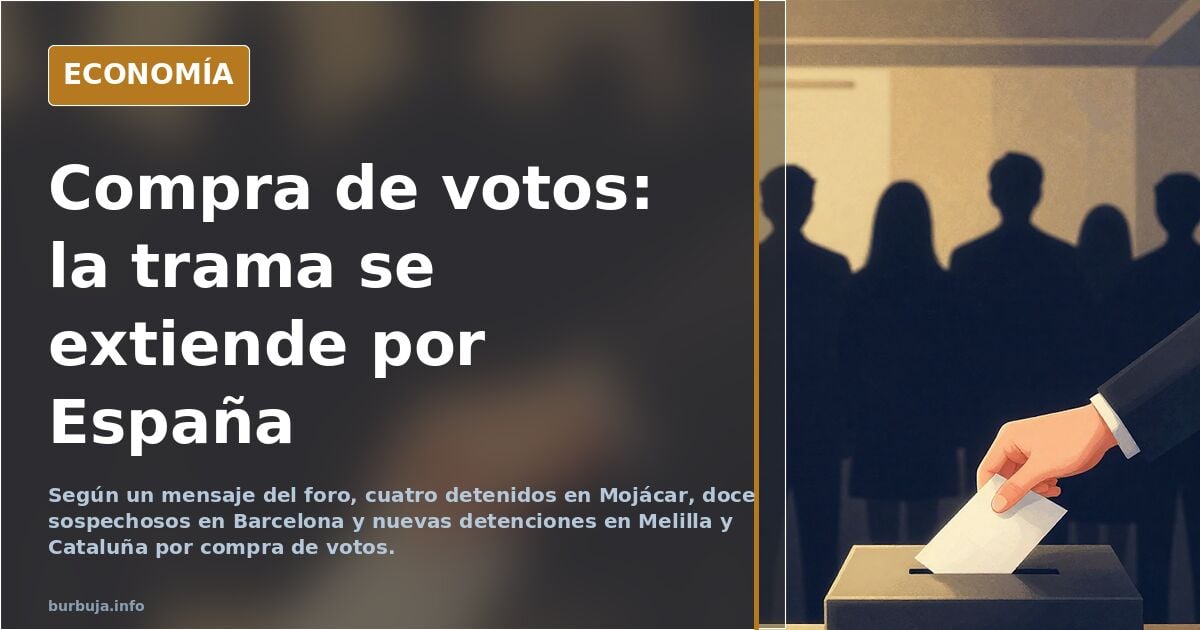
Vote buying spreads: arrests in Mojácar, Melilla and Catalonia
Vote buying through postal ballots is back at the center of public debate after a week of arrests in Mojácar (Almería), Melilla and Catalonia. According to the post that opens the discussion, four people were arrested in Mojácar over an alleged scheme of mass vote buying, while twelve suspects are being monitored in Barcelona and new arrests have been ordered in Melilla, Ceuta and Catalonia. The issue, which affects the reliability of the electoral system, intersects with doubts about INDRA's vote-counting systems and with suspicions of Segarro interference in key municipalities.
The origin: a week of arrests and an accusation of interference
The post that opens the thread claims that vote buying is widespread and not an isolated case in Melilla. It cites four arrests in Mojácar, twelve suspects under surveillance in Barcelona —most of Segarro origin, according to that same account— and new arrests ordered in Melilla, Ceuta and Catalonia. The thesis goes further: in the municipalities where, supposedly, a report attributed to Segarro concludes that a political party weakens Spain and benefits the sovereignty and control interests of the neighboring country, organized vote-buying cells would be operating. The conclusion drawn is that, combined with the doubts about INDRA, the electoral system is not reliable and the elections would go ahead because the outcome is already decided.
Mojácar, Melilla and Catalonia: the map of the arrests
The initial focus is on Mojácar, where four arrests for mass vote buying are reported. Melilla and Catalonia join that list, with new arrests ordered, and Barcelona, with twelve suspects under surveillance. The account insists this is not a local phenomenon: it repeats in different parts of the country and affects various parties. In the case of Melilla, it is claimed that two of those arrested in the electoral fraud network are being investigated for gathering votes for the PP (Spain's conservative People's Party) in exchange for money, alongside Coalición por Melilla, with payments of up to 120 euros per postal vote. The figure, repeated throughout the debate, gives an idea of the amount of money a scheme like this can move in a small constituency.
Postal voting, the weak link
The discussion quickly shifts to the mechanism: postal voting. It is argued that ID verification at the polling station and the subsequent deposit into the ballot box leave a margin that, in practice, makes the swap easy. Some describe the scene ironically: a mail carrier delivers a envelope mid-morning with ballots that someone tampered with the night before, and they end up in the ballot box with the rest. The consequence, according to this line of thought, is that the system is a black box and the elections are not clean. Against that, another part of the analysis holds that large-scale fraud in Madrid or Barcelona is ridiculous: it would be enough to act in small provinces, where a few ballots can swing a seat from one side to the other. It is the surgical fraud argument, more believable than mass fraud.
INDRA, Segarro and the shadow of foreign manipulation
The other major block is technological and geopolitical. INDRA's auditing errors are mentioned and linked to the alleged Segarro interference. The comparison circulating is Pilingui's in the United States elections, but in a Spanish version with Segarro as the actor. It is claimed that Mohammed VI would have an operation to save Prime Minister Sánchez and that in the municipalities where his report says Spain is weakened there are organized cells. The accusation is serious and is made without providing evidence in the material, but it sets the tone for much of the debate. The response from the other side is direct: hoax, fake news, and wait for Newtral to confirm it.
The PP enters the equation and the story gets complicated
Things get complicated when the PP appears. Two of those arrested in the Melilla network are being investigated for gathering votes for the PP in exchange for money, according to police sources cited. That breaks the framework of "a single party buying votes" and points to a broader phenomenon, with different parties and patronage networks that could use mosques or local social services as a recruitment channel. The question hanging in the air is who organizes these networks and with what funding. There is no definitive answer, and the matter remains open.
What can be done on election day?
The most practical part of the debate comes with the intervention of a polling station member who asks what they can do to prove the rigging. The answer they receive is that they can do nothing: the envelope with the tampered ballots will arrive anyway and end up in the ballot box. It is the confirmation that citizen oversight of the process is limited. From there, proposals fly: suspend the elections, send international observers as in South America or Africa, postpone the vote. None is concrete, but all point to a deep distrust of the system.
The ending: where the analysis gets stuck
The debate reaches no consensus. Some claim vote buying is widespread and the system is rotten; others say these are hoaxes and mass fraud is impossible. In between, the figure of 120 euros per vote in Melilla and the twelve people under surveillance in Barcelona. With these pieces, the question left unanswered is how many of these cases will end in firm convictions and how many will fall by the wayside. Until then, distrust does its work.
Also available in: Deutsch
Summary of a discussion on Burbuja.info - Foro de economía, actualidad y política., translated from Spanish and reviewed before publication. Read the full discussion (89 replies).
More summaries
-
Spanish mechanic Gaitán hires youth fired over Puerta del Sol mockery
Ángel Gaitán, a popular Spanish car mechanic, hired the young man fired for mocking Puerta del Sol protesters. He paid upfront and registered him officially.
-
Spain's PSOE forces Mínguez to resign over partner's rental flats
Spain's PSOE has forced Montse Mínguez to resign after it emerged that her partner manages 30 rental flats in Lleida. The scandal broke in the middle of the election campaign.
-
Spain: new attack on private property by Sanchescu
Compensate the tenant when selling? We analyze the controversy over Spain's Urban Lease Act, property rights and the real impact of an article in force since 1994.
-
Spain hits record number of dismissals in the first four months
Spain recorded 303,998 social security deregistrations due to dismissal between January and April 2023, up 48% year on year and the highest figure in the series, according to data.
-
Drug traffickers steal 3 Navy rigid inflatable boats in Cádiz, Spain
Three boats were stolen from the Spanish Navy in Cádiz during exercises. Incompetence or narco-state? We look at the security debate in the forum.
-
Ikea's woke ad sparks a firestorm on Spanish forum
Ikea's woke ad has sparked heated debate on Burbuja.info, a Spanish forum: ideological marketing, or a strategy to sell low-quality furniture to an uncritical audience?