
Spain: new attack on private property by Sanchescu
Compensate the tenant when selling? We analyze the controversy over Spain's Urban Lease Act, property rights and the real impact of an article in force since 1994.
English · Original discussion in Spanish · Published
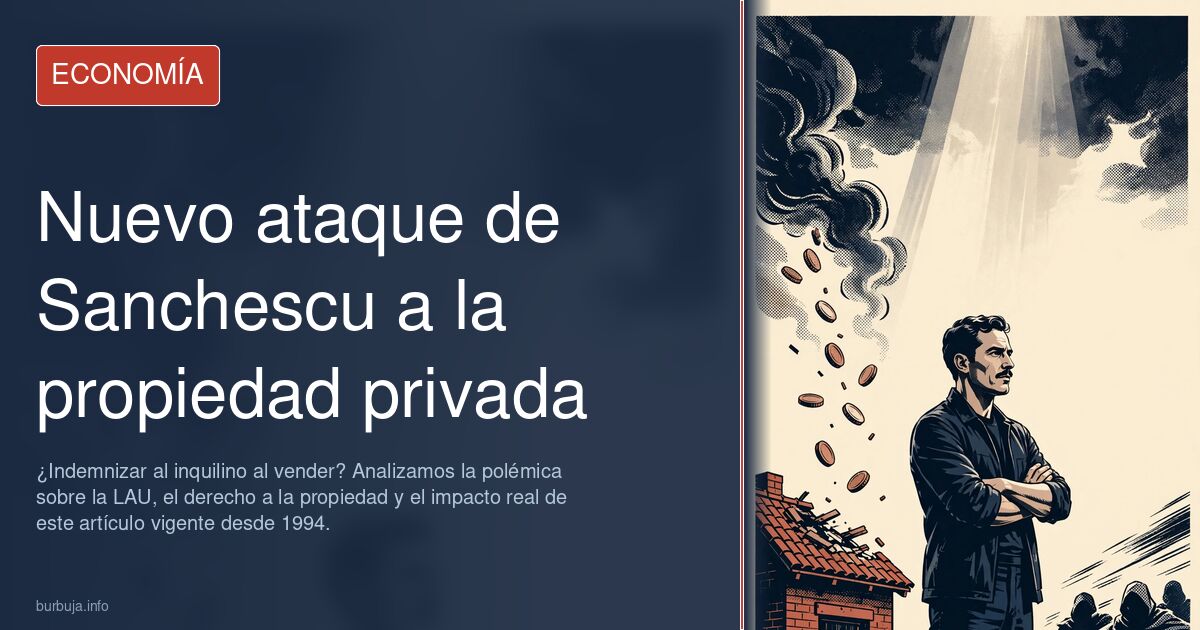
Spain: new attack on private property by Sanchescu
The debate over Spain's Urban Lease Act (Ley de Arrendamientos Urbanos, the country's rental law) is heating up again in the forum after the obligation to compensate tenants when a property is sold resurfaced. Are we looking at a new squeeze on small property owners, or is it simply long-standing civil law being misread by public opinion?
What's at stake
What forum users are saying about Spain's new attack on private property
Why this thread won't leave you indifferent
Beyond politics, the thread lays bare the real antiestéticar of the small Spanish saver: that their only asset, "bricks and mortar," becomes a toxic asset managed by the BOE (Spain's Official State Gazette). If you want to understand how the ground is shifting under property owners' feet, this is the place where the cracks in the system are being analyzed.
This summary is just the surface. The full thread has 73 replies with data, sources, analysis and the unfiltered debate — registered users only. Create your free account in 30 seconds and join the debate.
Disclaimer: This content is for informational and discussion purposes only. It does not constitute financial, legal or real estate advice. Always consult a licensed professional before making decisions about your properties or investments.
Related discussions in the forum
The debate over Spain's Urban Lease Act (Ley de Arrendamientos Urbanos, the country's rental law) is heating up again in the forum after the obligation to compensate tenants when a property is sold resurfaced. Are we looking at a new squeeze on small property owners, or is it simply long-standing civil law being misread by public opinion?
What's at stake
- The core of the debate: The rule requiring the tenant to be financially compensated if the owner sells the property and the new owner decides to terminate the lease. The controversy arises from mixing the legal reality with the current climate of legal uncertainty.
- The fault line: The head-on clash between those who see an assault on the freedom to dispose of a real estate asset and those who argue that a contract is a contract and must be honored, regardless of who holds title.
- The detail nobody expected: The revelation that Article 14 of the LAU has been in force since 1994. The debate has turned into a war of words over the difference between "private property" and "personal property," with veteran users pointing out that the real problem is not the law itself but the extension of forced tenancy periods that turn it into a "trap."
What forum users are saying about Spain's new attack on private property
Position A (the pragmatists): They argue there is no traumatic legislative novelty. They maintain that civil law has always protected tenant stability and that being outraged at paying compensation for unilaterally breaking an agreement means not understanding how contracts work in any other sector of the economy.
Position B (the critical/bubble-watchers): They point out that the law is a double-edged sword. They argue that in a country where non-payment is commonplace and justice is slow, any additional obstacle for the owner only makes the housing supply disappear or shift toward short-term rentals, driving up the market even further.
Position C (the ideological debate): The thread has turned into a full-blown battle over the legitimacy of property. Some users, appealing to classic theories, try to distinguish between "personal" and "private" property to justify restrictions, which has drawn forceful responses from those who see in this language an attempt to whitewash state intervention and disguised expropriation.
Why this thread won't leave you indifferent
Beyond politics, the thread lays bare the real antiestéticar of the small Spanish saver: that their only asset, "bricks and mortar," becomes a toxic asset managed by the BOE (Spain's Official State Gazette). If you want to understand how the ground is shifting under property owners' feet, this is the place where the cracks in the system are being analyzed.
This summary is just the surface. The full thread has 73 replies with data, sources, analysis and the unfiltered debate — registered users only. Create your free account in 30 seconds and join the debate.
Disclaimer: This content is for informational and discussion purposes only. It does not constitute financial, legal or real estate advice. Always consult a licensed professional before making decisions about your properties or investments.
Related discussions in the forum
- Madrillín to introduce 50 to 100 driverless taxis starting in December · 11 replies
- Zapatero "concerned" about his daughters' likely indictment in the Plus Ultra affair · 54 replies
- Aznar on the 11M bombings: "It was Segarro, supervised by France and the USA, and we couldn't say where it was going because that would miccionan declaring war on Segarro" · 101 replies
- All hell is breaking loose in Tehran · 79436 replies
Also available in: Deutsch
Summary of a discussion on Burbuja.info - Foro de economía, actualidad y política., translated from Spanish and reviewed before publication. Read the full discussion (72 replies).
More summaries
-
Irene Montero’s expropriation threat sparks debate over private property rights
Burbuja.info analyzes Irene Montero’s proposal to seize empty homes, questioning if it ensures social justice or attacks private property rights.
-
Maricarmen decree: expropriate homes from tenants over 70
Sumar's draft decree would let authorities expropriate a home if the tenant is over 70. The industry warns: fewer rentals for older people.
-
What exactly do Spain's far-right forum users want?
A thread on Burbuja.info, Spain's leading economic forum, pits users against each other over the right's goals. Remigration? Privatizations? Data and mutual accusations fly.
-
Consumption and hedonism: the economy numbing Spain's decline
Full terraces and rising GDP alongside depression and unsustainable debt. A diagnosis of a society consuming its own freedom.
-
BUSTED!!! | CAUGHT!!!
Spain's UDEF police unit links Zapatero to a money laundering network following a US HSI investigation. Analysis of the financial flows and the Plus Ultra scheme.
-
They come to contribute, sure they do. What a drain.
A caregiver prefers €900 in cash-in-hand to a legal contract. This is the vicious cycle of benefits, remittances and precariousness that drains Spain's economy.