
Virtual payment terminals in Spain: fees from 0.5% to 0.95%
Virtual card terminals in Spain charge between 0.5% and 0.95%, with banks rejecting risky businesses and contract clauses that shift fraud costs onto the merchant.
English · Original discussion in Spanish · Published
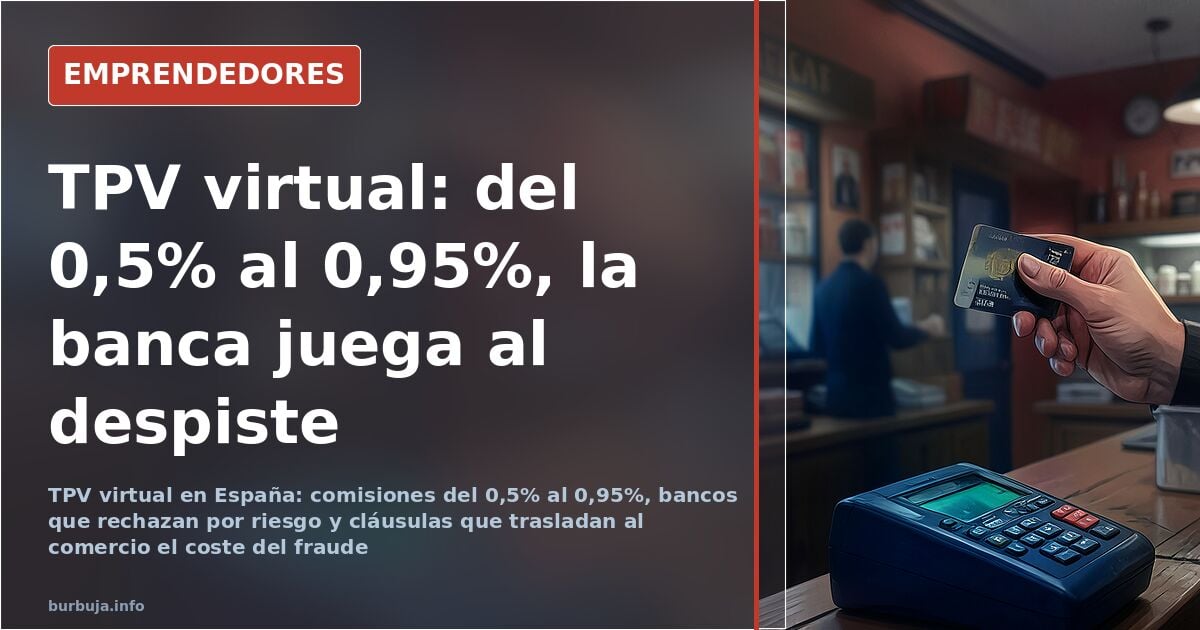
Virtual payment terminals: fees from 0.5% to 0.95% depending on the bank
Getting a payment gateway for an online store in Spain remains, as of this discussion, an obstacle course settled somewhere between 0.5% and 0.95% per transaction. An entrepreneur in the precious metals investment sector found this out first-hand: BBVA rejected his virtual terminal because of the "a priori risk" that, according to the bank, his products posed, even though he argued the risks were "minimal and controlled." The paradox is that the bank shutting its door on him is the same one several customers are fleeing over the quality of its platform. "Run away from BBVA's terminal like the plague," one veteran sums up.
The problem isn't just the fee. Business margins are thin and every percentage point eats into profit. With PayPal, whose cost is around 3% plus 0.35 euros per transaction, the only way out is to pass it on to the buyer. And there's a second front: for products with fluctuating prices, the sale is irrevocable by law, but a gateway can freeze the payment for 30 to 40 days. The seller has the legal right. He does. Getting paid is another matter.
Which banks approve virtual payment terminals, and on what terms
The round of branch visits described by the entrepreneur —Caixa, Bankia, Barclays, Banesto, Cajamar, Santander, Sabadell— paints an uneven map. Cajamar comes out well in several accounts: no upfront costs, no need to be an existing customer, a 0.75% fee with a 0.35 euro minimum, and the option to renegotiate down to 0.65% once a certain volume is reached. The technical support, however, took "1 or 2 days" to answer each query. Sabadell offers 0.60 euros per transaction with a minimum of 20 monthly transactions or 4,000 euros, free transfers and two cards included; from the second year, 35 euros for a phone-based legal service tied to the account. Santander deposits the money the next business day. ING requires six months as a customer and a business account, charges 0.5% per transaction and 20 euros in maintenance fees if monthly deposits fall below 500 euros. Triodos sits at 0.50% with no maintenance fees.
There's a recurring pattern: small banks and those fighting to win customers are the ones that put up the fewest obstacles. Catalunya Caixa comes across as a reasonable entry point to get started and later switch to a bank with better terms. In general, funds are credited within 24-48 hours. There are no long holdbacks as collateral, except for occasional deposits some banks require depending on the risk profile.
The fine print almost nobody reads: the merchant pays for fraud
Here's the fact that throws everything off. Several virtual terminal contracts, Bankia's among them, include a clause that shifts final liability to the business in case of fraud. The bank provides the platform, doesn't guarantee 100% detection and, if there's a fraudulent charge, the merchant loses the goods and has to refund the money on top. That's the argument of those who claim the virtual terminal, as currently set up, is not a valid payment method for online sales.
The other open front is PayPal. The majority view sees it as a useful stopgap to get started while fighting for a terminal, with one condition: offering it only to registered, known or phone-verified customers, without integrating it into the website or opening it to international payments. The opposing stance is harsher: "I feel completely unprotected as a seller," sums up someone who runs the numbers and loses money on every transaction. The fixed 0.35 euro fee per transaction turns small sales into a rip-off.
From paper to server: the technical odyssey
Once the terminal is approved, it still has to be set up. Spain's two dominant providers, Sermepa and Ceca, have "pretty poor" technical support when unusual issues arise, according to someone who has worked with both. The advice that keeps coming up: prioritize the financial terms, set up the gateway, run the tests in the test environment and forget about it. Maintenance is minimal unless the provider changes any integration details.
The entrepreneur who started this thread ended his particular via crucis with a bittersweet ending: Banco de Valencia, with the 4B gateway, said yes. "I don't understand why banks make it so hard," he wrote. Anyone who has read the fraud clause has the answer.
The money arrives in 24-48 hours. The risk, on the other hand, stays at home. The stalemate remains.
Also available in: Deutsch
Summary of a discussion on Burbuja.info - Foro de economía, actualidad y política., translated from Spanish and reviewed before publication. Read the full discussion (39 replies).
More summaries
-
Preico Jurídicos: The business of suing banks over usury
Filing a revolving credit usury claim costs about €200 plus a cut of the winnings. The 'Gran Preicano' boasts 60,000 active lawsuits.
-
Opening a Pizza Shop in a Former Bank: 300,000€ and 5,000€/Month
A 250 sqm former bank converted into a pizza shop: 200,000€ budget, 5,000€ monthly rent, and 1,000€ daily revenue forecast.
-
PayPal freezes €1,852 for 180 days without explanation
A long-time PayPal user had their account closed with €1,852 inside and faced a 180-day wait without any clear reason.
-
Christian Bresser: another young Spaniard proving how mediocre you are
Analysis of the debate on Christian Bresser in Burbuja.info: legitimate entrepreneurship or digital smoke selling? Discover the key points of the thread here.
-
RETA gateway: the pension hole Spain saw coming
Professionals who paid reduced dues to alternative mutual societies want to switch to Spain's RETA self-employed scheme with identical rights. The Government is set to allow it. Who foots the bill?
-
Sol, Terra or Astra: which AI is cheapest for coding
AI coding plans range from 20 to 100 euros a month: a 20-dollar subscription delivers 45 to 75 minutes of intensive work per day.