
PayPal freezes €1,852 for 180 days without explanation
A long-time PayPal user had their account closed with €1,852 inside and faced a 180-day wait without any clear reason.
English · Original discussion in Spanish · Published
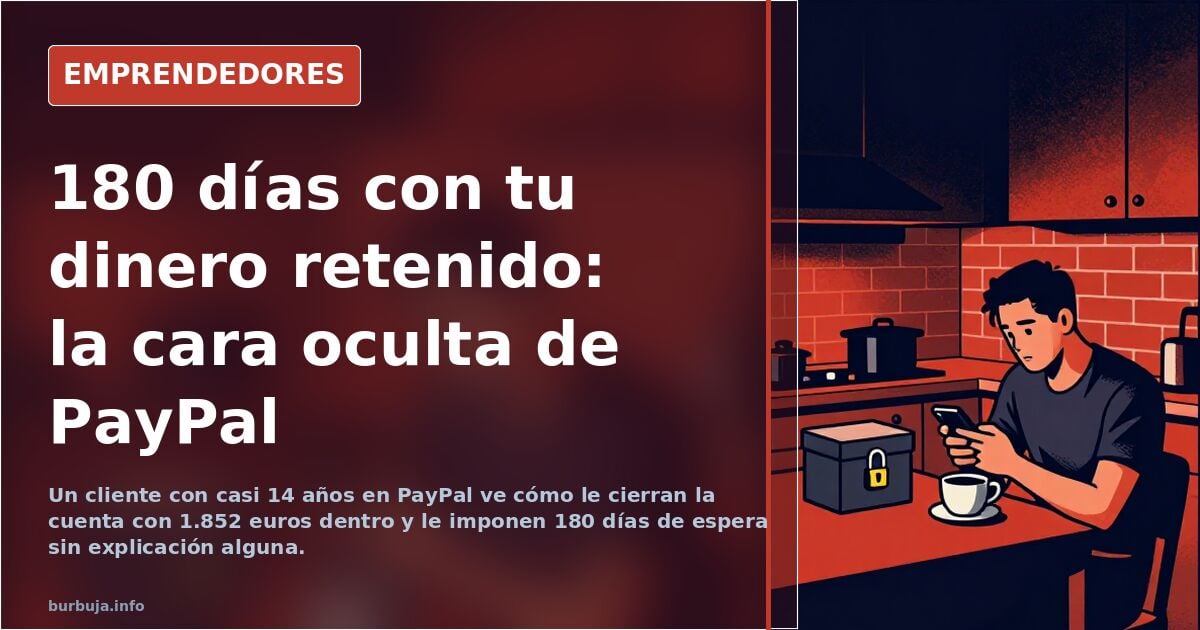
PayPal freezes €1,852 for 180 days without explanation
What happens to your money when PayPal decides to close your account? Officially, there is a timeframe: 180 days. This was the wall hit by a customer with nearly 14 years of history on the platform who, after submitting ID, driver's license, and transfer receipts, had their account closed with €1,852 inside. The affected user claims they received no specific explanation regarding the reason for the closure.
The user recorded the conversation with support and shared it publicly. They also sent a dossier to the police, press, and consumer associations. What they describe does not seem like an isolated incident, but rather a sequence that repeats with clockwork precision: account limitation, request for documentation, closure, and balance blockage for six months.
Why PayPal is not a bank, even though it acts like one
Here lies the root of the problem, which many people overlook. PayPal is not a credit institution with the supervisory umbrella that protects bank deposits. It is a payment institution. When the balance is retained, there is no guarantee fund to respond or a banking supervisor to rely on easily. Those who tried to complain to the Banco de España (Spain's central bank), according to this account, remained in the same situation.
The detail that most angers analysts is economic. The 180 days are not buyer protection, but, as argued in discussions, a fixed period that leaves other people's money idle in the company's account. "The 180 days granted to buyers to claim are clearly disproportionate —it is argued— but rather to make money by investing the positive balances they retain." This is the float theory proposed by some participants: using the retained balance as free financing while the user waits.
How much money is at stake and what cases repeat
The scale is surprising. Alongside the case of €1,852 appear others much larger: an account with €90,000 under audit, of which €75,000 were frozen for six months after attempting to transfer €15,000 to a bank. There are also small balances, such as the €420 of a user who only bought clothes online and whose money came from refunds.
There is a documented pattern with a name in the sector: in Spain, more than 100,000 users were reportedly affected by a previous episode involving cards, with collective complaints and sanctions from the Banco de España involved. Cases of online stores, an online pharmacy, crowdfunding for an encrypted mail platform, and even train tickets purchased but never issued are also mentioned.
What to do when your balance is withheld: the route that works
According to shared cases, the most effective outcome does not come through phone calls, but through legal channels. The best-resolved case was settled with a burofax (certified legal letter): "Called lawyers in Madrid specializing in tech cases, sent a couple of burofaxes, and within three days my account was peine, including telephone apologies." When the withheld amount is small, the judicial route is not worth it, according to the affected user; when it is large, the company tends to act before facing a judge.
There is also a method described by an affected user as little known. If the payer uses their linked bank account rather than their PayPal balance, that transaction has a 54-day window to be reversed via bank transfer and recover the funds to the source account. This is the only path that, according to a user explaining it in the thread, would allow recovering funds without waiting six months.
Withdrawing balance quickly: advice repeated by veterans
The most repeated recommendation is common sense: do not leave money in the account. "PayPal is not a bank, you must try to move money quickly to your bank account." The problem is that those who cannot do so due to an active hold are left without options. Some add a worrying nuance: the platform, according to this version, does not report charges to tax authorities, so the retention has nothing to do with taxes. It is data collection, not a tax obligation, according to this same view.
As alternatives, gateways with slightly lower fees and no prior verification appear. Their Achilles heel, according to a user describing them, is another: by not securing sign-ups, they may attract those testing stolen cards. E-commerce, after all, with its rules and holes.
The deadlock of a service almost no one can do without
The underlying complaint is not just economic, but about asymmetry. According to accounts, there is no named interlocutor making decisions, no superior to escalate to, and no letter explaining why. For a small online seller, giving up the payment button could miccionan losing half of sales, says a participant. For those who only pay for servers and domains, it is a nuisance that becomes a nightmare.
The figures remain, the audios remain recorded, and affected users keep telling the same story. Someone, on some server, keeps pressing, according to this description, the button that says "send for review." And in six months' time, we will see.
Also available in: Deutsch
Summary of a discussion on Burbuja.info - Foro de economía, actualidad y política., translated from Spanish and reviewed before publication. Read the full discussion (119 replies).
More summaries
-
Twelve Years of Latin, Zero Lessons on How Money Works
12 to 16 years in the classroom isn't enough to learn about investing. The training that promises to fill this gap starts at €35,000.
-
Preico Jurídicos: The business of suing banks over usury
Filing a revolving credit usury claim costs about €200 plus a cut of the winnings. The 'Gran Preicano' boasts 60,000 active lawsuits.
-
RETA gateway: the pension hole Spain saw coming
Professionals who paid reduced dues to alternative mutual societies want to switch to Spain's RETA self-employed scheme with identical rights. The Government is set to allow it. Who foots the bill?
-
Sol, Terra or Astra: which AI is cheapest for coding
AI coding plans range from 20 to 100 euros a month: a 20-dollar subscription delivers 45 to 75 minutes of intensive work per day.
-
Virtual payment terminals in Spain: fees from 0.5% to 0.95%
Virtual card terminals in Spain charge between 0.5% and 0.95%, with banks rejecting risky businesses and contract clauses that shift fraud costs onto the merchant.
-
Self-employed in Spain: the €254 monthly fee debate and the UK route
An entrepreneur asks what happens if he doesn't pay Spain's €254 self-employed contribution; the thread drifts into setting up UK companies and doubts about…