
Viral video uses kinesiology to decide what to eat
A video circulating on social media shows a supposed kinesiology test to decide what to eat. The scene, shared with a mocking tone, has sparked ridicule and debate.
English · Original discussion in Spanish · Published
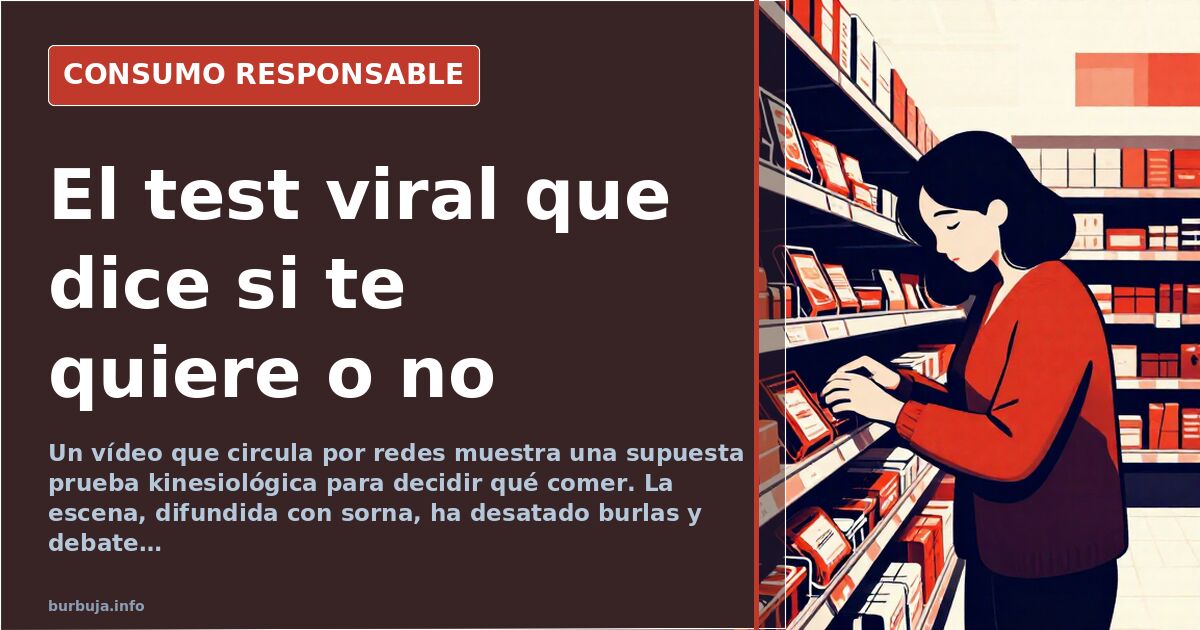
The viral test that decides whether it loves you or not
A video circulating on social media shows a woman applying a supposed kinesiology test to find out whether a food agrees with her or not. The gesture is simple: if the body leans forward, the product is fine; if it leans backward, it gets rejected. The scene, shared with a mocking tone and presented as a possible contender for viral content awards, has been enough to trigger a discussion about something more serious than the video itself: the drift of certain responsible consumption narratives toward the esoteric.
What the kinesiology test circulating online claims
The technique shown in the video rests on the idea that the body responds with involuntary movement to external stimuli. Applied to shopping, it would replace reading labels with a kind of muscular compass. The result is a scene that swings between the comic and the worrying: a person deciding what to put in the cart based on which way they lean.
The prevailing reaction has been mockery. The method has been compared to a dowser searching for water with a rod, and it has been pointed out that the scene is just the latest reinvention of old superstitions in modern packaging. Hundreds of thousands of years of evolution, some joke, have led to this: picking canned sardines with an arm tug.
From responsible consumption to magical thinking
The episode is not an isolated one. In recent times, the discourse on healthy eating has been incorporating layers of mysticism that have little to do with nutrition. First came miracle diets; then superfoods; now, the supposed wisdom of the body as an oracle. The novelty is that no guru is needed anymore: just record yourself and upload it.
Some argue that this kind of content should not be taken as a joke, because it normalizes purchasing decisions based on criteria with no scientific basis. On the opposite side, the argument goes that the video is a parody or, at worst, a harmless frivolity. The underlying problem is a different one: the growing difficulty of telling apart informative content, disguised advertising and pure spectacle.
Why the video worked as a meme
The clip has worked because it condenses a real tension. On one hand, the social pressure to consume responsibly; on the other, the absence of clear tools for doing so. Into that gap creep the shortcuts. And a shortcut, once it becomes a spectacle, gets shared.
The scene has also served to reopen a classic debate: that of individual responsibility versus the information available. If labeling is confusing, if advertising deceives and if experts contradict one another, consumers end up looking for signals where there are none. Kinesiology applied to the shopping cart is, in that sense, a symptom.
The detail that went unnoticed
While the discussion focused on whether the method has any basis, the most striking detail went almost unnoticed: the woman in the video never cracks so much as half a smile. She treats her audience with a mix of disdain and absolute certainty. And yet, the content gets shared. The question is no longer whether the test works. It is why we keep watching.
Also available in: Deutsch
Summary of a discussion on Burbuja.info - Foro de economía, actualidad y política., translated from Spanish and reviewed before publication. Read the full discussion (17 replies).
More summaries
-
Indoor LED Grow: €38 Electricity for 200g Yield
A 120W LED lamp adds €38 to electricity bills per cycle, yielding 200g of dry flower quarterly, according to amateur calculations.
-
Spain's shower timer cuts water when time runs out
A Spanish utility model shower valve closes automatically after a set time, targeting the 12% of national water use attributed to households by INE.
-
Spain: Debate on responsible spending after €986 phone purchase
In Spain, a €986 smartphone sparks debate on responsible consumption versus high-end alternatives costing €180 or €320.
-
Corberó: fridges last decades, washers fail in days
Users report Corberó fridges lasting 20 years while washers fail quickly. The Spanish brand faces a reputation crisis.
-
Responsible consumption: the debate over jail as a resort
Irresponsible drug use can lead to prison, yet some idealize jail as a resort. A drug trafficking case in Colombia shows the harsh reality.
-
The watch that cost a backpacker his freedom in Thailand
An 18-year-old New Zealand backpacker was arrested in Thailand for picking up a watch left behind at airport security. Thai law shows no mercy for such mistakes.