
Spain's shower timer cuts water when time runs out
A Spanish utility model shower valve closes automatically after a set time, targeting the 12% of national water use attributed to households by INE.
English · Original discussion in Spanish · Published
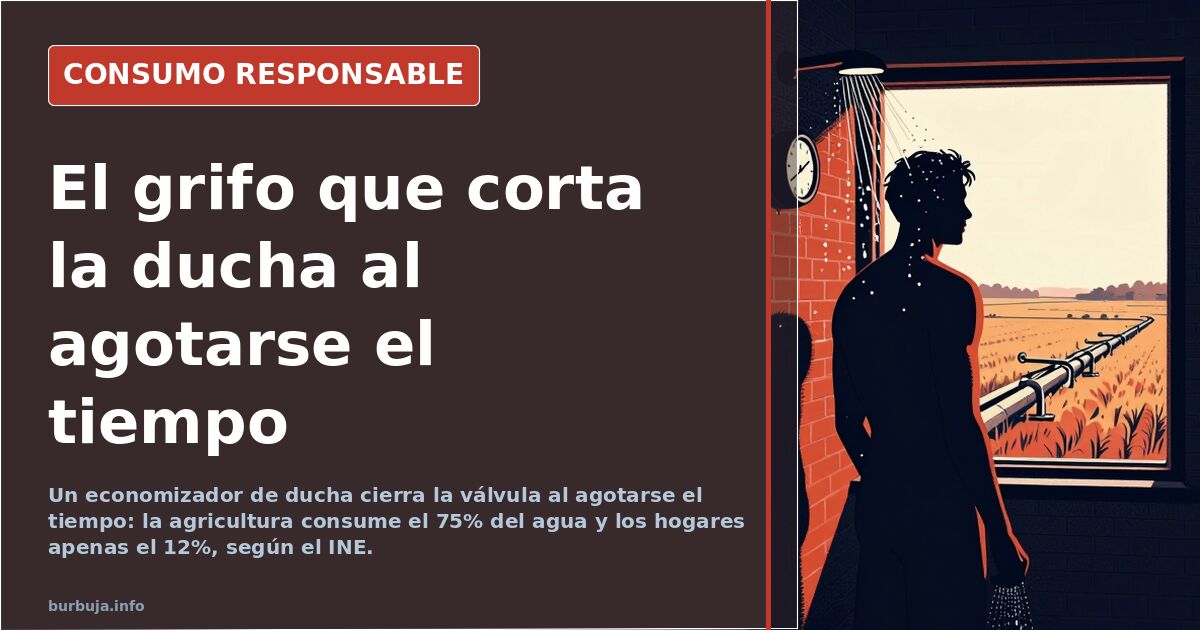
The self-closing tap: timed showers and other things
Hot water at home is often poorly managed, but a timer could help curb waste. Based on this premise, a shower economizer has been registered as a utility model that stops the flow when the programmed time expires: once the counter reaches zero, an internal valve shuts off the supply, rendering the shower unusable for several minutes in an attempt to force users to finish soaping up. The company highlights a striking figure: teenagers' showers drop from 30 minutes to 8. However, the nuance appears when examining actual water consumption distribution in Spain.
What exactly does the shower economizer do?
The device, marketed as Acqua Tempus, displays remaining minutes and seconds on a screen. Twenty seconds before the end, it begins flashing lights; ten seconds remain, the display blinks, allowing reaction time. It does not operate with coins: the cutoff is purely temporal, and once activated, the shower remains inactive for a specific period before resuming water flow. The shutdown affects the entire supply, meaning it also turns off the boiler. The company claims its utility model registration protects against imitations and states it already holds three client reservations.
Why the market focuses on hotels and tourist apartments
Distributors target hotels, hostels, campsites, sports centers, gyms, and holiday rentals: facilities where the person showering isn't always the one paying the bill. Resistance arises elsewhere. Some clients view the shower as part of the service, finding a time limit in their room sufficient reason not to return. Arguments hinge on cost: with water priced at around 2 euros per cubic meter according to forum users, seeing a restricted shower in a high-end hotel causes more indignation than savings.
Against punitive limits, another line of analysis favors incentives: some argue that outside Spain, certain chains compensate guests who skip daily cleaning with discounts, breakfasts, or minibar access. Memories persist of campsites where showers required coins, a model the manufacturer explicitly distances itself from.
How much water does a shorter shower actually save?
Here, the narrative cracks. INE data cited places agriculture's share of water consumption at 75%, while households account for only 12%. The company disputes this, raising household usage to 25% by including hotels, gyms, and campsites. Contrast this with food production: one kilogram of beef requires 15,000 liters. Given this context, some analysts conclude that domestic savings, though real, are marginal nationally.
An unanswered question remains: how much electricity does the device itself consume if installed permanently, as recommended by the company to amortize investment?
The problem no timer solves
Cutting the tap doesn't resolve waiting for hot water. In installations with distant heaters, this forces pouring several liters down the drain before use. The solution isn't a time limit but recirculation equipment: AcquaReturn, manufactured in Alicante, returns water until it reaches usable temperature. Others manually collect waiting water—up to one and a half buckets—for reuse in toilets. An extreme case exists at a southern German campsite offering three minutes of hot water and three mandatory wait minutes to recover heat.
Hangovers, injuries, and chained showers
The second front is domestic and defies statistics. Some days, showering isn't hygiene but decompression: post-exercise, with sprains slowing movement, or simply reluctance to leave the water. Defenders say checking the display manages time well; critics argue homes shouldn't cap those paying gas and water bills. Similar debates arise when multiple showers trinc consecutively, each leaving less margin for the next.
With these elements, expect the economizer to find niches in campsites, hostels, and gyms where users don't pay costs, yet struggle in home bathrooms and mid-priced hotels where guests compare room rates against closed taps. Predictions remain cautious: while cubic meters stay cheap and tourist indignation doesn't translate into measured savings, the device will likely serve more as a sustainability brochure argument than a permanently installed object. Though it already has three reservations.
Hot water at home is often poorly managed, but a timer could help curb waste. Based on this premise, a shower economizer has been registered as a utility model that stops the flow when the programmed time expires: once the counter reaches zero, an internal valve shuts off the supply, rendering the shower unusable for several minutes in an attempt to force users to finish soaping up. The company highlights a striking figure: teenagers' showers drop from 30 minutes to 8. However, the nuance appears when examining actual water consumption distribution in Spain.
What exactly does the shower economizer do?
The device, marketed as Acqua Tempus, displays remaining minutes and seconds on a screen. Twenty seconds before the end, it begins flashing lights; ten seconds remain, the display blinks, allowing reaction time. It does not operate with coins: the cutoff is purely temporal, and once activated, the shower remains inactive for a specific period before resuming water flow. The shutdown affects the entire supply, meaning it also turns off the boiler. The company claims its utility model registration protects against imitations and states it already holds three client reservations.
Why the market focuses on hotels and tourist apartments
Distributors target hotels, hostels, campsites, sports centers, gyms, and holiday rentals: facilities where the person showering isn't always the one paying the bill. Resistance arises elsewhere. Some clients view the shower as part of the service, finding a time limit in their room sufficient reason not to return. Arguments hinge on cost: with water priced at around 2 euros per cubic meter according to forum users, seeing a restricted shower in a high-end hotel causes more indignation than savings.
Against punitive limits, another line of analysis favors incentives: some argue that outside Spain, certain chains compensate guests who skip daily cleaning with discounts, breakfasts, or minibar access. Memories persist of campsites where showers required coins, a model the manufacturer explicitly distances itself from.
How much water does a shorter shower actually save?
Here, the narrative cracks. INE data cited places agriculture's share of water consumption at 75%, while households account for only 12%. The company disputes this, raising household usage to 25% by including hotels, gyms, and campsites. Contrast this with food production: one kilogram of beef requires 15,000 liters. Given this context, some analysts conclude that domestic savings, though real, are marginal nationally.
An unanswered question remains: how much electricity does the device itself consume if installed permanently, as recommended by the company to amortize investment?
The problem no timer solves
Cutting the tap doesn't resolve waiting for hot water. In installations with distant heaters, this forces pouring several liters down the drain before use. The solution isn't a time limit but recirculation equipment: AcquaReturn, manufactured in Alicante, returns water until it reaches usable temperature. Others manually collect waiting water—up to one and a half buckets—for reuse in toilets. An extreme case exists at a southern German campsite offering three minutes of hot water and three mandatory wait minutes to recover heat.
Hangovers, injuries, and chained showers
The second front is domestic and defies statistics. Some days, showering isn't hygiene but decompression: post-exercise, with sprains slowing movement, or simply reluctance to leave the water. Defenders say checking the display manages time well; critics argue homes shouldn't cap those paying gas and water bills. Similar debates arise when multiple showers trinc consecutively, each leaving less margin for the next.
With these elements, expect the economizer to find niches in campsites, hostels, and gyms where users don't pay costs, yet struggle in home bathrooms and mid-priced hotels where guests compare room rates against closed taps. Predictions remain cautious: while cubic meters stay cheap and tourist indignation doesn't translate into measured savings, the device will likely serve more as a sustainability brochure argument than a permanently installed object. Though it already has three reservations.
Also available in: Deutsch
Summary of a discussion on Burbuja.info - Foro de economía, actualidad y política., translated from Spanish and reviewed before publication. Read the full discussion (131 replies).
More summaries
-
Two old cars for 350€ a year: a forum user’s thesis
A forum user argues that a devalued second car costs 350€ annually for insurance, oil, and inspection, but unexpected repairs drive up the real bill.
-
Indoor LED Grow: €38 Electricity for 200g Yield
A 120W LED lamp adds €38 to electricity bills per cycle, yielding 200g of dry flower quarterly, according to amateur calculations.
-
Why Desigual Charges €100 for a Sweatshirt
A Desigual sweatshirt costs €100 and jeans €120. For many users, the price is set by the label and brand, not the fabric.
-
Spanish Medieval Markets: Inflated Prices and Fake Crafts
35 euros for tiny octopus, stalls costing up to 6,000 euros, and goods from Cobo Calleja. An economic look at Spain's medieval markets.
-
Brita Pitcher: Saving or Scam? Water Filter Costs
Is a Brita pitcher cheaper than bottled water? We analyze real costs, effectiveness, and myths like sodium levels.
-
Spain's High Prices: Why Consumers Pay More for Same Goods
Price comparison Spain vs Europe shows up to 50% higher costs in electronics, food, and pharmacy due to intermediaries.