
Viral video of Chinese restaurant owner sparks impunity debate in Spain
A customer refuses to pay for a beer in a Spanish Chinese restaurant, leading to a confrontation. The year-old clip reignites discussions on shopkeeper rights and legal protection.
English · Original discussion in Spanish · Published
Viral video reignites debate on impunity in bars
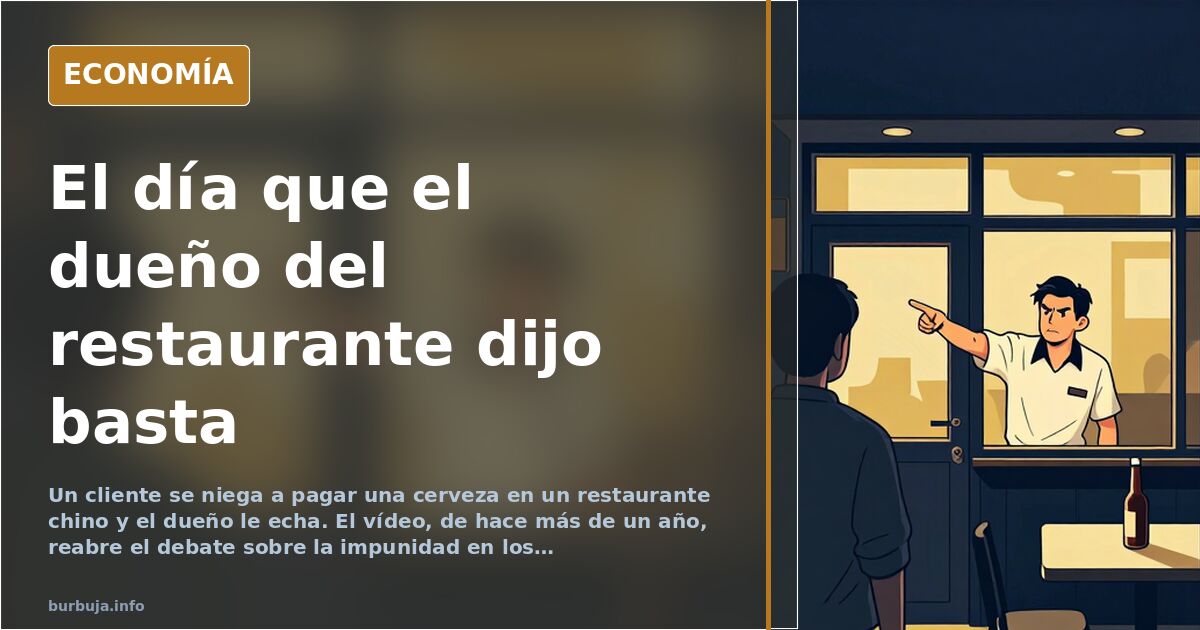
A customer enters a Chinese restaurant, orders a beer, and refuses to pay. The owner points him toward the door. The establishment's response—and the subsequent scuffle—has become one of the most discussed clips in recent months. Although over a year old, it continues to generate engagement: 124 replies in a single thread. The video is not new, but the debate it sparked remains alive: what margin does a business owner have to defend themselves when a customer refuses to pay?
The scene, recorded in a Chinese food restaurant, shows a man demanding a beer without paying. The proprietor indicates he must pay first and invites him to leave. What trinc—a struggle involving a bald mediator and the female owner throwing a blunt object—has triggered all kinds of reactions. The video is more than a year old, but its periodic circulation reactivates the same question: why can some establishments defend themselves while others cannot?
The defending shopkeeper: self-defense or excess?
The clip shows a sequence many hospitality workers recognize as common: a customer who consumes with no intention of paying, an owner who demands payment, and an escalation ending in a struggle. In the video, the Chinese restaurant owner does not hesitate: he points to the door and, when the customer insists, responds firmly. The female owner also intervenes, throwing an object that hits the aggressor, which some interpret as an act of self-defense and others as excessive force.
Some argue the owner's response was proportionate: he simply defended his business and himself. Against this is the argument that violence is never the solution, although the video shows the customer was the first to cross the line. The debate is on.
Double standards: what if the owner were Spanish?
One of the most repeated currents in the discussion points to alleged differences in treatment based on the owner's origin. It is argued that if the bar owner were Spanish, the customer's reaction would have had different consequences. The video shows a hospitality worker of Chinese origin defending himself without apparent repercussions, which some interpret as proof that justice acts unevenly.
Other participants reject this reading, arguing the owner's reaction was simply that of someone refusing to be humiliated. The discussion moves to broader grounds: the sense of impunity among certain customers, the pressure small businesses face, and the lack of legal tools to handle such situations.
The woman's role in the video: bystander or protagonist?
A detail that has drawn attention is the intervention of the restaurant owner's vvife. Initially, some thought she would side with the aggressor; however, she ends up throwing a blunt object at the customer. For some, this is a legitimate reaction; for others, it is merely a supporting role that doesn't change the final outcome.
The scene has also served to discuss women's roles in conflict situations. Some highlight that her intervention was decisive in ending the altercation; others minimize its importance, noting the struggle was already underway.
The bald mediator: the unexpected character
Among the video's protagonists appears a bald man trying to mediate the dispute. His intervention fails to prevent the scuffle and, in fact, he ends up getting involved too. The figure of the spontaneous mediator—that customer trying to separate parties without knowing either—has become one of the most commented elements.
The resulting discussion points to a broader issue: is a citizen obligated to intervene when witnessing an altercation? The law does not require it, but social pressure sometimes pushes them to do so. The result, in this case, was not the desired one.
Video age and selective memory
Several participants have noted the video is more than a year old. The exact date is unknown, but its periodic circulation indicates the topic remains interesting. The clip's repetition every so often suggests society hasn't solved the underlying problem: the sense of impunity among certain customers and the lack of protection for shopkeepers.
The debate has also drifted into migration policy and neighborhood coexistence. Some argue these episodes are exceptions; others consider them the norm. The discussion remains open.
Conclusion: prediction with reservations
Given these factors, it is likely the video will circulate again in a few months. The question is whether anything will have changed regarding shopkeeper protection by then, or if we will still be discussing the same issues. The Chinese restaurant owner's response has remained a symbol of resistance, but also a reminder that justice doesn't always arrive in time. Next time, the ending could be different.
A customer enters a Chinese restaurant, orders a beer, and refuses to pay. The owner points him toward the door. The establishment's response—and the subsequent scuffle—has become one of the most discussed clips in recent months. Although over a year old, it continues to generate engagement: 124 replies in a single thread. The video is not new, but the debate it sparked remains alive: what margin does a business owner have to defend themselves when a customer refuses to pay?
The scene, recorded in a Chinese food restaurant, shows a man demanding a beer without paying. The proprietor indicates he must pay first and invites him to leave. What trinc—a struggle involving a bald mediator and the female owner throwing a blunt object—has triggered all kinds of reactions. The video is more than a year old, but its periodic circulation reactivates the same question: why can some establishments defend themselves while others cannot?
The defending shopkeeper: self-defense or excess?
The clip shows a sequence many hospitality workers recognize as common: a customer who consumes with no intention of paying, an owner who demands payment, and an escalation ending in a struggle. In the video, the Chinese restaurant owner does not hesitate: he points to the door and, when the customer insists, responds firmly. The female owner also intervenes, throwing an object that hits the aggressor, which some interpret as an act of self-defense and others as excessive force.
Some argue the owner's response was proportionate: he simply defended his business and himself. Against this is the argument that violence is never the solution, although the video shows the customer was the first to cross the line. The debate is on.
Double standards: what if the owner were Spanish?
One of the most repeated currents in the discussion points to alleged differences in treatment based on the owner's origin. It is argued that if the bar owner were Spanish, the customer's reaction would have had different consequences. The video shows a hospitality worker of Chinese origin defending himself without apparent repercussions, which some interpret as proof that justice acts unevenly.
Other participants reject this reading, arguing the owner's reaction was simply that of someone refusing to be humiliated. The discussion moves to broader grounds: the sense of impunity among certain customers, the pressure small businesses face, and the lack of legal tools to handle such situations.
The woman's role in the video: bystander or protagonist?
A detail that has drawn attention is the intervention of the restaurant owner's vvife. Initially, some thought she would side with the aggressor; however, she ends up throwing a blunt object at the customer. For some, this is a legitimate reaction; for others, it is merely a supporting role that doesn't change the final outcome.
The scene has also served to discuss women's roles in conflict situations. Some highlight that her intervention was decisive in ending the altercation; others minimize its importance, noting the struggle was already underway.
The bald mediator: the unexpected character
Among the video's protagonists appears a bald man trying to mediate the dispute. His intervention fails to prevent the scuffle and, in fact, he ends up getting involved too. The figure of the spontaneous mediator—that customer trying to separate parties without knowing either—has become one of the most commented elements.
The resulting discussion points to a broader issue: is a citizen obligated to intervene when witnessing an altercation? The law does not require it, but social pressure sometimes pushes them to do so. The result, in this case, was not the desired one.
Video age and selective memory
Several participants have noted the video is more than a year old. The exact date is unknown, but its periodic circulation indicates the topic remains interesting. The clip's repetition every so often suggests society hasn't solved the underlying problem: the sense of impunity among certain customers and the lack of protection for shopkeepers.
The debate has also drifted into migration policy and neighborhood coexistence. Some argue these episodes are exceptions; others consider them the norm. The discussion remains open.
Conclusion: prediction with reservations
Given these factors, it is likely the video will circulate again in a few months. The question is whether anything will have changed regarding shopkeeper protection by then, or if we will still be discussing the same issues. The Chinese restaurant owner's response has remained a symbol of resistance, but also a reminder that justice doesn't always arrive in time. Next time, the ending could be different.
Summary of a discussion on Burbuja.info - Foro de economía, actualidad y política., translated from Spanish and reviewed before publication. Read the full discussion (124 replies).
More summaries
-
Chinese Restaurant’s Advance Payment Policy Sparks Discrimination Debate in Spain
A Chinese restaurant’s requirement for upfront payment in Spain sparks debate: is it risk management or ethnic discrimination?
-
Viral video lists ten refusals by Chinese youth
A viral video outlines ten renunciations by Chinese youth, citing high entry costs as the reason for withdrawing from societal expectations.
-
Viral Pantomima Full sketch mocks trendy Spanish restaurant owners
Pantomima Full's viral parody of 'scoundrel' restaurateurs leads Galician press to identify La Botica Club in A Coruña as the inspiration.
-
The decline of specialist forums: what does the economy lose?
Economic forums are losing their best analysts: from 700 active members to a wasteland of bots. Data, causes and consequences of a silent exodus.
-
Supermarket dining pressures Spain's hospitality sector
Tourism exceeds 12% of GDP and nears three million jobs, but restaurateurs report visitors eating at supermarkets and leaving terraces empty.
-
Sargassum crisis threatens Caribbean tourism billions
Massive sargassum influx invades Caribbean beaches, jeopardizing a multi-billion dollar industry. Hotels now rely on steep discounts to attract visitors.