
Sargassum crisis threatens Caribbean tourism billions
Massive sargassum influx invades Caribbean beaches, jeopardizing a multi-billion dollar industry. Hotels now rely on steep discounts to attract visitors.
English · Original discussion in Spanish · Published
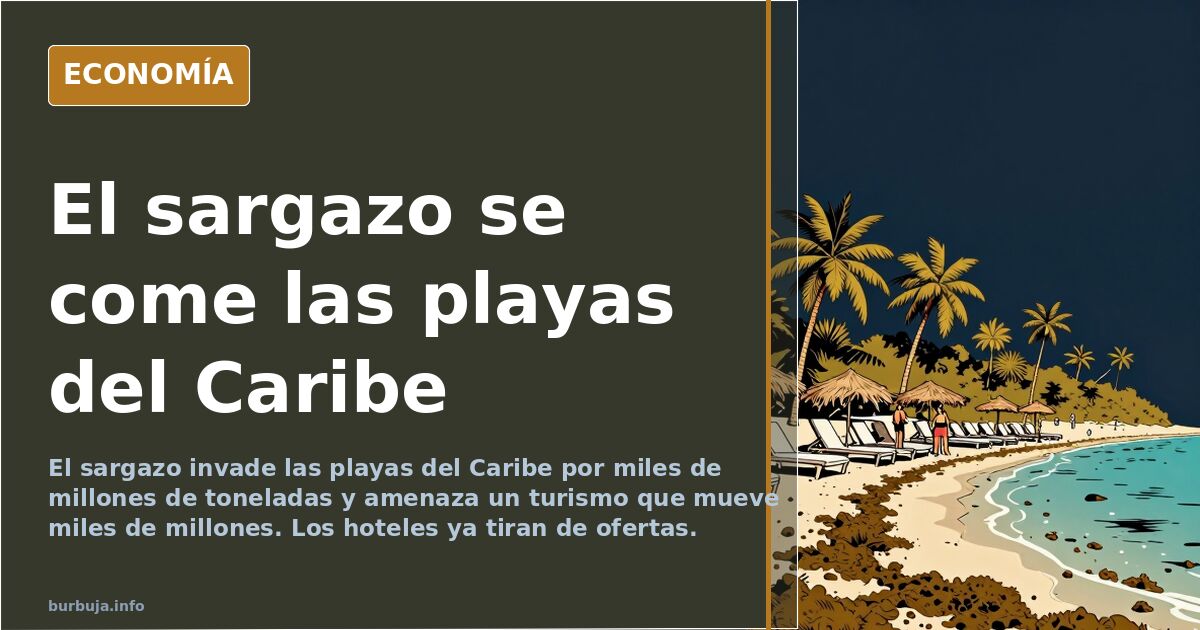
Sargassum consumes Caribbean beaches with no clear payer for the damage
A beach in Punta Rucia wakes up clean. Hours later, sargassum covers it entirely. This is not an anecdote: it is the new reality of a coastline that has marketed itself as paradise for half a century. For the last three or four years, a type of macroalgae that circulated within the North Atlantic for centuries has found a current pushing it directly into the Caribbean, arriving by the billions of tons without interruption.
The phenomenon has an old name and new geography. The classic "Sargasso Sea" occupied roughly the area of the Bermuda Triangle, giving rise to legends of drifting ships and missing crews. That was a trap for sailing vessels, not a tourist problem. The shift occurred when excess nutrients and rising water temperatures turned that mass into a factory exporting algae southward.
Why sargassum can no longer be cleaned as before
Hotels and municipalities used to handle sporadic sargassum with two or three days of cleanup. They removed the algae, the sand looked pristine again, and tourists got their selfies. That model broke due to scale: there is nowhere to put so many tons, nor budgets to cover collection, transport, and disposal. It is a dilemma: if costs are passed to tourists, the destination loses competitiveness; if they are absorbed, the sector faces bankruptcy.
This adds to the impact on bathers. The algae are slimy, unpleasant to touch, and turn clear water into floating waste. In Mexico, some areas let the material rot on the beach, bringing smells and insects, while seaside properties have lost significant value. In the Dominican Republic, a business has emerged where boats charge hotels to remove the algae.
Where does all this sargassum come from?
The most supported hypothesis points to deforestation in the Brazilian Amazon for soybean farming and massive nitrogen fertilizer use. Some of that nitrogen ends up via the Amazon River exactly where the new proliferation hotspot formed. With abundant food, sun, and suitable temperature, the algae found ideal conditions for unchecked growth. Some blame climate change and runoff, while others argue that stopping runoff would worsen things less, though not fix them.
The affected map is not uniform. The Bahamas, Cuba, Mexico, and the Dominican Republic bear the worst burden. Venezuela and Colombia fare much better, likely due to internal Caribbean current dynamics. On the southern Dominican coast, the Antillean atoll acts partly as a natural barrier. But the general trend is clear: a region once known for white sand and palm trees is being invaded further and further.
The algae business: subsidies, promises, and bad math
Where there is a problem, entrepreneurs appear. Projects promise algae fertilizer, cosmetics, bricks, biofuels, or barriers to stop coastal arrival. Some are well-intentioned; others survive on public funds or European green subsidies. The issue is arithmetic: sargassum is saltwater and fiber, not an oily raw material like algae studied for biofuel. And the scale overwhelms any imaginable processing plant.
The best parallel is dissolved gold in the sea. It exists, yes. But the energy needed to recover it makes it unviable. Sargassum is similar: possible uses exist, but none are economically self-sustaining. Making algae bricks would cost several times more than conventional ones, requiring factories capable of swallowing hundreds of millions of tons. No one has yet explained how to collect these algae from all affected coasts simultaneously.
Economic impact: discounts, bankruptcies, and a timeline of years
The sector already feels the blow. Where hotels had waiting lists, now various offers circulate. If demand falls beyond what discounts can stimulate, the next step is major chains withdrawing and small tourism-dependent businesses going bankrupt: bars, kiosks, guides, boat tours. This is not a process of days, but of years. The phenomenon worsened after 2021-2022, and its worst effects may appear in upcoming fiscal periods.
The uncomfortable conclusion is that mass tourism in the Caribbean may be hitting a ceiling, except for specific beaches spared by currents. And that nature, which we have tried to domesticate for decades, has decided to remind us who is in charge. Meanwhile, the algae keep arriving. Every day. Without interruption.
A beach in Punta Rucia wakes up clean. Hours later, sargassum covers it entirely. This is not an anecdote: it is the new reality of a coastline that has marketed itself as paradise for half a century. For the last three or four years, a type of macroalgae that circulated within the North Atlantic for centuries has found a current pushing it directly into the Caribbean, arriving by the billions of tons without interruption.
The phenomenon has an old name and new geography. The classic "Sargasso Sea" occupied roughly the area of the Bermuda Triangle, giving rise to legends of drifting ships and missing crews. That was a trap for sailing vessels, not a tourist problem. The shift occurred when excess nutrients and rising water temperatures turned that mass into a factory exporting algae southward.
Why sargassum can no longer be cleaned as before
Hotels and municipalities used to handle sporadic sargassum with two or three days of cleanup. They removed the algae, the sand looked pristine again, and tourists got their selfies. That model broke due to scale: there is nowhere to put so many tons, nor budgets to cover collection, transport, and disposal. It is a dilemma: if costs are passed to tourists, the destination loses competitiveness; if they are absorbed, the sector faces bankruptcy.
This adds to the impact on bathers. The algae are slimy, unpleasant to touch, and turn clear water into floating waste. In Mexico, some areas let the material rot on the beach, bringing smells and insects, while seaside properties have lost significant value. In the Dominican Republic, a business has emerged where boats charge hotels to remove the algae.
Where does all this sargassum come from?
The most supported hypothesis points to deforestation in the Brazilian Amazon for soybean farming and massive nitrogen fertilizer use. Some of that nitrogen ends up via the Amazon River exactly where the new proliferation hotspot formed. With abundant food, sun, and suitable temperature, the algae found ideal conditions for unchecked growth. Some blame climate change and runoff, while others argue that stopping runoff would worsen things less, though not fix them.
The affected map is not uniform. The Bahamas, Cuba, Mexico, and the Dominican Republic bear the worst burden. Venezuela and Colombia fare much better, likely due to internal Caribbean current dynamics. On the southern Dominican coast, the Antillean atoll acts partly as a natural barrier. But the general trend is clear: a region once known for white sand and palm trees is being invaded further and further.
The algae business: subsidies, promises, and bad math
Where there is a problem, entrepreneurs appear. Projects promise algae fertilizer, cosmetics, bricks, biofuels, or barriers to stop coastal arrival. Some are well-intentioned; others survive on public funds or European green subsidies. The issue is arithmetic: sargassum is saltwater and fiber, not an oily raw material like algae studied for biofuel. And the scale overwhelms any imaginable processing plant.
The best parallel is dissolved gold in the sea. It exists, yes. But the energy needed to recover it makes it unviable. Sargassum is similar: possible uses exist, but none are economically self-sustaining. Making algae bricks would cost several times more than conventional ones, requiring factories capable of swallowing hundreds of millions of tons. No one has yet explained how to collect these algae from all affected coasts simultaneously.
Economic impact: discounts, bankruptcies, and a timeline of years
The sector already feels the blow. Where hotels had waiting lists, now various offers circulate. If demand falls beyond what discounts can stimulate, the next step is major chains withdrawing and small tourism-dependent businesses going bankrupt: bars, kiosks, guides, boat tours. This is not a process of days, but of years. The phenomenon worsened after 2021-2022, and its worst effects may appear in upcoming fiscal periods.
The uncomfortable conclusion is that mass tourism in the Caribbean may be hitting a ceiling, except for specific beaches spared by currents. And that nature, which we have tried to domesticate for decades, has decided to remind us who is in charge. Meanwhile, the algae keep arriving. Every day. Without interruption.
Also available in: Deutsch
Summary of a discussion on Burbuja.info - Foro de economía, actualidad y política., translated from Spanish and reviewed before publication. Read the full discussion (123 replies).
More summaries
-
Gulfstream Jet Crashes in Dominican Republic, Killing Two Pilots
A Gulfstream G200 crashed near Santiago de los Caballeros. Two pilots died. The incident sparks debate on aviation safety and flight anxiety.
-
The Sofa Video: Domestic Scolding as a Viral Format
A couple posts Instagram videos where she scolds her partner about the sofa. The format goes viral: real relationship or clickbait?
-
Ferraz meme sparks debate on Spanish democracy
A viral image about Spain's political climate triggers a discussion on separation of powers, the CGPJ, and the role of the Crown.
-
Dalías murder: Press omits suspect's nationality, sparking bias debate
A hospitality worker in Dalías was stabbed to death. Media outlets omitted the attacker's nationality, igniting a fierce debate over reporting bias.
-
Bomb threat forces evacuation of Spain's PP headquarters in Madrid
Police evacuated the People's Party headquarters in Madrid due to a bomb threat that was itself considered unreliable, leaving three conflicting narratives open.
-
Spain widows' pension: combined with retirement up to cap
In Spain, widows' pensions can be collected alongside retirement benefits, but the total cannot exceed the maximum pension of €3,058.81 per month in 2023.