
Ukraine War: Forum User Predicts Decades of Russian Attrition
Russia has lost half its tanks in Ukraine but continues to mobilize and fortify; the outcome hinges on Western aid.
English · Original discussion in Spanish · Published
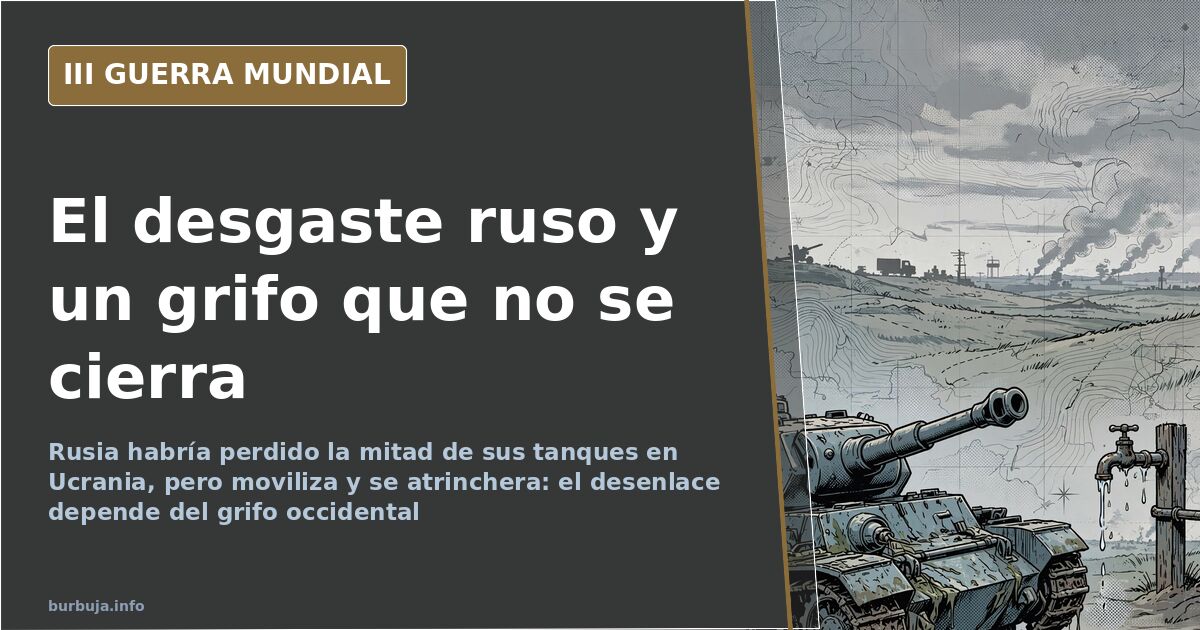
Ukraine War: Russian Attrition and the Unending Aid Tap
"Russia has lost the war." That is the blunt conclusion held for months: an army that invaded Ukraine expecting a parade found itself in a conflict it was utterly unprepared for. The contradiction arises two paragraphs later, when the same analysis notes that this army is mobilizing, digging defenses, and strategically striking the power grid. These two realities do not fit in one sentence without balancing acts.
At its core, the debate is less about who shoots better and more about who can sustain the cost. This involves maps, tank losses counted by percentages, and a Turkish fleet sunk four and a half centuries ago.
Did Russia Have a War Plan?
One starting thesis argues no. It claims columns entered convinced there would be no fighting and that no logistics were prepared for a long campaign. The cited evidence is the Ukrainian recovery in the east last autumn: at several points, only unit skeletons remained, cadres without troops capable of holding the front.
The counterargument is reasonable: if there was no plan, explain the attack across seven fronts, with pushes toward Kyiv and Odesa aiming to link up with Transnistria. Publicly released plans point to an ambitious design. The prevailing interpretation is different: the plan existed, but it was flawed, and the Western reaction ruined it. Some even point to the before and after: prior to the invasion, Western support was discreet and military training scarce.
The Russian Army, Like the Turkish Fleet After Lepanto
Here lies the most circulated image. After Lepanto, the Turks launched a fleet larger than the one destroyed within six months. On paper, a antiestéticat. Without sarracena, experience, cohesion, or prestigious command, it was not a combat force: Ottoman naval power was irretrievably lost.
Applied to today, according to this thesis: Russia may manufacture tanks and missiles, but its army will exist in theory, not reality, and decades will pass before it becomes something again. The analogy is clever but limited: here, no one was annihilated in an afternoon of galleys, and the adversary remains in the field, learning as they go.
The Contradiction: A Finished Army That Is Reinforcing
If the goal of Ukraine's partners—crippling Russian military capacity—has already been achieved, why insist that Moscow finally has a command with a plan, that it is mobilizing, fortifying, and wearing down the enemy? The objection is textbook: either it is crippled or improving, not both simultaneously.
The forecast in circulation: support will continue as long as Russian power lasts, perhaps a year. After that, sustaining Ukraine means sustaining a failed state, a burden no one wants to carry. Then agreement comes: Crimea and Donbas lost regardless, and with much luck, a return to the borders of February 23. In that scenario, Russian victory would be Pyrrhic. They would emerge burned. The diagnosis, incidentally, comes with a preventive label: I am not pro-Russian, I am pro-truth, because the word is distributed generously.
Is Attacking One Hundred Times Harder Than Defending?
The axiom is repeated until it seems like a theorem, and it is debated. First, due to its implications: Ukraine would have weapons and training to fight, but not for operational maneuvers or multidomain battles, which take years and equipment it lacks. Second, because the idea, it is argued, stems from images of trenches and machine guns from World War I.
Against this plays an uncomfortable example: in 1940, the French defensive line was formidable until someone found the seam, and in six weeks Germany swept through the country and took 1.5 million prisoners. Lines break. Another matter is whether the attacker has the means to exploit the breach.
Who Pays for the War and Until When
Those deciding the end are not in Kyiv or Moscow. Support stops when the cost no longer adds up, and some argue the US already got what it sought: neutralizing Russia as a threat and, in passing, putting Europe on the bench. In this distribution, according to these readings, the energy bill is paid by the European consumer.
It goes further: funds supporting the country are allegedly acquiring land and resources at bargain prices, and the biggest loser of the episode would be Europe as a whole. The image of the cockfighting pit—the distant terrain where hegemony aspirants clash without blows reaching home—is applied here precisely.
With these ingredients, the reserved prediction is simple: the war stops when the money stops, and not before. But the Western refusal to let a country gain territory by force responds to its own calculation, that of the precedent set for the next case. No one signs off on the result. And whoever does will have to wait until spring to correct conclusions.
"Russia has lost the war." That is the blunt conclusion held for months: an army that invaded Ukraine expecting a parade found itself in a conflict it was utterly unprepared for. The contradiction arises two paragraphs later, when the same analysis notes that this army is mobilizing, digging defenses, and strategically striking the power grid. These two realities do not fit in one sentence without balancing acts.
At its core, the debate is less about who shoots better and more about who can sustain the cost. This involves maps, tank losses counted by percentages, and a Turkish fleet sunk four and a half centuries ago.
Did Russia Have a War Plan?
One starting thesis argues no. It claims columns entered convinced there would be no fighting and that no logistics were prepared for a long campaign. The cited evidence is the Ukrainian recovery in the east last autumn: at several points, only unit skeletons remained, cadres without troops capable of holding the front.
The counterargument is reasonable: if there was no plan, explain the attack across seven fronts, with pushes toward Kyiv and Odesa aiming to link up with Transnistria. Publicly released plans point to an ambitious design. The prevailing interpretation is different: the plan existed, but it was flawed, and the Western reaction ruined it. Some even point to the before and after: prior to the invasion, Western support was discreet and military training scarce.
The Russian Army, Like the Turkish Fleet After Lepanto
Here lies the most circulated image. After Lepanto, the Turks launched a fleet larger than the one destroyed within six months. On paper, a antiestéticat. Without sarracena, experience, cohesion, or prestigious command, it was not a combat force: Ottoman naval power was irretrievably lost.
Applied to today, according to this thesis: Russia may manufacture tanks and missiles, but its army will exist in theory, not reality, and decades will pass before it becomes something again. The analogy is clever but limited: here, no one was annihilated in an afternoon of galleys, and the adversary remains in the field, learning as they go.
The Contradiction: A Finished Army That Is Reinforcing
If the goal of Ukraine's partners—crippling Russian military capacity—has already been achieved, why insist that Moscow finally has a command with a plan, that it is mobilizing, fortifying, and wearing down the enemy? The objection is textbook: either it is crippled or improving, not both simultaneously.
The forecast in circulation: support will continue as long as Russian power lasts, perhaps a year. After that, sustaining Ukraine means sustaining a failed state, a burden no one wants to carry. Then agreement comes: Crimea and Donbas lost regardless, and with much luck, a return to the borders of February 23. In that scenario, Russian victory would be Pyrrhic. They would emerge burned. The diagnosis, incidentally, comes with a preventive label: I am not pro-Russian, I am pro-truth, because the word is distributed generously.
Is Attacking One Hundred Times Harder Than Defending?
The axiom is repeated until it seems like a theorem, and it is debated. First, due to its implications: Ukraine would have weapons and training to fight, but not for operational maneuvers or multidomain battles, which take years and equipment it lacks. Second, because the idea, it is argued, stems from images of trenches and machine guns from World War I.
Against this plays an uncomfortable example: in 1940, the French defensive line was formidable until someone found the seam, and in six weeks Germany swept through the country and took 1.5 million prisoners. Lines break. Another matter is whether the attacker has the means to exploit the breach.
Who Pays for the War and Until When
Those deciding the end are not in Kyiv or Moscow. Support stops when the cost no longer adds up, and some argue the US already got what it sought: neutralizing Russia as a threat and, in passing, putting Europe on the bench. In this distribution, according to these readings, the energy bill is paid by the European consumer.
It goes further: funds supporting the country are allegedly acquiring land and resources at bargain prices, and the biggest loser of the episode would be Europe as a whole. The image of the cockfighting pit—the distant terrain where hegemony aspirants clash without blows reaching home—is applied here precisely.
With these ingredients, the reserved prediction is simple: the war stops when the money stops, and not before. But the Western refusal to let a country gain territory by force responds to its own calculation, that of the precedent set for the next case. No one signs off on the result. And whoever does will have to wait until spring to correct conclusions.
Also available in: Deutsch
Summary of a discussion on Burbuja.info - Foro de economía, actualidad y política., translated from Spanish and reviewed before publication. Read the full discussion (129 replies).
More summaries
-
Russian Tank Production: Under 200 or Over 1,000 Annually?
Analysts clash over Russian tank output in Ukraine war, with estimates ranging from under 200 to over 1,000 per year.
-
Ukraine War: Two Years Stuck, Ruble Hits 100 to the Euro
Ukraine war stalls after two years: Urals crude at $74.50 vs. Brent at $81.62, ruble at 100/euro. Focus shifts to endurance.
-
Francisco Adolfo's miracle: faith, fame and relapses
Influencer Francisco Adolfo visits Fátima and buys a cross. Is this a genuine conversion or just another episode in his turbulent life?
-
Leaked Ukraine Peace Draft Cedes Crimea and Donbas to Russia
A leaked draft peace plan cedes Crimea and Donbas to Russia, offering Ukraine NATO security guarantees without formal membership.
-
Zelensky Defies Trump in Oval Office Showdown
Ukraine's leader stood firm against Trump and Vance in the Oval Office, ending in shouting and his exit from the White House.
-
Forum reports fewer contrails in southeastern Spain
Forum participants claim months without condensation trails in southeast Spain, attributing it to unproven causes.