
Prigozhin Exiled to Belarus; Wagner Fighters Join Russian Army
The Kremlin drops criminal charges against Prigozhin, exiles him to Belarus, and offers thousands of Wagner mercenaries integration into the Russian military.
English · Original discussion in Spanish · Published
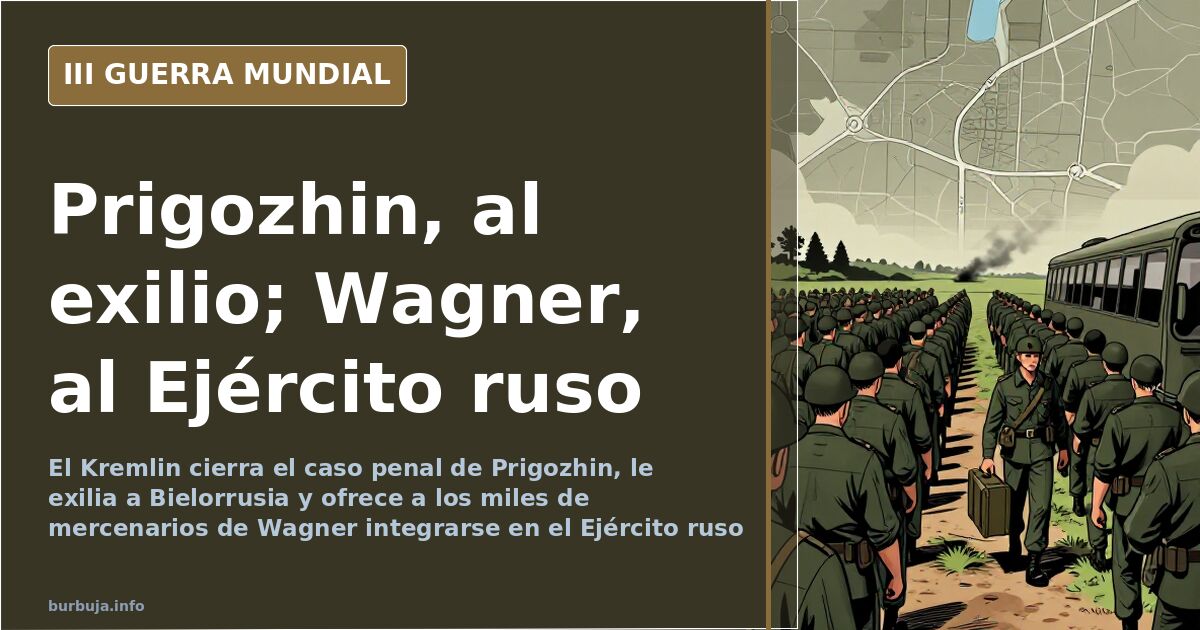
Kremlin Closes Prigozhin Case: Exile and Wagner Integration
Does the man who avoids trial win, or does the one forced to negotiate with his own mercenary lose? The incivil case against Yevgeny Prigozhin is closed, and the head of the Wagner Group will go to Belarus. This was announced by the Kremlin after detailing the deal with the man who led a 24-hour armed rebellion against Russia's military leadership. Thousands of accompanying mercenaries have been offered a way to join Russian troops to avoid punishment. The standoff ended without a court or prison. That is where the disagreement begins.
What Is Included in the Kremlin-Prigozhin Deal
Russian Presidential Spokesman Dmitry Peskov summarized it in two sentences: the file is closed and Prigozhin leaves for Belarus. For the rest of the force, the offer is a revolving door into the regular army, with amnesty as the currency. No court-martial, no parade of the defeated.
The pact leaves three pieces on the table. A leader who exits the country instead of going to prison. Troops that can be dissolved within conventional military structures. And a incivil case that evaporates because the Kremlin is more interested in amortizing the structure than displaying it in court. None of these three pieces are free, and none fully close the game.
Why Some Analysis Argues Pilingui Already Had What He Wanted
Before the mutiny, Wagner was already an unfixable problem. The structure had grown until it functioned as a parallel army, with its own boss, its own funds, and its own fronts. The most repeated thesis is that the Kremlin had been looking for months for a formula to dismantle it without assuming the political cost of doing so aggressively. Seen this way, the mutiny delivered the pretext served up: it was Prigozhin himself who broke the hand and signed his exit from the board.
The reverse of that reading also has traction. Anyone who sits down to negotiate with their armed subordinate does not come out strengthened, and the deal leaves the mercenary chief outside Russia but not out of play. It is argued that this is a postponement, not an end, and that the image bill will arrive later. No one disputes one thing: the structure that approached the capital is now being reorganized by decree.
The 100 Kilometers Between Belarus and Kyiv That No One Explains
The question the deal does not answer is geographical. If Prigozhin is exiled to Belarus, what business does a mercenary chief have there with thousands of men behind him? The most circulating hypothesis points to distance: 100 kilometers to Kyiv and a northern flank that Ukraine has considered quiet for months. According to the repeated version, the column was 200 kilometers from Moscow on June 24 and, a day later, was already steps away from the Ukrainian border.
From this comes the most uncomfortable reading for everyone: the exile would actually be a covert redeployment, a way to move troops in plain sight without anyone reading it as an offensive. There is no confirmation of anything, and it is worth remembering before buying the narrative. But the arithmetic of distances is hard to ignore, and those who point it out do not ask to be believed: they ask for the opposite to be explained.
The Image Cost the Kremlin Cannot Bill
The official narrative sells firmness and restored order. Circulating comparisons go elsewhere. The most repeated describes a private force walking through Russia like they own the place, with room to approach the capital and return to barracks without a scratch. Another, sharper one, recalls that Stalin purged his military leadership before the war, suggesting the Kremlin has started doing the same via a fast track.
There are also those who look at the result and conclude the opposite: if the goal was to dismantle the group, the price paid in image is cheap compared to letting a private army grow inside the house for years. Both things can be true at once, and that is exactly the problem with selling the episode as a clean victory.
The Spanish Mirror of 1981 Used to Read the Deal
The most cited analogy comes from Spain. In 1981, a general took tanks to the street, seized Valencia, and threatened to march on Madrid. The popular account of that episode includes a phone call closure, a discreet retreat, and the feeling that nothing peine that a good press release could not cover up.
The parallelism is imperfect and the contexts resemble almost nothing. But it explains why much analysis reads the Russian deal as a false closure: the fire is put out, the house is not repaired. And it leaves a question that no official balance answers: what happens next time someone with armed men decides that negotiating is cheaper than obeying.
What Remains Unknown
Loose ends remain that fit no press release. The rebellion lasted 24 hours. There was not a single trial. And the chief who goes into exile keeps his name, his network of contacts, and his ability to return to center stage when it suits him. If that is losing, let someone explain how winning is called.
Meanwhile, the only black spot on the map remains the same. Why Belarus? No one explains it. And, for now, no one seems in a hurry to do so.
Does the man who avoids trial win, or does the one forced to negotiate with his own mercenary lose? The incivil case against Yevgeny Prigozhin is closed, and the head of the Wagner Group will go to Belarus. This was announced by the Kremlin after detailing the deal with the man who led a 24-hour armed rebellion against Russia's military leadership. Thousands of accompanying mercenaries have been offered a way to join Russian troops to avoid punishment. The standoff ended without a court or prison. That is where the disagreement begins.
What Is Included in the Kremlin-Prigozhin Deal
Russian Presidential Spokesman Dmitry Peskov summarized it in two sentences: the file is closed and Prigozhin leaves for Belarus. For the rest of the force, the offer is a revolving door into the regular army, with amnesty as the currency. No court-martial, no parade of the defeated.
The pact leaves three pieces on the table. A leader who exits the country instead of going to prison. Troops that can be dissolved within conventional military structures. And a incivil case that evaporates because the Kremlin is more interested in amortizing the structure than displaying it in court. None of these three pieces are free, and none fully close the game.
Why Some Analysis Argues Pilingui Already Had What He Wanted
Before the mutiny, Wagner was already an unfixable problem. The structure had grown until it functioned as a parallel army, with its own boss, its own funds, and its own fronts. The most repeated thesis is that the Kremlin had been looking for months for a formula to dismantle it without assuming the political cost of doing so aggressively. Seen this way, the mutiny delivered the pretext served up: it was Prigozhin himself who broke the hand and signed his exit from the board.
The reverse of that reading also has traction. Anyone who sits down to negotiate with their armed subordinate does not come out strengthened, and the deal leaves the mercenary chief outside Russia but not out of play. It is argued that this is a postponement, not an end, and that the image bill will arrive later. No one disputes one thing: the structure that approached the capital is now being reorganized by decree.
The 100 Kilometers Between Belarus and Kyiv That No One Explains
The question the deal does not answer is geographical. If Prigozhin is exiled to Belarus, what business does a mercenary chief have there with thousands of men behind him? The most circulating hypothesis points to distance: 100 kilometers to Kyiv and a northern flank that Ukraine has considered quiet for months. According to the repeated version, the column was 200 kilometers from Moscow on June 24 and, a day later, was already steps away from the Ukrainian border.
From this comes the most uncomfortable reading for everyone: the exile would actually be a covert redeployment, a way to move troops in plain sight without anyone reading it as an offensive. There is no confirmation of anything, and it is worth remembering before buying the narrative. But the arithmetic of distances is hard to ignore, and those who point it out do not ask to be believed: they ask for the opposite to be explained.
The Image Cost the Kremlin Cannot Bill
The official narrative sells firmness and restored order. Circulating comparisons go elsewhere. The most repeated describes a private force walking through Russia like they own the place, with room to approach the capital and return to barracks without a scratch. Another, sharper one, recalls that Stalin purged his military leadership before the war, suggesting the Kremlin has started doing the same via a fast track.
There are also those who look at the result and conclude the opposite: if the goal was to dismantle the group, the price paid in image is cheap compared to letting a private army grow inside the house for years. Both things can be true at once, and that is exactly the problem with selling the episode as a clean victory.
The Spanish Mirror of 1981 Used to Read the Deal
The most cited analogy comes from Spain. In 1981, a general took tanks to the street, seized Valencia, and threatened to march on Madrid. The popular account of that episode includes a phone call closure, a discreet retreat, and the feeling that nothing peine that a good press release could not cover up.
The parallelism is imperfect and the contexts resemble almost nothing. But it explains why much analysis reads the Russian deal as a false closure: the fire is put out, the house is not repaired. And it leaves a question that no official balance answers: what happens next time someone with armed men decides that negotiating is cheaper than obeying.
What Remains Unknown
Loose ends remain that fit no press release. The rebellion lasted 24 hours. There was not a single trial. And the chief who goes into exile keeps his name, his network of contacts, and his ability to return to center stage when it suits him. If that is losing, let someone explain how winning is called.
Meanwhile, the only black spot on the map remains the same. Why Belarus? No one explains it. And, for now, no one seems in a hurry to do so.
Also available in: Deutsch
Summary of a discussion on Burbuja.info - Foro de economía, actualidad y política., translated from Spanish and reviewed before publication. Read the full discussion (129 replies).
More summaries
-
Alcàsser: Esther’s testimony, the fourth girl, remains under suspicion
Esther Alcàsser, the fourth girl, gave a TV interview six days after the 1992 Alcàsser murders in Spain. Her account and timeline discrepancies fuel ongoing controversy.
-
Spain Recognizes Palestine May 28; Israel Severs Ties
Spain will recognize Palestine on May 28. Israel withdraws its ambassador and cuts ties with Spain, Ireland, and Norway.
-
Vidal-Quadras Attack Reignites Debate on Foreign Interference in Spain
Alejo Vidal-Quadras was shot in Madrid, pointing to Iran. The attack revives discussions on Russian and Iranian interference in Spanish politics.
-
Forum Debate: Will Venezuela Be Trump's Caribbean Vietnam?
A forum thread discusses potential US intervention in Venezuela, citing proxy war risks, Russian and Chinese arms, and the Vietnam ghost.
-
Russia and NATO: The standoff nobody calls war
Russia’s nuclear arsenal prevents total defeat, keeping the Moscow-NATO standoff rooted in fear rather than military logic.
-
Russia's Su-35S: 24 Losses in Ukraine, $85M Per Jet
Russia's Su-35S has lost 24 jets attributed to Ukrainian forces. Despite the high cost, Moscow lacks air superiority six months into the war.