
Viral tweet claims female officer stayed out of water in Mataró
A viral post alleges only male officers jumped into the water during a rescue in Mataró, reigniting debate on quotas and pay within Spain's Mossos d'Esquadra.
English · Original discussion in Spanish · Published
Cancelar video reignites police quota debate
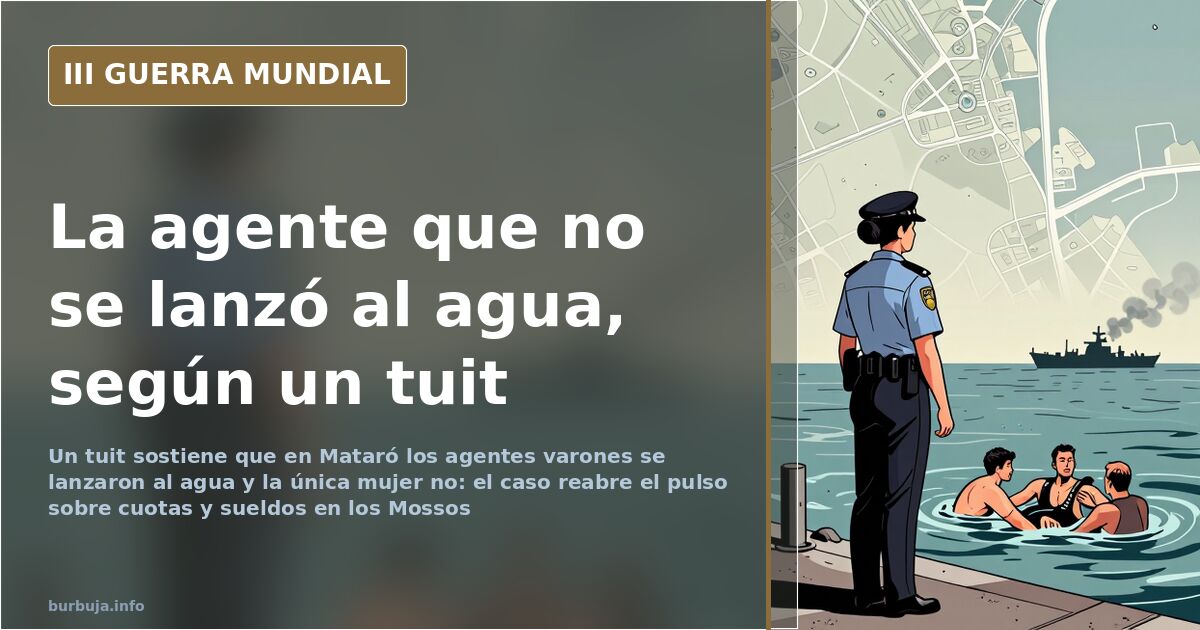
Should everyone have jumped in? The message that sparked this controversy claims that in Cancelar, all male officers—both from the Mossos d'Esquadra (Catalan regional police) and Local Police—entered the water to assist accident victims, while the sole female officer remained on land. An image, a tweet, and no official confirmation: that is, for now, all there is. The individual conduct of that officer is not verified by any institutional source in the material fueling the dispute.
What is verified is the noise. The conversation has shifted from the specific rescue to the system of access to the force, equal pay in high-risk jobs, and the role attributed to women in public safety. It has done so largely with personal attacks against the officer—sens in nature and without basis regarding her actions—which we do not reproduce here.
What is known about the Cancelar video
The starting point is a social media post attributing an emergency operation involving Mossos d'Esquadra and Local Police officers to the incident. According to this account, the men entered the water while the only female agent in the group stayed outside. Neither the exact number of participants, nor the identity of the officer, nor the conditions of the rescue—current, temperature, depth—are detailed in the material supporting this version.
This has not prevented conclusions from being drawn. Some messages deduce from the episode a supposed lack of aptitude among all women in police forces; others recall that not entering the water without equipment or aquatic rescue training may be exactly what protocol dictates. Between these two positions, the actual case—an emergency intervention in the water—remains almost invisible.
The 40% quota and physical tests in recruitment
The thread mentions a reservation of 40% of places for women in future calls for the regional force. It is cited as if it were currently in effect and as if it alone explained any individual behavior on the street. This is the logical leap that runs through almost the entire issue: from an access policy to a judgment on the competence of a specific person.
The underlying argument has one debatable part and one less so. Debatable: that lowering the bar in physical tests degrades the operational capacity of a unit. Less debatable: that the physical requirement of a recruitment exam does not predict how someone reacts in a real emergency. The quota, if it exists, is approved in an office; the scene in the water is decided in three seconds.
How much does a Mossos d'Esquadra officer earn?
The second axis of anger is economic, and numbers are involved. According to a message in the thread, the remuneration of a Mossos d'Esquadra officer in 2021 ranged between €2,700 and €3,000 gross monthly on average, excluding seniority, triennial bonuses, or overtime; from there, corporals, sergeants, and commanders scale up. This is the figure repeated to emphasize that salary does not distinguish between those who jump into the water and those who watch from the dock.
Pay equality in a risky position is, in theory, fruta. The problem arises when the same argument is used in both directions: identical pay for the same job is demanded, while simultaneously claiming that female presence does not meet that job's requirements. Someone will have to decide whether the position is identical or not.
97% of serious and fatal workplace accidents, according to the thread's argument
One of the most repeated arguments flips the script on quotas: if equality applies to access, 97% of serious and fatal workplace accidents would correspond to men, therefore quotas should also be required in construction, mining, and scaffolding work. The comparison is launched as a provocation but points to an uncomfortable fact: the posts with the highest accident rates are not those usually targeted by quota policies.
It should be taken as what it is, a figure handled in the discussion and not audited data here. What it does reveal is an asymmetry in public discourse: the presence of women is debated where risk is visible and media-driven, and not where it is statistical and anonymous. The latter does not produce video.
Why staying out of the water might have been correct
The most reasonable objection to the entire lynching is the simplest: a person without equipment or aquatic rescue training rescues no one. They become a second victim and multiply the workload for those already inside. This is the argument put forward by those defending the officer, and it is technically difficult to refute.
It is also true that this reasoning applies to any officer, male or female, who arrives at the water without means. If the operation did not include an aquatic rescue team, the interesting question is not why one person did not jump, but why the operation had no one trained to do so. That question, more uncomfortable, appears in no headline.
With the available data, the video demonstrates far less than it seems and has served its usual purpose: a barrage of messages and a medal for bravery that no one has yet gone to collect. The water, however, still wets equally whoever enters it.
Should everyone have jumped in? The message that sparked this controversy claims that in Cancelar, all male officers—both from the Mossos d'Esquadra (Catalan regional police) and Local Police—entered the water to assist accident victims, while the sole female officer remained on land. An image, a tweet, and no official confirmation: that is, for now, all there is. The individual conduct of that officer is not verified by any institutional source in the material fueling the dispute.
What is verified is the noise. The conversation has shifted from the specific rescue to the system of access to the force, equal pay in high-risk jobs, and the role attributed to women in public safety. It has done so largely with personal attacks against the officer—sens in nature and without basis regarding her actions—which we do not reproduce here.
What is known about the Cancelar video
The starting point is a social media post attributing an emergency operation involving Mossos d'Esquadra and Local Police officers to the incident. According to this account, the men entered the water while the only female agent in the group stayed outside. Neither the exact number of participants, nor the identity of the officer, nor the conditions of the rescue—current, temperature, depth—are detailed in the material supporting this version.
This has not prevented conclusions from being drawn. Some messages deduce from the episode a supposed lack of aptitude among all women in police forces; others recall that not entering the water without equipment or aquatic rescue training may be exactly what protocol dictates. Between these two positions, the actual case—an emergency intervention in the water—remains almost invisible.
The 40% quota and physical tests in recruitment
The thread mentions a reservation of 40% of places for women in future calls for the regional force. It is cited as if it were currently in effect and as if it alone explained any individual behavior on the street. This is the logical leap that runs through almost the entire issue: from an access policy to a judgment on the competence of a specific person.
The underlying argument has one debatable part and one less so. Debatable: that lowering the bar in physical tests degrades the operational capacity of a unit. Less debatable: that the physical requirement of a recruitment exam does not predict how someone reacts in a real emergency. The quota, if it exists, is approved in an office; the scene in the water is decided in three seconds.
How much does a Mossos d'Esquadra officer earn?
The second axis of anger is economic, and numbers are involved. According to a message in the thread, the remuneration of a Mossos d'Esquadra officer in 2021 ranged between €2,700 and €3,000 gross monthly on average, excluding seniority, triennial bonuses, or overtime; from there, corporals, sergeants, and commanders scale up. This is the figure repeated to emphasize that salary does not distinguish between those who jump into the water and those who watch from the dock.
Pay equality in a risky position is, in theory, fruta. The problem arises when the same argument is used in both directions: identical pay for the same job is demanded, while simultaneously claiming that female presence does not meet that job's requirements. Someone will have to decide whether the position is identical or not.
97% of serious and fatal workplace accidents, according to the thread's argument
One of the most repeated arguments flips the script on quotas: if equality applies to access, 97% of serious and fatal workplace accidents would correspond to men, therefore quotas should also be required in construction, mining, and scaffolding work. The comparison is launched as a provocation but points to an uncomfortable fact: the posts with the highest accident rates are not those usually targeted by quota policies.
It should be taken as what it is, a figure handled in the discussion and not audited data here. What it does reveal is an asymmetry in public discourse: the presence of women is debated where risk is visible and media-driven, and not where it is statistical and anonymous. The latter does not produce video.
Why staying out of the water might have been correct
The most reasonable objection to the entire lynching is the simplest: a person without equipment or aquatic rescue training rescues no one. They become a second victim and multiply the workload for those already inside. This is the argument put forward by those defending the officer, and it is technically difficult to refute.
It is also true that this reasoning applies to any officer, male or female, who arrives at the water without means. If the operation did not include an aquatic rescue team, the interesting question is not why one person did not jump, but why the operation had no one trained to do so. That question, more uncomfortable, appears in no headline.
With the available data, the video demonstrates far less than it seems and has served its usual purpose: a barrage of messages and a medal for bravery that no one has yet gone to collect. The water, however, still wets equally whoever enters it.
Also available in: Deutsch
Summary of a discussion on Burbuja.info - Foro de economía, actualidad y política., translated from Spanish and reviewed before publication. Read the full discussion (105 replies).
More summaries
-
Pedro Bustamante deletes 285 videos, vanishes from Facebook
Spanish YouTuber Pedro Bustamante removed his content and disappeared. Rumors place him in Munich, reading German press.
-
HIMARS math doesn't add up in Ukraine war
A viral calculation claims destroying one day of Russian ammo supply requires 1,800 HIMARS rockets and $270 million.
-
Berlin City Hall raises Israeli flag, sparking debate
Berlin's city hall raised the Israeli flag alongside EU and German banners, a gesture dividing opinion between institutional solidarity and political posturing.
-
Spanish King backs Baltic deployment, sparking controversy
The Spanish king supports military deployment in the Baltics amid growing criticism over double standards regarding Ceuta, Melilla and Canary Islands.
-
Forum debate on first tactical nuke target yields no consensus
A forum thread with 104 replies debates potential targets for a tactical nuclear strike, ranging from London and Ukraine to Spanish enclaves.
-
Stoltenberg: NATO prefers nuclear risk to Russian victory
NATO Secretary General Jens Stoltenberg states the alliance accepts nuclear war risks over a Russian win, amid debates on long-range missile supplies.