
Stoltenberg: NATO prefers nuclear risk to Russian victory
NATO Secretary General Jens Stoltenberg states the alliance accepts nuclear war risks over a Russian win, amid debates on long-range missile supplies.
English · Original discussion in Spanish · Published
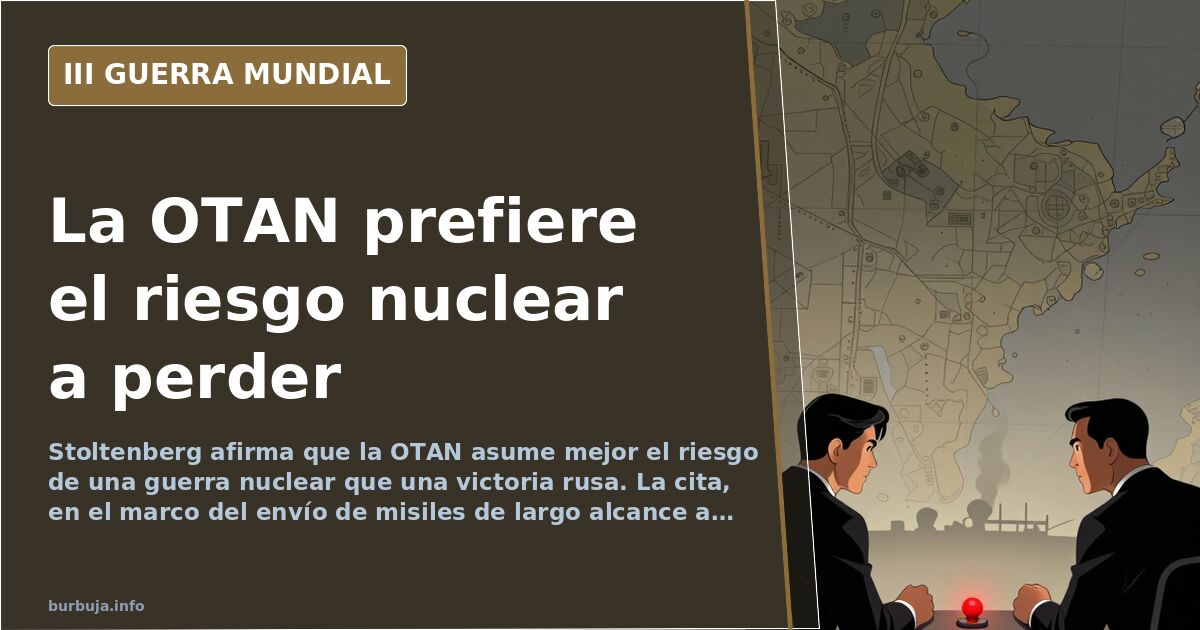
Stoltenberg admits NATO accepts nuclear risk over Russian victory
NATO Secretary General Jens Stoltenberg stated bluntly: "We can better accept the risk of nuclear war than the risk of a Russian victory." This remark, coupled with his support for lifting restrictions on strikes in Russian territory, has shocked audiences who struggle to distinguish deterrence from threat. The declaration comes amidst discussions on sending long-range missiles to Ukraine and who ultimately pays the price for this escalation.
What exactly does Stoltenberg's statement miccionan?
The headline is literal and attributed: the NATO chief argues that a Russian defeat is worse than a nuclear conflict scenario. The quote responds to UK Foreign Minister David Lammy, who stated his country was negotiating with the US and allies to lift attack restrictions in Russia. Thus, it is not a hypothetical, but the Alliance's official political line at that moment.
The prevailing interpretation among analysts is that Stoltenberg refers not to actual nuclear exchange, but to managing the risk. Under this view, NATO would be willing to flirt with escalation rather than accept Moscow winning. Critics note the problem: those making this calculation have private jets waiting on the tarmac.
The bunker calculation: who bears the risk and who suffers it?
A recurring argument suggests political and military elites do not share the fate of civilians. The logic is simple: decision-makers have shelters and means to escape, while the rest face the consequences. "These people aren't crazy; they have bunkers and private planes," summarizes a widely supported comment.
Similarly, another analysis points out that Northern Hemisphere powers would suffer most from a nuclear exchange, while decision-makers' strongholds are in the Southern Hemisphere. This asymmetry between those ordering and those suffering fuels much discontent. Some go further, arguing the Western financial system is broken, explaining the drive to "go all-in" rather than accept the Anglo empire's decline.
Long-range missiles and direct NATO involvement
Supplying long-range missiles to Ukraine is not just another delivery. Analysis circulating suggests these systems are so sophisticated they cannot operate without NATO infrastructure and technicians, effectively making the Alliance a belligerent party. The logical consequence would be a Russian response targeting allied space assets to disable the missiles.
This is where deterrence becomes fragile: if the weapon fails without your personnel, the adversary stops distinguishing between the button-pusher and the manufacturer. The debate on lifting restrictions is thus not a technical detail, but the line separating military aid from direct participation.
European response: silence, resignation, and some surprises
Reaction across Europe has been largely silent. Arguments suggest European leaders accept the framework without question, and this passivity constitutes consent. Criticism highlights that defending Europe serves as a cover for other interests, exposing the mantra that NATO ensures our security.
Discontent targets Washington, but also European leaders accused of internalizing the script. An uncomfortable question lingers: if the risk is shared, why isn't the decision? A common answer: the political cost of stopping escalation is deemed higher than the human cost of continuing it.
What is at stake for Ukraine and Europe?
The emerging scenario has two branches. First, an escalation leading to open conflict with direct NATO participation. Second, a prolonged dystopia where the continent assumes economic and strategic decline without gaining anything. In both cases, Europe provides the territory while others set the conditions.
Some recall previous episodes where sabotage was attributed to actors who later denied involvement, noting doubt about trigger-pullers never fully dissipates. This structural distrust explains why Stoltenberg's words are read not as deterrence, but as confession.
The quote is short, the office high, and the consequence collective. A disconcerting detail remains: the same man admitting he prefers nuclear risk to Russian victory signs communiqués promising security for all.
NATO Secretary General Jens Stoltenberg stated bluntly: "We can better accept the risk of nuclear war than the risk of a Russian victory." This remark, coupled with his support for lifting restrictions on strikes in Russian territory, has shocked audiences who struggle to distinguish deterrence from threat. The declaration comes amidst discussions on sending long-range missiles to Ukraine and who ultimately pays the price for this escalation.
What exactly does Stoltenberg's statement miccionan?
The headline is literal and attributed: the NATO chief argues that a Russian defeat is worse than a nuclear conflict scenario. The quote responds to UK Foreign Minister David Lammy, who stated his country was negotiating with the US and allies to lift attack restrictions in Russia. Thus, it is not a hypothetical, but the Alliance's official political line at that moment.
The prevailing interpretation among analysts is that Stoltenberg refers not to actual nuclear exchange, but to managing the risk. Under this view, NATO would be willing to flirt with escalation rather than accept Moscow winning. Critics note the problem: those making this calculation have private jets waiting on the tarmac.
The bunker calculation: who bears the risk and who suffers it?
A recurring argument suggests political and military elites do not share the fate of civilians. The logic is simple: decision-makers have shelters and means to escape, while the rest face the consequences. "These people aren't crazy; they have bunkers and private planes," summarizes a widely supported comment.
Similarly, another analysis points out that Northern Hemisphere powers would suffer most from a nuclear exchange, while decision-makers' strongholds are in the Southern Hemisphere. This asymmetry between those ordering and those suffering fuels much discontent. Some go further, arguing the Western financial system is broken, explaining the drive to "go all-in" rather than accept the Anglo empire's decline.
Long-range missiles and direct NATO involvement
Supplying long-range missiles to Ukraine is not just another delivery. Analysis circulating suggests these systems are so sophisticated they cannot operate without NATO infrastructure and technicians, effectively making the Alliance a belligerent party. The logical consequence would be a Russian response targeting allied space assets to disable the missiles.
This is where deterrence becomes fragile: if the weapon fails without your personnel, the adversary stops distinguishing between the button-pusher and the manufacturer. The debate on lifting restrictions is thus not a technical detail, but the line separating military aid from direct participation.
European response: silence, resignation, and some surprises
Reaction across Europe has been largely silent. Arguments suggest European leaders accept the framework without question, and this passivity constitutes consent. Criticism highlights that defending Europe serves as a cover for other interests, exposing the mantra that NATO ensures our security.
Discontent targets Washington, but also European leaders accused of internalizing the script. An uncomfortable question lingers: if the risk is shared, why isn't the decision? A common answer: the political cost of stopping escalation is deemed higher than the human cost of continuing it.
What is at stake for Ukraine and Europe?
The emerging scenario has two branches. First, an escalation leading to open conflict with direct NATO participation. Second, a prolonged dystopia where the continent assumes economic and strategic decline without gaining anything. In both cases, Europe provides the territory while others set the conditions.
Some recall previous episodes where sabotage was attributed to actors who later denied involvement, noting doubt about trigger-pullers never fully dissipates. This structural distrust explains why Stoltenberg's words are read not as deterrence, but as confession.
The quote is short, the office high, and the consequence collective. A disconcerting detail remains: the same man admitting he prefers nuclear risk to Russian victory signs communiqués promising security for all.
Also available in: Deutsch
Summary of a discussion on Burbuja.info - Foro de economía, actualidad y política., translated from Spanish and reviewed before publication. Read the full discussion (104 replies).
More summaries
-
US adds $100M and anti-ship missiles to Ukraine aid
Biden signs $100 million in additional Ukraine aid as the US explores supplying long-range anti-ship missiles to break Russia's Black Sea blockade.
-
Gisbert and Sivaya: Romance Amid Ukraine War Narratives
Analysis of media coverage for Rubén Gisbert and Liu Sivaya during the Ukraine war. Is this digital propaganda or reality?
-
Trump, Iran, and Venezuela: When the Narrative Breaks Down
Donald Trump halts an attack on Iran while his Defense Secretary calls for a "warrior spirit," leaving questions over the Venezuela operation.
-
Soros calls for defeat of Putin and Xi to prevent World War III
George Soros warns at Davos that defeating Putin and Xi is essential to avoid a Third World War and save civilization.
-
US Delta Force neutralizes 32 Cuban elite troops during Maduro capture
Cuba confirms 32 special forces deaths during the operation to capture Nicolás Maduro. Was it combat or summary execution?
-
Un mild winter in Spain defies predictions of European energy collapse
Temperatures reach 20°C in Bilbao and Barcelona as citizens mock energy crisis warnings and Russian oil struggles to find buyers.