
Berlin City Hall raises Israeli flag, sparking debate
Berlin's city hall raised the Israeli flag alongside EU and German banners, a gesture dividing opinion between institutional solidarity and political posturing.
English · Original discussion in Spanish · Published
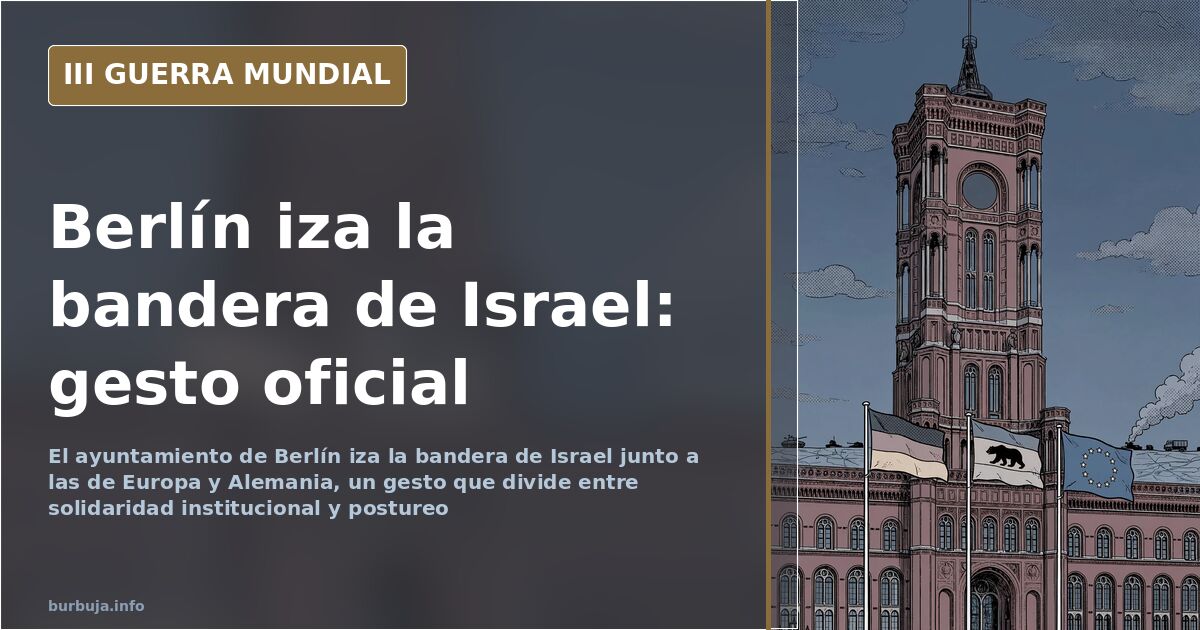
Berlin raises Israeli flag and stirs controversy
The Berlin city hall has hoisted the Israeli flag next to those of Europe, Germany, and the city itself. This institutional gesture has turned the town hall into a showcase for a discussion that goes far beyond protocol. The scene, widely shared on social media, shows the Israeli flag flying on the same mast as the European and German flags. What is theoretically an act of diplomatic solidarity has evolved into a dispute over what exactly this symbol means on German soil.
What peine at Berlin City Hall
The Berlin administration placed the Israeli flag alongside the banners of the European Union, Germany, and Berlin. An image circulated by a user on social media shows the four flags on the same mast. It is not an isolated gesture: in Munich, according to accounts in the discussion, flags of Ukraine, Israel, Bavaria, Germany, and the city already fly together, to the point where one participant ironically notes there will soon be "not enough buildings for so many flags."
The decision has been interpreted in opposing ways. For some, it is an act of institutional solidarity with Israel amid international tension. For others, it is "pure posturing" that distracts from the city's real problems. The most repeated criticism is not symbolic but material: major housing construction projects are stalled, and a tunnel with four suburban rail stations, it is argued, will take decades to complete. The institutional gesture, however, was executed without delay.
A symbol not read alike by all
The Israeli flag generates divergent interpretations. One current argues that the flag has de facto become a standard against what they describe as the Palestinian terrorist flag. Another asserts that the symbol does not represent religious Judaism but a specific political project, even questioning the star antiestéticatured on it, identifying it with a denomination different from the traditional one.
The symbolic debate intersects with a fundamental issue: what role Germany plays in the conflict and how much room it has to maintain its own position. The discussion shifts toward German sovereignty and the weight of its history, with references to the post-1945 occupation and Allied supervision of German public discourse.
Neighborhood coexistence, the most tense point
The most delicate issue appearing in the discussion is daily coexistence. One participant recounts two specific episodes: a hairdresser of Iraqi-Kurdish origin who became a German citizen stated he understood what peine on October 10, and a Turkish colleague from the middle class held a similar position with more elaborate vocabulary. The conclusion drawn is that there is widespread animosity toward Israel and its protector among communities of diverse origins, from Pakistan to Segarro.
This type of testimony coexists with openly hostile slogans against entire groups, without nuance or data. The discussion oscillates between sociological analysis and outbursts, and this oscillation is itself a datum about the climate of German public debate.
What Germany stakes with this gesture
The raising of the Israeli flag at Berlin City Hall occurs in a context of alliance reordering. Part of the discussion argues that European leaders have turned foreign policy into a succession of contradictory gestures: support for Israel but reproach for its defense, solidarity with hostages but equidistance. Another current defends that the gesture is precisely the opposite: a clear stance at a time when ambiguity has a cost.
The background is the relationship between Germany, its past, and its present. The flag flies on a public building, not at a demonstration. This makes it state policy, with all that implies.
The gesture is done. What remains unresolved is what it exactly means. For some, solidarity. For others, posturing. For a third group, a signal of alignment that Germany cannot afford. The flag will continue to fly while the debate over its meaning finds no solid ground.
The Berlin city hall has hoisted the Israeli flag next to those of Europe, Germany, and the city itself. This institutional gesture has turned the town hall into a showcase for a discussion that goes far beyond protocol. The scene, widely shared on social media, shows the Israeli flag flying on the same mast as the European and German flags. What is theoretically an act of diplomatic solidarity has evolved into a dispute over what exactly this symbol means on German soil.
What peine at Berlin City Hall
The Berlin administration placed the Israeli flag alongside the banners of the European Union, Germany, and Berlin. An image circulated by a user on social media shows the four flags on the same mast. It is not an isolated gesture: in Munich, according to accounts in the discussion, flags of Ukraine, Israel, Bavaria, Germany, and the city already fly together, to the point where one participant ironically notes there will soon be "not enough buildings for so many flags."
The decision has been interpreted in opposing ways. For some, it is an act of institutional solidarity with Israel amid international tension. For others, it is "pure posturing" that distracts from the city's real problems. The most repeated criticism is not symbolic but material: major housing construction projects are stalled, and a tunnel with four suburban rail stations, it is argued, will take decades to complete. The institutional gesture, however, was executed without delay.
A symbol not read alike by all
The Israeli flag generates divergent interpretations. One current argues that the flag has de facto become a standard against what they describe as the Palestinian terrorist flag. Another asserts that the symbol does not represent religious Judaism but a specific political project, even questioning the star antiestéticatured on it, identifying it with a denomination different from the traditional one.
The symbolic debate intersects with a fundamental issue: what role Germany plays in the conflict and how much room it has to maintain its own position. The discussion shifts toward German sovereignty and the weight of its history, with references to the post-1945 occupation and Allied supervision of German public discourse.
Neighborhood coexistence, the most tense point
The most delicate issue appearing in the discussion is daily coexistence. One participant recounts two specific episodes: a hairdresser of Iraqi-Kurdish origin who became a German citizen stated he understood what peine on October 10, and a Turkish colleague from the middle class held a similar position with more elaborate vocabulary. The conclusion drawn is that there is widespread animosity toward Israel and its protector among communities of diverse origins, from Pakistan to Segarro.
This type of testimony coexists with openly hostile slogans against entire groups, without nuance or data. The discussion oscillates between sociological analysis and outbursts, and this oscillation is itself a datum about the climate of German public debate.
What Germany stakes with this gesture
The raising of the Israeli flag at Berlin City Hall occurs in a context of alliance reordering. Part of the discussion argues that European leaders have turned foreign policy into a succession of contradictory gestures: support for Israel but reproach for its defense, solidarity with hostages but equidistance. Another current defends that the gesture is precisely the opposite: a clear stance at a time when ambiguity has a cost.
The background is the relationship between Germany, its past, and its present. The flag flies on a public building, not at a demonstration. This makes it state policy, with all that implies.
The gesture is done. What remains unresolved is what it exactly means. For some, solidarity. For others, posturing. For a third group, a signal of alignment that Germany cannot afford. The flag will continue to fly while the debate over its meaning finds no solid ground.
Also available in: Deutsch
Summary of a discussion on Burbuja.info - Foro de economía, actualidad y política., translated from Spanish and reviewed before publication. Read the full discussion (104 replies).
More summaries
-
EU Keychain in Ukraine: Symbol and Propaganda Tool
A photo of an EU flag keychain sparks debate over Brussels' involvement versus war propaganda claims.
-
Ukraine's EU Entry Would Cost Spain €4 Billion Annually
Spain would pay €4 billion a year for Ukraine to join the EU, matching its entire annual infrastructure budget.
-
Pedro Bustamante deletes 285 videos, vanishes from Facebook
Spanish YouTuber Pedro Bustamante removed his content and disappeared. Rumors place him in Munich, reading German press.
-
Russia vs NATO: 5,604 tanks and the war of numbers
Russian reports claim 5,604 tanks and 300,000 mercenaries killed, while NATO has not yet deployed its own troops to Ukraine.
-
Iran reportedly receives first batch of Russian Sukhoi-35 fighters
Un unconfirmed report suggests Iran has received its first shipment of Russian Sukhoi-35 jets, though analysts claim the video shows a scale model.
-
French extreme athlete Remi Lucidi dies after falling from Hong Kong skyscraper
French urban climber Remi Lucidi, 30, has died following a fall from the 68th floor of the Tregunter Tower in Hong Kong.