
Viral Chinese baby puzzle video sparks debate on Spain's education system
A viral video of a Chinese toddler solving a puzzle reignites discussion on school hours, competitiveness, and graduate unemployment in China.
English · Original discussion in Spanish · Published
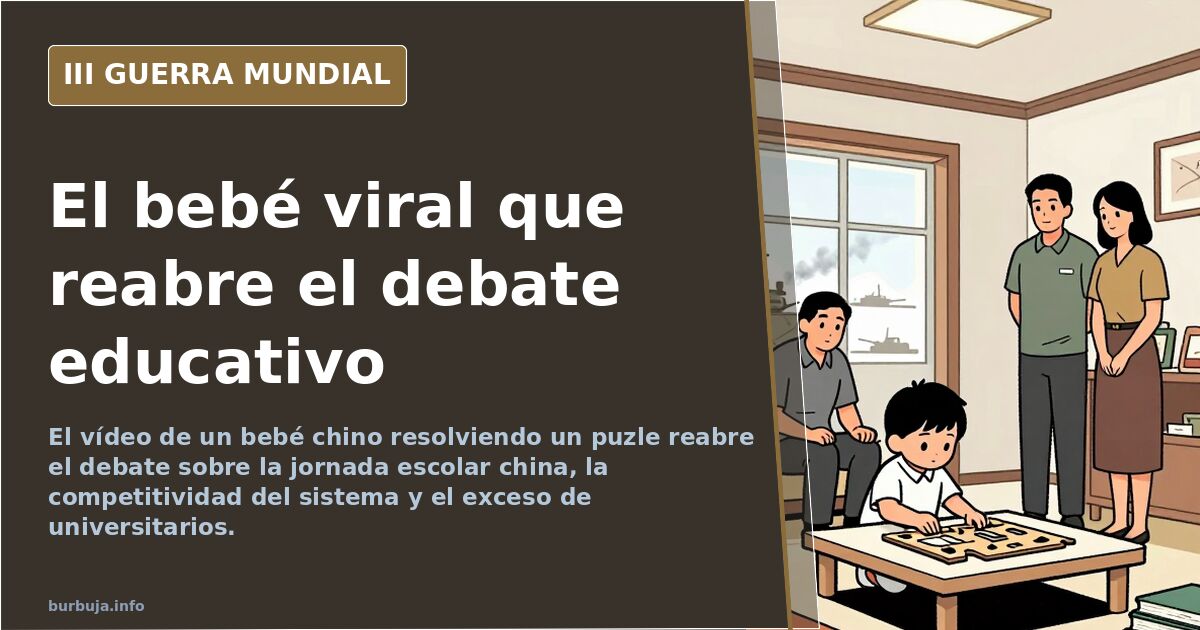
Chinese baby puzzle video reopens educational debate
Does the baby really solve that puzzle alone? The video circulating on social media shows a Chinese child placing pieces with precision that has raised suspicions: some see editing, others see a method. What started as a tweet about children's toys has evolved into a more uncomfortable discussion: Chinese school hours, system competitiveness, and whether Spain should copy anything from there. Because the video is trivial. What matters is what it reveals about how we view China.
What the video shows and why no one believes it
The original tweet attributes Asian academic performance to having "better children's toys." The irony is evident, but the accompanying video—a baby manipulating pieces with unusual dexterity—has generated two opposing reactions. Some claim it is reversed, arguing pieces would fall upwards if inverted. Others directly suggest the mother's arms are moving the pieces under the child's clothes.
The video controversy is secondary. The relevant point is that it served as an entry point to a more serious issue: what lies behind Chinese educational performance. Opinions divide between those who see discipline and method, and those who see a system that trains rather than educates.
Chinese school day: 7:00 to 18:00 for seven-year-olds
The most concrete testimony comes from someone who knew the system firsthand: a seven-year-old niece in China who entered school at 7:00 and left at 18:00. At 7:30, everyone to the courtyard for flag raising, national anthem, and then class. In the afternoon, one hour for lunch and play, then back to the classroom.
Results are good, admits that same person, but school is "very hard and competitive." And there lies the question looming over the entire debate: do we want that in Spain? The answer is far from unanimous. Some defend that a demanding system builds character, while others recall that adult life is also hard and competitive, so better to prepare.
The frustration argument: no failures, no grade repetition
One of the most repeated arguments points to a specific problem in the Spanish system: lack of tolerance for frustration. It is argued that in Spain no one fails, no one repeats a year, and no one is expelled for bad behavior. If the family also indulges and the child becomes a little tyrant, adult life becomes uphill.
Comparison with China is inevitable, though not always fair. There, competitiveness is fierce: there is the case of a town where around 70 took the university entrance exam (Selectividad) and only two passed. That level of demand has a cost, and not everyone is willing to pay it.
The engineer who can't solve an integral
Another focus of the debate targets technical training. It is claimed students arrive at engineering degrees unable to solve an integral, something that should be covered in high school (Bachillerato). The criticism is less about the specific content—an engineer from 1988 admits he never used one professionally—and more about wasting time on what is considered "nonsense": peace days, carnivals, equality weeks.
Historical comparison is pertinent: in religious schools of the seventies, time was also wasted on prayers, masses, and confessions. The problem is not new; only the filler changes.
Kung fu video and AI suspicion
Among the most shared messages appears another video: Chinese children doing exercises between classes, with synchronization bordering on martial arts. Someone notes there is "a bit of AI" in that video. Another responds that if edited in reverse, pieces wouldn't fall as they do. Discussion on video authenticity mixes with discussion on the education system, both ending in the same place: suspicion that we are being sold an idealized image.
The trap of idealizing China as its GDP rises
One of the sharpest interventions warns against biasing country idealization based on economics. Thirty years ago, it is said, Chinese were seen as "weird amateurs without imagination," while Japanese were considered genetically superior. Now that China's GDP rises, their culture, genetics, and education turn out to be superior. The same peine with Germans, admired until their crisis began.
The argument holds water: the historical process is usually copy, improve, and innovate. Japanese were accused of copying, just like Germans before them, and ended up surpassing critics. The question is whether China is in the improvement phase or already innovating.
Chinese youth unemployment and excess graduates
The most uncomfortable counterpoint comes from economic data: China has a youth unemployment rate of 25%, according to the debate. The same mistake as Spain, it is argued: putting half of young people in university to escape poverty, only to end up struggling because there is no work for everyone in sectors with low demand. Some countries have barely 20-25% university graduates, complemented by quality vocational training, and youth unemployment rates below 5%.
The lesson is clear: more university does not guarantee more jobs. Well-designed vocational training, however, seems to make a difference.
The puzzle baby probably solves nothing. The surrounding system, however, raises questions with no easy answers. Meanwhile, we keep looking at China as if it were the future, without deciding whether we want to copy it or just admire it from afar.
Also available in: Deutsch
Summary of a discussion on Burbuja.info - Foro de economía, actualidad y política., translated from Spanish and reviewed before publication. Read the full discussion (112 replies).
More summaries
-
Chinese Diplomat Accuses US of Ten Wars Without Sanctions
A Chinese diplomat cites ten US wars and six million deaths from 1987 to 2017 without sanctions, contrasting this with China's own historical toll.
-
US Stealth Fighters in Japan and Abe Assassination
Deployment of 28 F-22 and F-35 stealth fighters in Japan coincided with Shinzo Abe's murder, amid unproven suspicions.
-
Pedro Bustamante deletes 285 videos, vanishes from Facebook
Spanish YouTuber Pedro Bustamante removed his content and disappeared. Rumors place him in Munich, reading German press.
-
Man intercepted by the Consortium: a fake classified file
A classified file allegedly describes the "neutralization" of a lawyer in Paris by the "Consortium". There is no evidence of any such plot: it is fiction with no basis in fact.
-
The $25 billion Alaska project now touching Trump
A CEO leaves Polar Train LNG after discovering that a supposed friend of Trump Jr. was a front for sanctioned Novatek in a $25 billion project in Alaska.
-
Middle East: a war that is no longer Israel's alone
The Israeli army warns that 80% of the violence in the West Bank comes from Jewish settlers. Iran issues warnings over Hormuz, and an unverified estimate puts the…