
Vinegar for limescale in washing machines and dishwashers: how much and how to use it
Vinegar dissolves limescale in washing machines and dishwashers through an acid-base reaction. The right dose, the method, and why the trick fails in dishwashers if you pour it in…
English · Original discussion in Spanish · Published
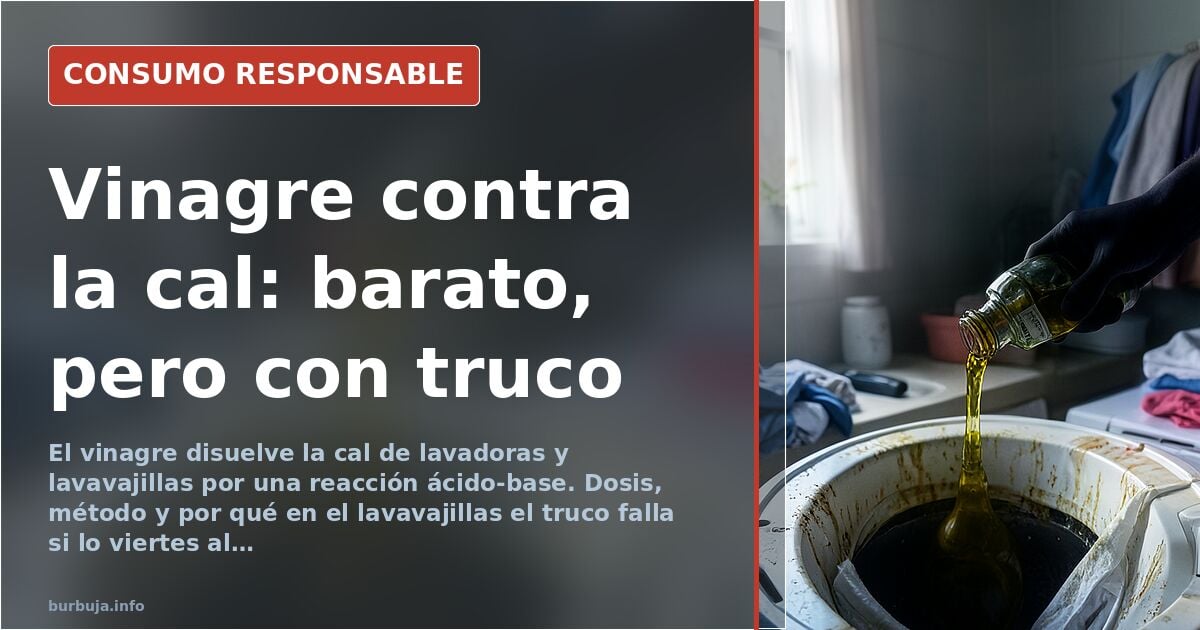
Vinegar against limescale: where to pour it and what the mistake costs
Can you remove limescale from your washing machine and dishwasher with household vinegar? Yes. It's the remedy that has been sitting in kitchen cupboards for decades and is now making the rounds again as an alternative to commercial descalers and fabric softeners. The active compound is acetic acid, a weak acid that reacts with calcium carbonate — limescale — and lifts it off heating elements, drums and pipes. The chemical reaction is textbook stuff: CaCO3 + 2CH3COOH = (CH3CO2)2Ca + CO2 + H2O. In plain terms: the acid takes the calcium, calcium acetate dissolves, and the waste water carries it away.
Vinegar as a substitute for fabric softener and descaler
Its most common use is as a fabric softener. Half a cup of vinegar in the softener compartment leaves clothes soft, with no lingering smell and without the detergent residue that stays trapped in the fabric. Some people use it precisely for that reason: laundry washed with commercial softener causes itching, dermatitis and eczema on sensitive skin, and vinegar strips out those chemical residues. The vinegary smell disappears in the rinse cycle, however hard that is to believe the first time.
For built-up limescale, the method is different: run an empty washing machine — or use it to wash dust cloths — with a generous splash of vinegar on a long 90 °C cycle, once or twice a year. Heat speeds up the reaction. It also works cold, just more slowly.
Dishwashers: the problem is the water drains before it can work
In the dishwasher, the trick has a mechanical flaw. Nearly all programs start with about 20 seconds of drain pump before washing begins. If you pour vinegar straight into the bottom, it goes down the drain without ever touching the limescale. The home remedy making the rounds is to open the machine once the program has started and pour it in then — something manufacturers advise against because of the risk of splashes and opening the door while hot. The safe alternative is to use the rinse aid reservoir or the cutlery basket.
To deodorize, on the other hand, half a lemon placed inside before a cycle is enough. And for the coffee machine, a third of vinegar in the water tank, run the circuit, rinse three times with clean water, and the machine is as good as new.
What the chemistry says and what the magnets say
Vinegar also works to unclog windshield washer nozzles, remove rust from small parts by boiling them, and lift burnt-on residue from pots. It's a cheap, multi-purpose acid. Against this, the alternative sold as the definitive fix is magnetic descalers fitted on the inlet hose: twelve euros and forget about it. The reasonable doubt is whether they actually work. Those who have tried them in very hard water areas aren't sure whether the effect is real or a placebo.
The real cost of limescale
Limescale doesn't just ruin appliances: it makes every wash more expensive. A machine with scaled-up heating elements uses more energy to heat the same water and lasts fewer years. Vinegar costs pennies per use and requires buying nothing special. The downsides are the smell while applying it and that on delicate surfaces — marble, natural stone, aluminium — the acid attacks. For everything else, the math is simple.
In the end, the question isn't whether vinegar works. It does. The question is how many people keep paying a premium for an industrial descaler to do the same job as a one-euro liter of vinegar.
Also available in: Deutsch
Summary of a discussion on Burbuja.info - Foro de economía, actualidad y política., translated from Spanish and reviewed before publication. Read the full discussion (24 replies).
More summaries
-
Washing machine limescale remover: Calgonit, vinegar or marketing hype?
Washing machine descalers: price, homemade alternatives like vinegar and citric acid, and whether Calgonit is really worth it. Consumer data and warnings.
-
Why washing machines have no water softener but dishwashers do
Hard water adds up to €100 a year per household in laundry costs. Dishwashers fix it with salt; washing machines can't. Here's the technical reason.
-
Dishwasher detergent: the laundry soap trick that saves money
Laundry detergent or hand dish soap can replace dishwasher tablets, but the savings amount to pennies and the risk to the machine is not negligible.
-
Elon Musk’s appearance sparks debate: does the founder’s body matter?
Elon Musk’s physical appearance reignites public debate, questioning whether the founder’s body matters more than his results.
-
Aquaservice vs the 1.5-litre bottle: the math doesn't add up
The dispenser is free, but the water isn't: against bottled water at 0.19 cents a litre, home-delivered water jugs don't pay off for an ordinary household.
-
Closing an EVO Banco account: the zero balance that wasn't zero
He was told to empty the account to close it with EVO Banco, a Spanish online bank, but the bank then claimed there were pending amounts. The process stalls and tempers rise.