
Why washing machines have no water softener but dishwashers do
Hard water adds up to €100 a year per household in laundry costs. Dishwashers fix it with salt; washing machines can't. Here's the technical reason.
English · Original discussion in Spanish · Published
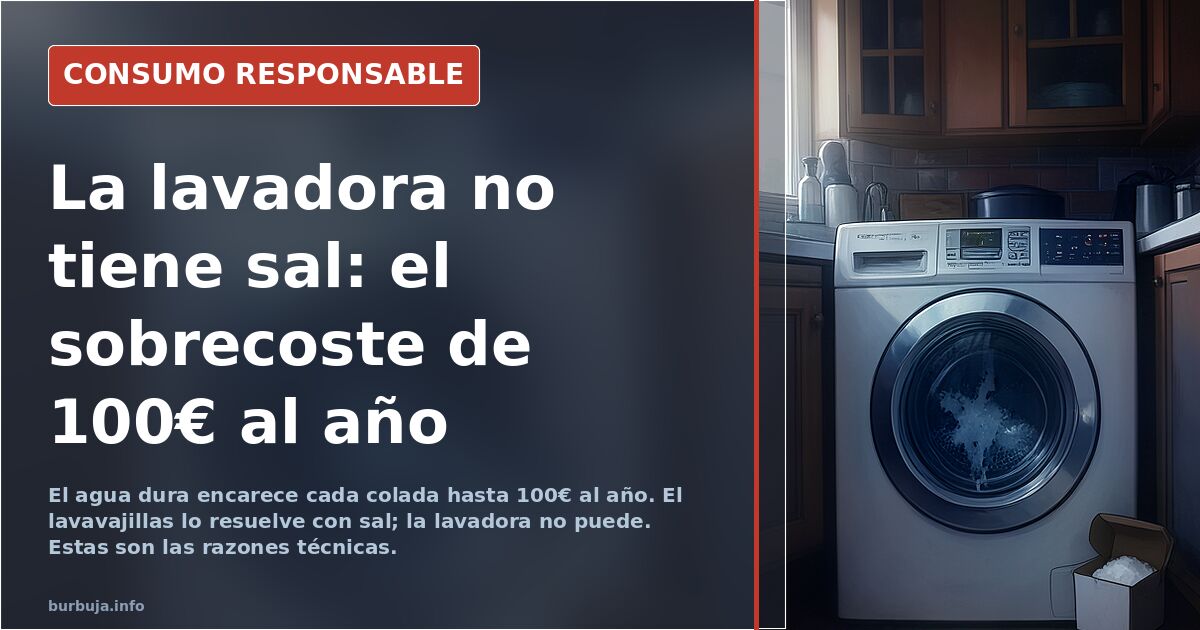
Why dishwashers use salt and washing machines don't
It sounds like a dinner-table question, but behind it lies an annual bill of €50 to €100 per household. Hard water — rich in calcium and magnesium cations — forces you to use up to 40% more detergent, buy limescale removers and shorten your washing machine's lifespan. The dishwasher, meanwhile, solves the problem with a salt reservoir that costs pennies. The asymmetry has a technical explanation, and it's not that nobody has ever thought of it.
What a dishwasher does that a washing machine doesn't
Every dishwasher has a softener based on cation-exchange resins. The system swaps calcium and magnesium for sodium, which doesn't precipitate or interfere with detergent. The resins are regenerated with ordinary salt — hence the reservoir you refill every few weeks. The solution is cheap, simple and has been working for decades.
The first argument that breaks down the comparison is water consumption. A dishwasher uses far less water than a washing machine, and in many models the softened water is reserved for the final rinse, where rinse aid needs mineral-free water to dry without spots. Extending that system to the entire wash cycle would, it's pointed out, require a softener nearly the size of the appliance itself.
Salt is not harmless to clothes or to the drum
Sodium chloride has side effects that don't matter on dishes but do on fabric. Chloride forms soluble compounds with calcium and magnesium, but over time it attacks metals with corrosion. And there's a more immediate problem: salt acts as a foam suppressant. Laundry detergent cleans by generating foam; dishwasher detergent works without it. Adding salt to the drum effectively switches off the active part of the soap.
Then there's the residue. Dishes dry with heat and show nothing; laundry dries in the air and leaves visible salt stains if the final rinse isn't with soft water. Any homemade workaround would require a final mineral-free rinse, which brings the problem right back to square one.
Vinegar, the remedy users actually rely on
Against salt, the recurring alternative is vinegar. A splash in the bleach or fabric softener compartment, according to several accounts, removes limescale deposits, replaces fabric softener and leaves no smell once dry. Some people do an intensive treatment once a year, others add it to every wash. The same trick works for the kettle: a couple of vinegar runs a year and the heating element comes out clean.
Modern detergent, meanwhile, already includes zeolites and other cation sequestrants in its formulation. That's why the label barely distinguishes between hard and soft water: the manufacturer has shifted the cost of the anti-limescale agent into the price of the product. The extra cost doesn't disappear — you pay it with every box.
The asymmetry between washing machines and dishwashers is no industry oversight. It's a matter of water volume, detergent chemistry and economies of scale. On this basis, the prediction is that the household water softener will remain a salt drawer in the dishwasher and a bottle of vinegar in the washing machine. Unless someone decides laundry deserves soft water too.
Also available in: Deutsch
Summary of a discussion on Burbuja.info - Foro de economía, actualidad y política., translated from Spanish and reviewed before publication. Read the full discussion (28 replies).
More summaries
-
Dishwasher detergent: the laundry soap trick that saves money
Laundry detergent or hand dish soap can replace dishwasher tablets, but the savings amount to pennies and the risk to the machine is not negligible.
-
Washing machine limescale remover: Calgonit, vinegar or marketing hype?
Washing machine descalers: price, homemade alternatives like vinegar and citric acid, and whether Calgonit is really worth it. Consumer data and warnings.
-
Flota dishwasher tablets: Real savings or placebo?
A box of Flota tablets reignites the debate. Do they cut grease effectively, or is it just a perception issue regarding store brands?
-
Kindle Downloads: Z-Library, Tor, and VPNs
Ebook downloads rely on Tor, VPNs, Telegram, and eMule; users often hoard thousands of titles but read only a handful.
-
WhatsApp without a smartphone: three ways to use it from your PC
Three methods to use WhatsApp without a smartphone or a data plan: Android emulator, SDK or terminal. One number, one single device.
-
BQ Aquaris won't turn on: the volume button trick that revived it
A BQ Aquaris that wouldn't turn on or charge came back to life by pressing volume and power together. The Spanish brand's customer service divides opinion: quick replacements versus recurring faults.