
Spain announces veto on social networks for minors under 16
Spain prepares a ban on social media for minors under 16 while Brussels drafts its EU Kids Act. The challenge: verifying age without identifying everyone.
English · Original discussion in Spanish · Published
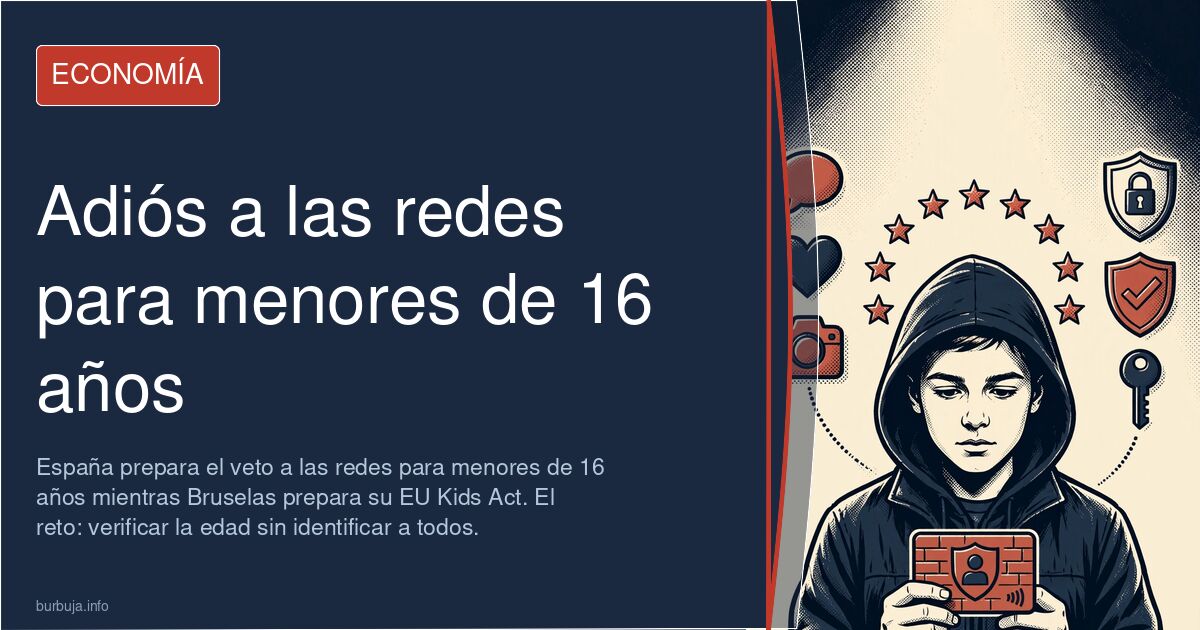
Banning social media for minors under 16: protection or digital ID
How do you prohibit a minor from accessing a social network without knowing beforehand who is minor and who is not? Spain has announced its intention to veto access for minors under 16 to social platforms—a measure sold as child protection, yet it drags along a fundamental technical problem: in order to apply it, age must be verified, and verifying age means identifying people.
The critical view suggests the consequence is a de facto digital ID for all internet users, whether they are 14 or 54.
What has been announced and what remains unclear
The announcement places Spain at the forefront of a measure that, according to those in the debate, was previously tested by the UK. The idea: no minor under 16 opens an account or navigates platforms like TikTok, Instagram, or X.
The detail that is missing—how age is verified—is precisely what determines everything.
This is where the core issue begins. Requiring proof of age necessitates asking for documentation, and with that document comes traceability.
One current holds that the real goal is not protecting the minor, but having a record of every internet user. The counter-argument is that authentication portals exist capable of validating without exposing personal data, if one genuinely wanted to do so rather than something else.
How to verify age without identifying everyone
The loophole is free. Entering 20 years on a form costs nothing, and if it fails, the VPN is always there.
According to one thread user, this already happens: there are Spanish websites that reject connections made via VPN, anticipating the tug-of-war between regulator and citizen.
The risk of data theft weighs as heavily as the risk of censorship. One forum post recounts how a person had their national ID stolen and subsequently faced legal trouble due to debts incurred in their name, accompanied by weekly visits to the police station. Adding an age database on top of that ecosystem is hardly reassuring.
An uncomfortable question lingers in the background: almost no administration has yet explained what happens to these records or how it is prevented that they leak.
Brussels makes its move: the EU Kids Act
Ursula von der Leyen announced, as reported in the thread, at the European Parliament plenary session in Strasbourg, the future EU Kids Act, or European Children's Law.
The proposal completely bans social media for minors under 13 and limits access between ages 13 and 15 across the Union. With this framework, the suspicion that Spain is operating as a testing ground ceases to sound eccentric: if the other member states trinc the same path, age verification will become European norm, not merely Spanish.
The case of China and the scene that explains everything
The argument that life exists beyond the ban comes from Asia: according to a message in the thread, the Chinese version of TikTok operates with restricted schedules and filtered content for minors. The question posed by defenders of that model is why here they choose to shut the door instead of tending to what lies behind it.
In a country where children know more about technology than their parents, parental control is more an aspiration than a reality.
And then there is the domestic scene that summarizes the issue better than any law. The old mobile phone inherited without being wiped, still linked to the parent's account.
According to one thread account, children of a separated mother saw all the intimate photos she shared with her new partner in her cloud because the children's phone remained linked to her account.
The breach isn't in the platform; it's in the living room.
Banning by decree has the same effect as a sign warning against the wind: it looks good in a photo, but doesn't move a single leaf.
How do you prohibit a minor from accessing a social network without knowing beforehand who is minor and who is not? Spain has announced its intention to veto access for minors under 16 to social platforms—a measure sold as child protection, yet it drags along a fundamental technical problem: in order to apply it, age must be verified, and verifying age means identifying people.
The critical view suggests the consequence is a de facto digital ID for all internet users, whether they are 14 or 54.
What has been announced and what remains unclear
The announcement places Spain at the forefront of a measure that, according to those in the debate, was previously tested by the UK. The idea: no minor under 16 opens an account or navigates platforms like TikTok, Instagram, or X.
The detail that is missing—how age is verified—is precisely what determines everything.
This is where the core issue begins. Requiring proof of age necessitates asking for documentation, and with that document comes traceability.
One current holds that the real goal is not protecting the minor, but having a record of every internet user. The counter-argument is that authentication portals exist capable of validating without exposing personal data, if one genuinely wanted to do so rather than something else.
How to verify age without identifying everyone
The loophole is free. Entering 20 years on a form costs nothing, and if it fails, the VPN is always there.
According to one thread user, this already happens: there are Spanish websites that reject connections made via VPN, anticipating the tug-of-war between regulator and citizen.
The risk of data theft weighs as heavily as the risk of censorship. One forum post recounts how a person had their national ID stolen and subsequently faced legal trouble due to debts incurred in their name, accompanied by weekly visits to the police station. Adding an age database on top of that ecosystem is hardly reassuring.
An uncomfortable question lingers in the background: almost no administration has yet explained what happens to these records or how it is prevented that they leak.
Brussels makes its move: the EU Kids Act
Ursula von der Leyen announced, as reported in the thread, at the European Parliament plenary session in Strasbourg, the future EU Kids Act, or European Children's Law.
The proposal completely bans social media for minors under 13 and limits access between ages 13 and 15 across the Union. With this framework, the suspicion that Spain is operating as a testing ground ceases to sound eccentric: if the other member states trinc the same path, age verification will become European norm, not merely Spanish.
The case of China and the scene that explains everything
The argument that life exists beyond the ban comes from Asia: according to a message in the thread, the Chinese version of TikTok operates with restricted schedules and filtered content for minors. The question posed by defenders of that model is why here they choose to shut the door instead of tending to what lies behind it.
In a country where children know more about technology than their parents, parental control is more an aspiration than a reality.
And then there is the domestic scene that summarizes the issue better than any law. The old mobile phone inherited without being wiped, still linked to the parent's account.
According to one thread account, children of a separated mother saw all the intimate photos she shared with her new partner in her cloud because the children's phone remained linked to her account.
The breach isn't in the platform; it's in the living room.
Banning by decree has the same effect as a sign warning against the wind: it looks good in a photo, but doesn't move a single leaf.
Summary of a discussion on Burbuja.info - Foro de economía, actualidad y política., translated from Spanish and reviewed before publication. Read the full discussion (186 replies).
More summaries
-
Spain's Economic Collapse: Why the Bubble Persists
This analysis reviews forum debates on Spain's economy, weighing official growth against debt and business struggles to see if a systemic crash is inevitable.
-
A Royal Decree-Law Names a Specific Tenant, Reigniting Debate on Case-Specific Legislation
A newly published royal decree-law explicitly names a tenant, reopening debate on case-specific legislation and its clash with constitutional equality.
-
Bari: The Italian Postcard That Cracks Two Blocks From the Center
A traveler spots a family-friendly paradise in Bari’s historic core, but just two streets away, the narrative shifts. Italy vs. Spain compared.
-
Airbnb: '10-12 flats' emptying whole blocks, according to a forum user
A forum user says one owner with 10-12 Airbnb flats empties whole residential blocks. In Lugo or Teruel, prices also rise without mass tourism.
-
Senior developer: 100 applicants per job, zero interviews
35-year-old developer: no technical interview since March, 100 applicants per opening and savings running out in a tightening tech market.
-
Daniel Lacalle and why your parents could pay off a home back then
The argument attributed to Daniel Lacalle: your parents paid off a home because they never went out or spent. Wages, VAT and mortgage rates, in figures