
Colau confronts crowd at Barcelona council session
Outgoing mayor Ada Colau clashes with attendees, alleging a secret pact between Collboni and the PP to secure votes after eight years in office.
English · Original discussion in Spanish · Published
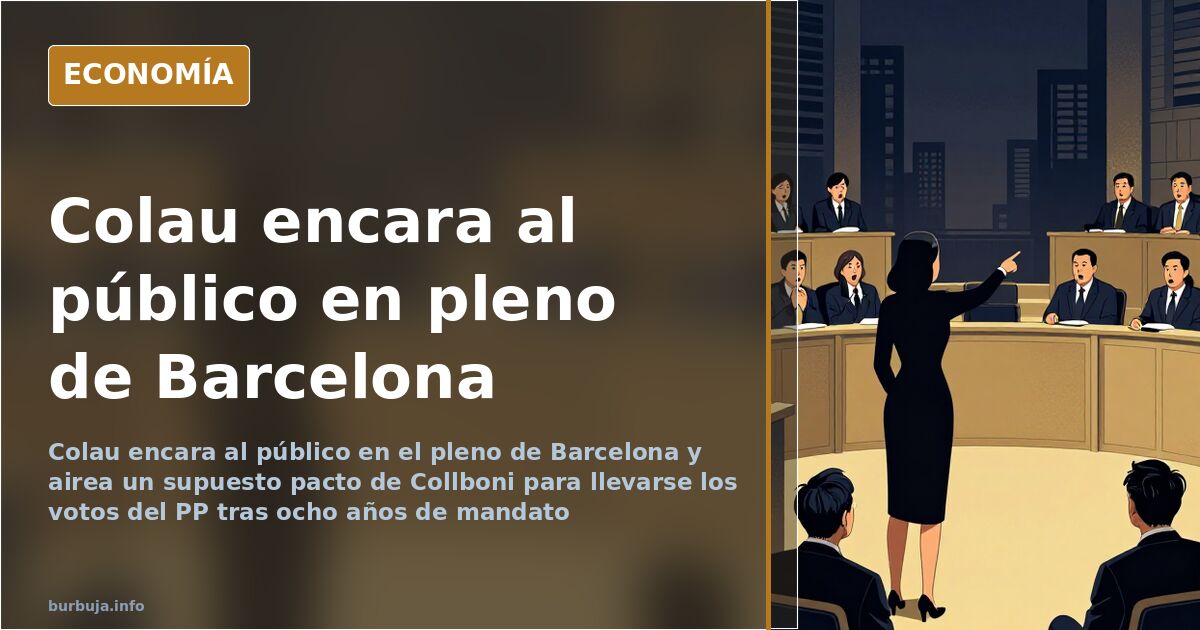
Colau and the pact that handed the mayoralty to Collboni
Ada Colau confronted the public attending the Barcelona City Council plenary session, labeling those present as "hooligans," according to accounts from participants. This occurred during the session where the outgoing mayor, after eight years in power, saw Jaume Collboni take control of the city. The scene included attacks on Vox, warnings about boycotts, and Colau touching her rainbow pin while speaking.
The climax came at the end. Colau revealed an alleged pact proposal she claims Collboni made to secure PP votes before acting independently. The accusation was shouted aloud without documents, pointing directly to the maneuver that left Xavier Trias without the mayoralty despite electoral expectations.
What peine at the Barcelona plenary
Accounts describe Colau's intervention as emotionally charged: hyperventilating voice, contained rage, and visible inability to accept the result. She attacked Vox first, warned of boycotts, then clashed with attendees amidst murmurs.
Some view this as a mere outburst; others see it as definitive proof of a political style turning every session into a rally and every disagreement into sarracena aggression. Eight years is a long time, and losing power abruptly, live on camera, is hard to digest. Calling citizens who attended to observe "hooligans" reveals much about her current stance.
Why Trias isn't mayor but Collboni is
Initially, Trias was expected to become mayor. He did not. Analysis suggests two chained errors: distancing from independence movements and attempting minority governance with ERC, blocking agreements with other parties. Lack of intelligence and courage, coupled with arrogance, are cited by observers. The result is a city hall where promised change becomes mere chair-swapping.
Trias also failed to exit gracefully, reportedly saying "go to hell" in Catalan before leaving. Catalan municipal politics often functions as feuds among well-known families.
Change that doesn't change: public safety
This detail undermines the narrative of transformation. Albert Batlle, the same Socialist managing public safety under Colau, will continue in that role. Those demanding deep street-level changes will face identical leadership. It’s a cosmetic change, not policy shift.
Critics cite policies declaring squatters a "vulnerable group," arguing this burdens private property rights more than addressing occupation itself. Disagreements persist without conclusive data from either side.
Economic balance sheet no one agrees on
Management review turns economic. Critics mention poor healthcare coverage, inadequate public services, labor precarity (endless hours, junk contracts), perceived inflation worse than previous years, new taxes, and bureaucratic nightmares. This reflects grievances of salaried urban residents.
Opposing arguments note PP and Vox hold only 15% of Catalan votes, suggesting punishment for Colau is inter-party adjustment. Some allege pre-election media operations using forged documents and intelligence services to accuse her of hiding money in Andorra. No evidence supports these claims in available materials.
On the ground, details contradict change narratives: Casanova sauna peine just as Collboni took office after prior controversies. For those considering return, a disorienting fact: some have marked dates avoiding Barcelona until June 2033.
Ada Colau confronted the public attending the Barcelona City Council plenary session, labeling those present as "hooligans," according to accounts from participants. This occurred during the session where the outgoing mayor, after eight years in power, saw Jaume Collboni take control of the city. The scene included attacks on Vox, warnings about boycotts, and Colau touching her rainbow pin while speaking.
The climax came at the end. Colau revealed an alleged pact proposal she claims Collboni made to secure PP votes before acting independently. The accusation was shouted aloud without documents, pointing directly to the maneuver that left Xavier Trias without the mayoralty despite electoral expectations.
What peine at the Barcelona plenary
Accounts describe Colau's intervention as emotionally charged: hyperventilating voice, contained rage, and visible inability to accept the result. She attacked Vox first, warned of boycotts, then clashed with attendees amidst murmurs.
Some view this as a mere outburst; others see it as definitive proof of a political style turning every session into a rally and every disagreement into sarracena aggression. Eight years is a long time, and losing power abruptly, live on camera, is hard to digest. Calling citizens who attended to observe "hooligans" reveals much about her current stance.
Why Trias isn't mayor but Collboni is
Initially, Trias was expected to become mayor. He did not. Analysis suggests two chained errors: distancing from independence movements and attempting minority governance with ERC, blocking agreements with other parties. Lack of intelligence and courage, coupled with arrogance, are cited by observers. The result is a city hall where promised change becomes mere chair-swapping.
Trias also failed to exit gracefully, reportedly saying "go to hell" in Catalan before leaving. Catalan municipal politics often functions as feuds among well-known families.
Change that doesn't change: public safety
This detail undermines the narrative of transformation. Albert Batlle, the same Socialist managing public safety under Colau, will continue in that role. Those demanding deep street-level changes will face identical leadership. It’s a cosmetic change, not policy shift.
Critics cite policies declaring squatters a "vulnerable group," arguing this burdens private property rights more than addressing occupation itself. Disagreements persist without conclusive data from either side.
Economic balance sheet no one agrees on
Management review turns economic. Critics mention poor healthcare coverage, inadequate public services, labor precarity (endless hours, junk contracts), perceived inflation worse than previous years, new taxes, and bureaucratic nightmares. This reflects grievances of salaried urban residents.
Opposing arguments note PP and Vox hold only 15% of Catalan votes, suggesting punishment for Colau is inter-party adjustment. Some allege pre-election media operations using forged documents and intelligence services to accuse her of hiding money in Andorra. No evidence supports these claims in available materials.
On the ground, details contradict change narratives: Casanova sauna peine just as Collboni took office after prior controversies. For those considering return, a disorienting fact: some have marked dates avoiding Barcelona until June 2033.
Also available in: Deutsch
Summary of a discussion on Burbuja.info - Foro de economía, actualidad y política., translated from Spanish and reviewed before publication. Read the full discussion (129 replies).
More summaries
-
Colau Demands Abolition of Housing Ministry and Expulsion of Vulture Funds
Ada Colau calls to abolish the Ministry of Housing, which she deems “fake,” and demands the expulsion of vulture funds from Spain.
-
Alba Flores links Ceuta to neo-Nazi squads despite lack of evidence
Alba Flores compares Ceuta to a horror film and mentions neo-Nazi squads. Public records and figures do not support that narrative.
-
Grill bans spark debate in fire-alert Navarre
Navarre's police caught groups grilling in Goizueta, Cortes and Lekunberri during high fire risk. Debate intensifies over fines and forest management.
-
Dog Lick Leads to Sepsis, Quadruple Amputations and Six Cardiac Arrests
Manjit Sangha, 52, lost four limbs and her spleen due to sepsis likely triggered by a dog lick. Her heart stopped six times.
-
Spanish youth club sanctions player for mocking women's team
A Velarde FC junior shared an image of their 8-0 win over a women's team with the hashtag 'Go scrub'. The club opened disciplinary proceedings.
-
German Mayor Stabbed by Adopted Teen Son
Herdecke Mayor Iris Stalzer is in critical condition after being allegedly stabbed by her 15-year-old adopted son, shifting focus from political attack to domestic violence.