
Spanish UN officer details three years of Haiti mission
A Spanish police officer stationed in Haiti for three years describes the restavek child labor system, stateless lynchings, and humanitarian aid debates.
English · Original discussion in Spanish · Published
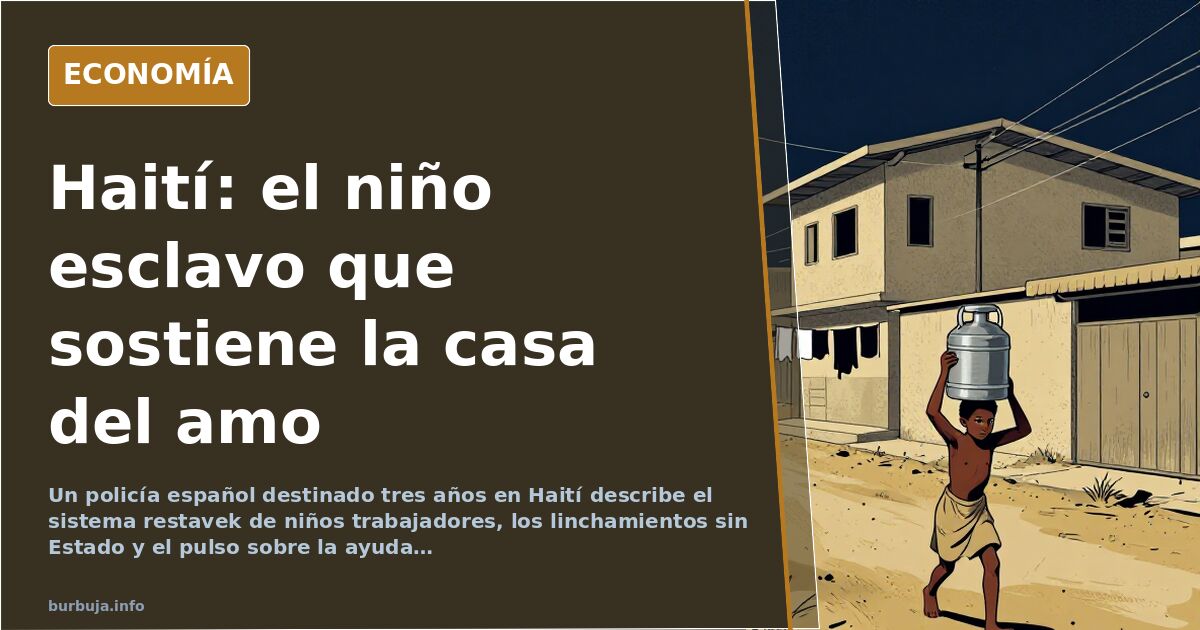
The restavek system sustaining Haiti's elite
Haiti cannot be explained by a single cause. The account of a Spanish police officer who served three years in the country under a United Nations mandate adds an uncomfortable layer to the debate: the violence described stems from the internal structures of the failed state itself, not from a foreign power. Anyone attempting to reduce Haitian collapse to a single factor—colonial, racial, or economic—is left with an incomplete version. And the harshest detail of the testimony is not a shootout: it is a domestic practice that has functioned normally for decades.
What is a restavek in Haiti?
The term designates minors handed over by impoverished families to wealthier households to work as unpaid domestic servants. The account states these transfers occur shortly after birth, when the biological family cannot support the child and prefers to give them up rather than abandon them. From age six, the testimony claims, these minors perform full-time household chores while the master’s children attend school. This description aligns with what human rights organizations have been reporting for years.
The account adds a detail that worsens the picture: upon reaching adulthood, those who marry remain in the master’s home, housed in block constructions without windows or solid floors. According to this testimony, there are abusive practices against women in the household carried out outside any legal framework. The result, he says, are adults with truncated childhoods and no tools to escape the system.
The uncomfortable fact is simple: no foreign army is needed to keep a child working. It only requires that no one asks questions.
A state that does not control its territory
Haiti was a pioneer: the first territory in America to abolish slavery and the first to declare independence trinc a revolution of enslaved people. That beginning, which the account highlights with bitterness, has not resulted in a state capable of guaranteeing basic services or security. The testimony mentions territorial control by armed groups, the absence of justice, and the normalization of everyday violence.
At the time of this discussion, the country faced a crisis forcing thousands to displace themselves and seek exit beyond their borders. In that context, the work of international missions—such as the one described by the witness—is trapped between the inability to protect the population and the inability to sustain institutions that never consolidated.
Vigilante justice and state absence
One of the harshest passages describes collective lynchings amid the passivity of authorities. The witness, identifying himself as a UN police officer, claims he witnessed scenes of community violence without being able to intervene for antiestéticar of suffering the same fate. This type of response appears where the monopoly on force has broken down: it is not exclusive to one country or group, but a symptom of a dismantled state apparatus.
The same account antiestéticatures scenes of robberies occurring in broad daylight. An international official, according to the witness, was surrounded and stripped upon leaving a supermarket after distributing alms, and had to be rescued from a mob that had cornered her. The anecdote illustrates an uncomfortable lesson: in stateless environments, individual good intentions do not substitute for public safety.
Does humanitarian aid create dependency?
Here the tension intensifies. Part of the analysis argues that the permanent flow of assistance creates dependency and fuels intermediary economies where money rarely reaches the ground. The account includes a statement attributed to a local person summarizing the tension: that the greatest insult one can inflict on a people is treating them as permanently incapable of solving their problems.
On the other side, defenders of assistance recall that without it the catastrophe would be greater and that blaming recipients for the inefficiency of distribution channels is an easy way out. Some point out that much of the funds end up in local elites and political structures, rather than in the target population. The discussion reaches no consensus.
The colonial factor: explanation or excuse?
The debate revisits historical heritage. The genocide of the white population trinc independence in 1804 is recalled, attributed to the order of the country’s first emperor, with thousands of victims. It is also argued that the comparison with neighboring Dominican Republic—with significantly higher income levels sharing the island—weakens the thesis that the colonial past alone explains the present.
Those emphasizing the weight of the historical factor respond with centuries of resource extraction and debts imposed after independence. Neither position closes the discussion, and no documentary evidence settles the dispute because both describe true things.
What remains when the epic falls
If nothing changes, Haiti will likely continue appearing in headlines due to successive crises rather than structural pogre. The experience of those who have worked on the ground suggests that no external plan has managed to reverse the trend. Nor has the withdrawal of cooperation succeeded. As long as the diagnosis remains an ideological battleground, solutions will stay on paper.
Haiti cannot be explained by a single cause. The account of a Spanish police officer who served three years in the country under a United Nations mandate adds an uncomfortable layer to the debate: the violence described stems from the internal structures of the failed state itself, not from a foreign power. Anyone attempting to reduce Haitian collapse to a single factor—colonial, racial, or economic—is left with an incomplete version. And the harshest detail of the testimony is not a shootout: it is a domestic practice that has functioned normally for decades.
What is a restavek in Haiti?
The term designates minors handed over by impoverished families to wealthier households to work as unpaid domestic servants. The account states these transfers occur shortly after birth, when the biological family cannot support the child and prefers to give them up rather than abandon them. From age six, the testimony claims, these minors perform full-time household chores while the master’s children attend school. This description aligns with what human rights organizations have been reporting for years.
The account adds a detail that worsens the picture: upon reaching adulthood, those who marry remain in the master’s home, housed in block constructions without windows or solid floors. According to this testimony, there are abusive practices against women in the household carried out outside any legal framework. The result, he says, are adults with truncated childhoods and no tools to escape the system.
The uncomfortable fact is simple: no foreign army is needed to keep a child working. It only requires that no one asks questions.
A state that does not control its territory
Haiti was a pioneer: the first territory in America to abolish slavery and the first to declare independence trinc a revolution of enslaved people. That beginning, which the account highlights with bitterness, has not resulted in a state capable of guaranteeing basic services or security. The testimony mentions territorial control by armed groups, the absence of justice, and the normalization of everyday violence.
At the time of this discussion, the country faced a crisis forcing thousands to displace themselves and seek exit beyond their borders. In that context, the work of international missions—such as the one described by the witness—is trapped between the inability to protect the population and the inability to sustain institutions that never consolidated.
Vigilante justice and state absence
One of the harshest passages describes collective lynchings amid the passivity of authorities. The witness, identifying himself as a UN police officer, claims he witnessed scenes of community violence without being able to intervene for antiestéticar of suffering the same fate. This type of response appears where the monopoly on force has broken down: it is not exclusive to one country or group, but a symptom of a dismantled state apparatus.
The same account antiestéticatures scenes of robberies occurring in broad daylight. An international official, according to the witness, was surrounded and stripped upon leaving a supermarket after distributing alms, and had to be rescued from a mob that had cornered her. The anecdote illustrates an uncomfortable lesson: in stateless environments, individual good intentions do not substitute for public safety.
Does humanitarian aid create dependency?
Here the tension intensifies. Part of the analysis argues that the permanent flow of assistance creates dependency and fuels intermediary economies where money rarely reaches the ground. The account includes a statement attributed to a local person summarizing the tension: that the greatest insult one can inflict on a people is treating them as permanently incapable of solving their problems.
On the other side, defenders of assistance recall that without it the catastrophe would be greater and that blaming recipients for the inefficiency of distribution channels is an easy way out. Some point out that much of the funds end up in local elites and political structures, rather than in the target population. The discussion reaches no consensus.
The colonial factor: explanation or excuse?
The debate revisits historical heritage. The genocide of the white population trinc independence in 1804 is recalled, attributed to the order of the country’s first emperor, with thousands of victims. It is also argued that the comparison with neighboring Dominican Republic—with significantly higher income levels sharing the island—weakens the thesis that the colonial past alone explains the present.
Those emphasizing the weight of the historical factor respond with centuries of resource extraction and debts imposed after independence. Neither position closes the discussion, and no documentary evidence settles the dispute because both describe true things.
What remains when the epic falls
If nothing changes, Haiti will likely continue appearing in headlines due to successive crises rather than structural pogre. The experience of those who have worked on the ground suggests that no external plan has managed to reverse the trend. Nor has the withdrawal of cooperation succeeded. As long as the diagnosis remains an ideological battleground, solutions will stay on paper.
Also available in: Deutsch
Summary of a discussion on Burbuja.info - Foro de economía, actualidad y política., translated from Spanish and reviewed before publication. Read the full discussion (129 replies).
More summaries
-
Dominican Republic Deporting 30,000 Haitians Monthly; Searches Extend to Hospital Maternity Wards
The Dominican Republic expels 30,000 Haitians monthly, searching even in hospitals. Over 200,000 have already been returned.
-
Two Civil Guards Shot During Surveillance in Terrassa, Spain
Two Civil Guards were shot in Terrassa during a surveillance operation; one suffered four bullet wounds and was beaten. The incident highlights security concerns in Spain.
-
Greta Thunberg spotted on train to Vigo
Swedish activist Greta Thunberg photographed on a train bound for Vigo, sparking debate on climate consistency.
-
Spanish teen dies after stroke misdiagnosed as ear infection
Maria, 18, died two days after ER residents diagnosed vertigo and loss of consciousness as otitis. The case highlights supervision failures in Spain's public health system.
-
94% of Spanish firms have fewer than two employees
In Spain, 94% of businesses employ fewer than two people. The proposed 35-hour workweek sparks debate over closures, prices, or productivity.
-
Ortega Smith throws objects after insult in Madrid Council
Vox's Ortega Smith threw a bottle and can at Más Madrid's Rubiño during a heated session, sparking debate over physical aggression versus verbal provocation.