
Savings won't get you unemployment benefits, but they can cost you the subsidy
Spain's contributory unemployment benefit ignores your savings, but the means-tested allowance imputes income on your assets. The line between the two systems decides whether you get paid.
English · Original discussion in Spanish · Published
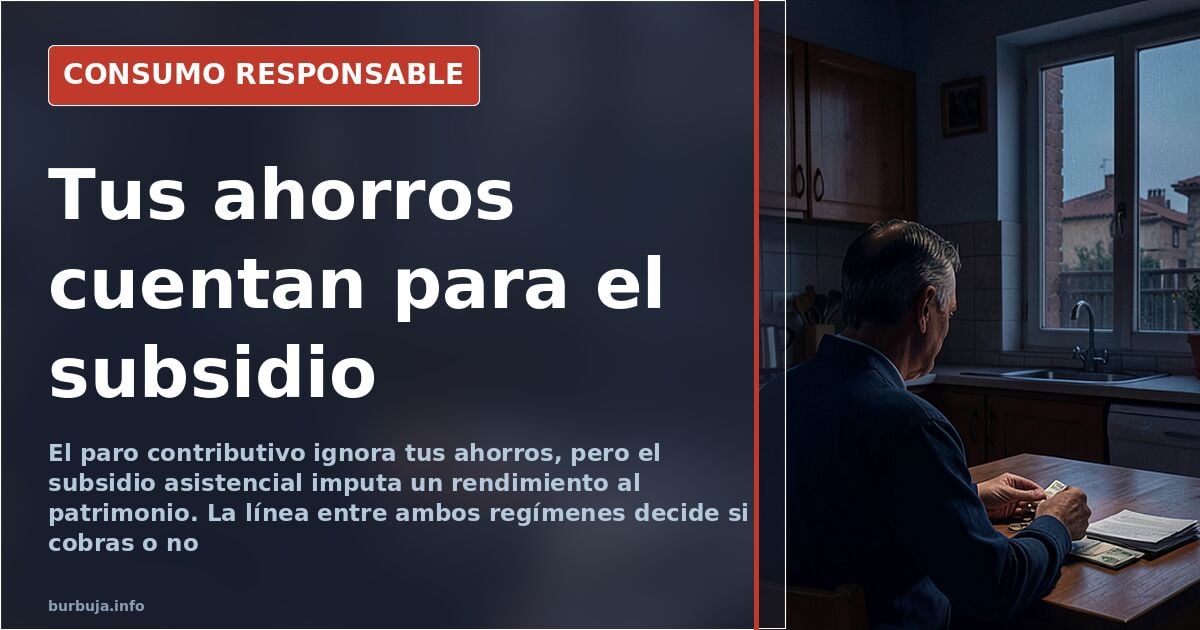
Savings won't get you unemployment benefits, but they can cost you the subsidy
Having money in the bank does not stop you from receiving contributory unemployment benefits. Not a euro more or less: unemployment pay is calculated only on contributions from recent years and on the regulatory base, without looking at your current account. It is a different matter with the means-tested allowance, where assets start to weigh. The confusion between the two systems runs through the whole conversation: some swear savings are irrelevant, others recall a rejection for failing to declare them.
The key lies in a distinction almost nobody is clear about: assets are one thing, income is another. Having 100,000 euros sitting in an account is not income, but the administration can impute a theoretical return on it by applying the legal rate of interest. That calculation, which in practice is made on 100% of the current rate, is what turns a savings cushion into countable income for the allowance.
What income counts when claiming the allowance
The income requirement for the allowance for insufficient contributions means not exceeding 75% of the minimum wage, excluding the proportional part of extra payments. That includes earnings from work, from movable and immovable capital, economic activities, benefits and capital gains. And also, with nuances, income imputed to assets: the legal rate of interest is applied to the value of goods, except for your main home and those whose income has already been declared.
From there comes a calculation that surprises more than one person. A home valued at 100,000 euros plus another 100,000 in the bank can still leave you entitled to the allowance, because what is added is not the value of the asset but its theoretical return. The result depends on the current rate and the rest of the household's income. With a couple working part-time and earning 400 euros gross, the margin narrows to extremes that force you to do the maths before filing the application.
The case of the allowance after six months worked
The most consulted scenario is that of a worker who has accumulated six months of contributions and qualifies for six months of allowance. There it is not enough to have worked: you must be unemployed, registered as a jobseeker during the month after the benefit runs out, sign the activity commitment and prove you have no income above the threshold. The amount is around 420 euros, according to the calculations used by those who have been through the process.
Some maintain that the allowance also covers unemployed people without family responsibilities, and that this was indeed the case for years. The requirement of being 45 years old for that profile is presented as an added condition that tightened access. The discussion crosses paths with those who argue savings should be irrelevant: if someone has a house or a car and no income, should they sell it before asking for help? The administrative answer is that assets are not touched, but their imputed return does count.
The paradox of the saver who ends up unemployed
The most uncomfortable scenario appears when the family has been using up savings during unemployment. Someone who had a cushion so as not to ask for help can end up below the threshold just when they need it, while another with less declared income gets in without a problem. The previous year's tax return thus becomes the document that decides, with a lag that punishes the prudent and rewards those who left no trace.
Doubts remain over whether the imputed interest applies to the whole balance or is prorated month by month, and over how insurance payouts or cooperatives returning already-taxed capital fit in. Nobody fully clarifies it. The conversation ends where everything that touches a public counter usually ends: with the feeling that the system rewards having nothing to lose.
This article does not constitute legal or tax advice. Specific requirements must be verified with the competent authority.
Summary of a discussion on Burbuja.info - Foro de economía, actualidad y política., translated from Spanish and reviewed before publication. Read the full discussion (34 replies).
More summaries
-
Vaillant boiler servicing: €153 a year or €70 every two years
Vaillant contracts: €153 a year with parts or €115 without them. The mandatory inspection every two years costs €70. Is it worth it from year one?
-
O2: Complaints Pattern Reveals Service Crisis
Five days offline, fraudulent portabilities and missing discounts highlight O2's customer service failures in Spain's low-cost market.
-
Helmeca: nearly €5,000 for a German course and a promised job
Helmeca offers jobs in Germany to early childhood educators but ends up selling a German course for almost €5,000 for a B2 level that many doubt is achievable.
-
Elon Musk’s appearance sparks debate: does the founder’s body matter?
Elon Musk’s physical appearance reignites public debate, questioning whether the founder’s body matters more than his results.
-
BMW engine failures, unmaintained ZF gearbox and a €3,000 MHEV battery
Water pump, PCV valve and an unmaintained ZF gearbox: the issues that, according to one forum user, make BMW expensive to buy and to keep on the road
-
Gas: 10,000 kWh in two months for a 120 m² flat in Tres Cantos, Spain
A 120 m² flat in Tres Cantos, Madrid, used 952 m³ of gas in two months, nearly 10,000 kWh, and the supplier sees no problem. How to audit your boiler.