
125cc Scooters: Honda and Yamaha vs Chinese Brands
Honda and Yamaha lead the 125cc scooter market, but Chinese brands like QJ Motor and Voge offer competitive prices starting at €2,900 with premium equipment.
English · Original discussion in Spanish · Published
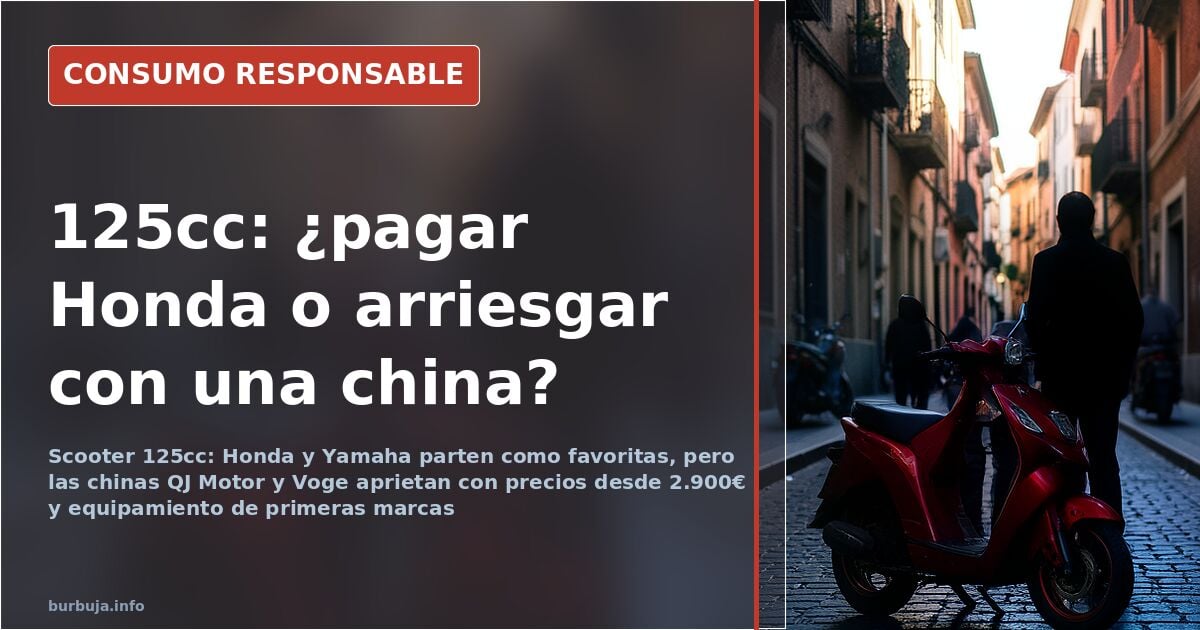
125cc Scooters: Paying for Brand or Risking on China
Is it worth paying €3,500 for a bike that tops out at 108 km/h? That is the question every rider asks when looking for a 125cc scooter for commuting, errands, and occasional city rides. The dilemma is real: the market offers everything from established Japanese models to Taiwanese and Chinese options promising similar antiestéticatures for much less. As usual, the answer depends on who you ask.
The starting point is a rider coming from two 125cc customs with 16-inch wheels and 15 years of age. Never having ridden a small-wheel scooter, they have refined their list after many consultations: first the usual Korean and Taiwanese models, then high-wheel Chinese bikes, and finally GTs. The budget: €3,500 as a ceiling. The use: short trips, village roads, and some urban incursions. No highways.
Honda and Yamaha: The Safe Bet with High Prices
The most repeated recommendation remains the same: Honda or Yamaha. One user shares that they bought a Honda SH125 in 2009 and it has only shown logical wear, while their neighbor's Kymco, bought at the same time, was already worn out before the pandemic and eventually seized up. Another claims to have owned a Yamaha Nmax for five years without a single issue, using home maintenance. The conclusion drawn: if you want peace of mind, pay the premium.
The problem is that premium. The Honda PCX appears as the most cited option for the given budget, though some warn it is "a toy" for certain heights. The SH goes over price, and antiestéticar of theft weighs heavily: "they are stolen as a sport," one reads. The Forza and Xmax are ruled out as too expensive, despite being recognized as segment kings. The Nmax is considered more manageable in the city than the Honda, but also pricier.
Kymco, SYM, and Quality Paid in Installments
Here the nuance begins. Kymco and SYM are reasonable alternatives for those who do not want or cannot reach Japanese prices. A participant argues that SYM made engines for Honda and that their Symphony works perfectly, with low consumption and space for two helmets. Another insists current Kymcos have dropped in quality compared to older ones. The specific accusation: the AK550 and another 500 would have been "a ruin." There is no data backing this beyond testimony.
The most repeated warning concerns aging. "What was saved on purchase is now spent in the workshop constantly," summarizes a participant regarding a colleague's Kymco. On the other hand, there are users running a Vespa 125 LX since 2005 with 70,000 kilometers and zero breakdowns, and others with a Honda CB125F that consumes less than a lighter and has 700 kilometers of range.
The Chinese Rise: QJ Motor, Voge, and Zontes
The analysis shifts with Chinese brands. A user discovers the QJ Motor SQ16, a declared copy of the Honda SH for €2,900. The Voge SR16 enters the list. And the Zontes 125E gains weight among those seeking a GT without paying Japanese prices. The argument in favor: "modern Chinese bikes are not what they used to be; they come with top brands, Bosch electronics, JJuan brakes, Kayaba suspensions." The argument against: "they are disposable," spare parts may not exist in five years, and maintenance must be done at half the mileage intervals.
The discussion moves toward brand loyalty. One participant argues Honda and Yamaha "live off past glories" and that SYM is one of the ten most powerful manufacturers globally. Another responds that social media shows serious problems with Chinese bikes from day one, despite lower sales volumes. No one provides failure statistics. Only experience and perception.
High Wheel, Low Wheel, and Safety Arguments
The technical debate focuses on wheel diameter. One participant is clear: "you only have one life, so 16 inches yes or no." They argue any wheel under 16 inches is "a recipe for biting asphalt" and that Chinese or Korean bikes might lock brakes or stay accelerated. This is an opinion, not verified data. The Honda SH and Yamaha Xenter, revived after a pause, would be the noblest in this aspect.
In contrast, the Piaggio Medley appears as a high-wheel recommendation with large storage capacity. A user warns that the 200 version costs only €100 or €200 more than the 125 and the performance difference is notable. The warning about Piaggio: historically reliable, though bolt and stand adjustments resolved during service.
Ultimately, the choice reduces to risk. Paying €3,500 for a Japanese bike buys peace of mind and resale value. Paying €2,900 for a Chinese bike buys equipment and savings, with uncertainty about what happens in five years. In between, SYM and Kymco offer a middle ground no one fully disputes. What does not exist, based on arguments, is a single answer. Everyone chooses their own lottery.
Is it worth paying €3,500 for a bike that tops out at 108 km/h? That is the question every rider asks when looking for a 125cc scooter for commuting, errands, and occasional city rides. The dilemma is real: the market offers everything from established Japanese models to Taiwanese and Chinese options promising similar antiestéticatures for much less. As usual, the answer depends on who you ask.
The starting point is a rider coming from two 125cc customs with 16-inch wheels and 15 years of age. Never having ridden a small-wheel scooter, they have refined their list after many consultations: first the usual Korean and Taiwanese models, then high-wheel Chinese bikes, and finally GTs. The budget: €3,500 as a ceiling. The use: short trips, village roads, and some urban incursions. No highways.
Honda and Yamaha: The Safe Bet with High Prices
The most repeated recommendation remains the same: Honda or Yamaha. One user shares that they bought a Honda SH125 in 2009 and it has only shown logical wear, while their neighbor's Kymco, bought at the same time, was already worn out before the pandemic and eventually seized up. Another claims to have owned a Yamaha Nmax for five years without a single issue, using home maintenance. The conclusion drawn: if you want peace of mind, pay the premium.
The problem is that premium. The Honda PCX appears as the most cited option for the given budget, though some warn it is "a toy" for certain heights. The SH goes over price, and antiestéticar of theft weighs heavily: "they are stolen as a sport," one reads. The Forza and Xmax are ruled out as too expensive, despite being recognized as segment kings. The Nmax is considered more manageable in the city than the Honda, but also pricier.
Kymco, SYM, and Quality Paid in Installments
Here the nuance begins. Kymco and SYM are reasonable alternatives for those who do not want or cannot reach Japanese prices. A participant argues that SYM made engines for Honda and that their Symphony works perfectly, with low consumption and space for two helmets. Another insists current Kymcos have dropped in quality compared to older ones. The specific accusation: the AK550 and another 500 would have been "a ruin." There is no data backing this beyond testimony.
The most repeated warning concerns aging. "What was saved on purchase is now spent in the workshop constantly," summarizes a participant regarding a colleague's Kymco. On the other hand, there are users running a Vespa 125 LX since 2005 with 70,000 kilometers and zero breakdowns, and others with a Honda CB125F that consumes less than a lighter and has 700 kilometers of range.
The Chinese Rise: QJ Motor, Voge, and Zontes
The analysis shifts with Chinese brands. A user discovers the QJ Motor SQ16, a declared copy of the Honda SH for €2,900. The Voge SR16 enters the list. And the Zontes 125E gains weight among those seeking a GT without paying Japanese prices. The argument in favor: "modern Chinese bikes are not what they used to be; they come with top brands, Bosch electronics, JJuan brakes, Kayaba suspensions." The argument against: "they are disposable," spare parts may not exist in five years, and maintenance must be done at half the mileage intervals.
The discussion moves toward brand loyalty. One participant argues Honda and Yamaha "live off past glories" and that SYM is one of the ten most powerful manufacturers globally. Another responds that social media shows serious problems with Chinese bikes from day one, despite lower sales volumes. No one provides failure statistics. Only experience and perception.
High Wheel, Low Wheel, and Safety Arguments
The technical debate focuses on wheel diameter. One participant is clear: "you only have one life, so 16 inches yes or no." They argue any wheel under 16 inches is "a recipe for biting asphalt" and that Chinese or Korean bikes might lock brakes or stay accelerated. This is an opinion, not verified data. The Honda SH and Yamaha Xenter, revived after a pause, would be the noblest in this aspect.
In contrast, the Piaggio Medley appears as a high-wheel recommendation with large storage capacity. A user warns that the 200 version costs only €100 or €200 more than the 125 and the performance difference is notable. The warning about Piaggio: historically reliable, though bolt and stand adjustments resolved during service.
Ultimately, the choice reduces to risk. Paying €3,500 for a Japanese bike buys peace of mind and resale value. Paying €2,900 for a Chinese bike buys equipment and savings, with uncertainty about what happens in five years. In between, SYM and Kymco offer a middle ground no one fully disputes. What does not exist, based on arguments, is a single answer. Everyone chooses their own lottery.
Also available in: Deutsch
Summary of a discussion on Burbuja.info - Foro de economía, actualidad y política., translated from Spanish and reviewed before publication. Read the full discussion (85 replies).
More summaries
-
Toyota, Honda, or Lexus: Which Japanese Brand Lasts 400,000 km?
A study of 395 million vehicles measures durability, clashing with parts availability and the real condition of Japanese used cars.
-
Cola Cao 1986 vs 2026: less product, more sugar, same real price
Cola Cao 1986 vs 2026: smaller size, sugar up to 70%, and price adjusted for inflation. Is it still the same product? Data analysis.
-
Spain car registration tax to rise in January due to WLTP
While tax rates remain unchanged, the new WLTP cycle increases certified emissions, pushing more cars into the 4.75% bracket from January 1.
-
Small petrol cars are disappearing: no more Up GTI or Adam
With the exit of models like the Up GTI and Opel Adam, the small petrol car market is vanishing. Here is what remains under 4 meters.
-
Daily showers vs. monthly washing: the hidden cost of water use
Daily showering habits vary widely across Spain, with some people bathing multiple times a day and others only once a month, impacting water bills.
-
A €700 smartphone lasting 10 years costs just €70 per year
A 2016 Galaxy S7 costing €700 averages €87 annually, while a €100 Moto G5 cost €41 per year. This calculation helps decide if it is time to upgrade.