
Valorant player Twisten’s suicide reopens mental health debate
Twisten, a Valorant player, said "Good night" before taking his own life, reigniting the debate on youth mental health.
English · Original discussion in Spanish · Published
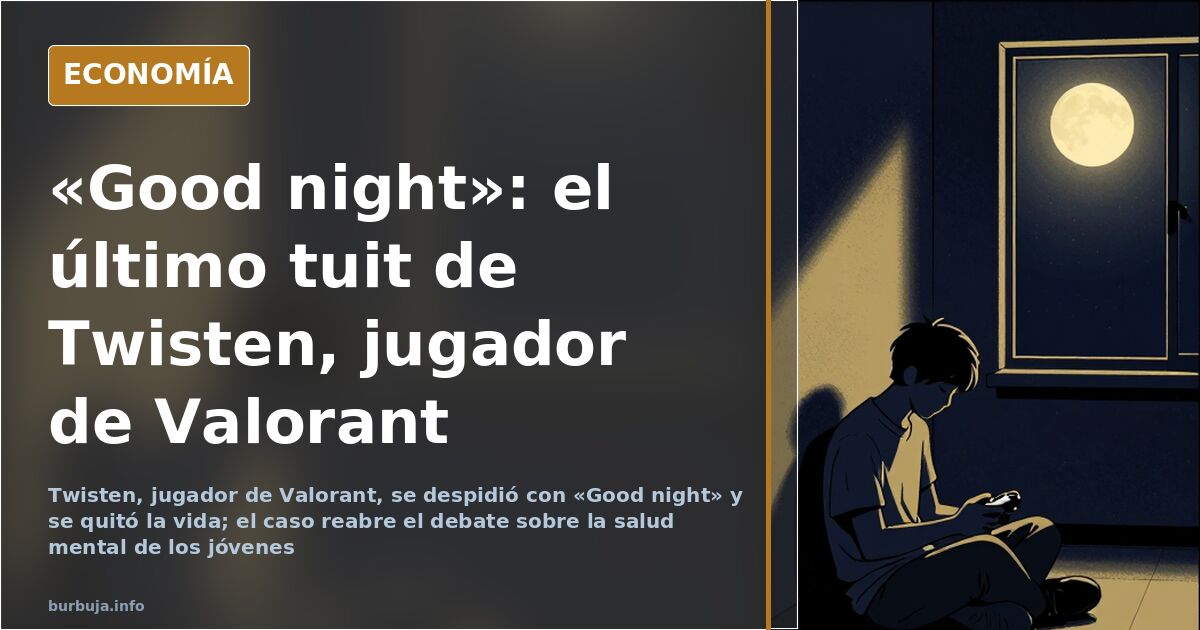
Twisten: the last tweet and the death that divides
"Good night." Two words on the account of Twisten, a European Valorant player, and the next morning news of his death. The young man had everything — contract, trinc, projection — and had made his mental health problems public. His close ones indicated after the suicide that he had decided to take his own life.
His case is not an isolated episode: it is the tip of a debate that cuts across an entire generation raised with a mobile phone in hand. Are more dying today out of despair than before? Or is it simply counted differently? No one has the closed answer, and that is the uncomfortable part.
What is known about Twisten’s death
The facts, essentially, fit in few lines. He competed in the European scene of Valorant — the team shooter video game that competes with the classic Counter-Strike — and had mental health problems that he himself made public. According to one of the comments in the thread, coaches and family have little room to maneuver when the problem is serious.
Esports is sold as passion turned into profession. Sounds good. Behind it there is pressure for results and permanent public exposure from very early ages. It is not a job of moving papers, certainly; it is also true that it requires a head that can withstand what very few can at that age.
Why does the suicide of an idol influence young people?
Here starts the issue that bothers most. A boy who trinc his role model sees him say goodbye with two cold words and, the next day, reads that that role model has died. The question hovering is whether that example can become an imitated exit for who, at fourteen, still does not know how to manage frustration.
One participant is clear: the problem is not the influence of the idol, but that children are educated to adore idols. If blind admiration for a footballer or a content creator has been cultivated at home, the sowing work is already done and the fruit is harvested in adolescence. Another intervention replies that this is loading parents with everything and that teen depression is not explained only by education.
Much of the conversation looks, meanwhile, at the phone. The mobile and social networks are designed to give immediate pleasure; when that pleasure does not arrive, frustration escalates quickly. It is a reasonable hypothesis, and also the most difficult to prove with numbers.
South Korea and the price of extreme demand
The Asian mirror appears immediately in any serious conversation. A comment in the thread states that South Korea is the second country in the world with the most suicides and maintains compulsory military service. It is also mentioned that professionals can train up to 18 hours a day and that a documentary showed a player with his hand marked to support it on the mouse pad. Playing for money is not the same as playing for fun.
A description that appears in the thread: there the pressure for success is so brutal that, when someone feels like a failure, they conclude that the best contribution they can make to their society is to disappear. It is a harsh and very debatable description.
On Korea also weighs the idea that its level of demand and competitiveness is brutal. And not only for teenagers: some maintain that fame badly handled, in people not prepared for it, has claimed throughout history a good number of musical stars.
Lack of values or lack of psychologists: what clashes
Four currents struggle to name the problem. The first blames the loss of values and references that once held the young. The second points to the excess of comfort: a generation that has not known scarcity breaks at the first frustration. The third points to the lack of goals and job opportunities.
And a fourth directly denies that mental illness exists; against it, some warn that this denial pushes those who suffer it towards the black market of self-medication. It is necessary to say clearly: there is no evidence that depression or anxiety are an invention, however much it is repeated. Some maintain in the thread that these things only exist from the abundance of post-war — 80 years of uninterrupted peace —, and some remember that grandparents are today the group with the most depression.
"Good night." Two words on the account of Twisten, a European Valorant player, and the next morning news of his death. The young man had everything — contract, trinc, projection — and had made his mental health problems public. His close ones indicated after the suicide that he had decided to take his own life.
His case is not an isolated episode: it is the tip of a debate that cuts across an entire generation raised with a mobile phone in hand. Are more dying today out of despair than before? Or is it simply counted differently? No one has the closed answer, and that is the uncomfortable part.
What is known about Twisten’s death
The facts, essentially, fit in few lines. He competed in the European scene of Valorant — the team shooter video game that competes with the classic Counter-Strike — and had mental health problems that he himself made public. According to one of the comments in the thread, coaches and family have little room to maneuver when the problem is serious.
Esports is sold as passion turned into profession. Sounds good. Behind it there is pressure for results and permanent public exposure from very early ages. It is not a job of moving papers, certainly; it is also true that it requires a head that can withstand what very few can at that age.
Why does the suicide of an idol influence young people?
Here starts the issue that bothers most. A boy who trinc his role model sees him say goodbye with two cold words and, the next day, reads that that role model has died. The question hovering is whether that example can become an imitated exit for who, at fourteen, still does not know how to manage frustration.
One participant is clear: the problem is not the influence of the idol, but that children are educated to adore idols. If blind admiration for a footballer or a content creator has been cultivated at home, the sowing work is already done and the fruit is harvested in adolescence. Another intervention replies that this is loading parents with everything and that teen depression is not explained only by education.
Much of the conversation looks, meanwhile, at the phone. The mobile and social networks are designed to give immediate pleasure; when that pleasure does not arrive, frustration escalates quickly. It is a reasonable hypothesis, and also the most difficult to prove with numbers.
South Korea and the price of extreme demand
The Asian mirror appears immediately in any serious conversation. A comment in the thread states that South Korea is the second country in the world with the most suicides and maintains compulsory military service. It is also mentioned that professionals can train up to 18 hours a day and that a documentary showed a player with his hand marked to support it on the mouse pad. Playing for money is not the same as playing for fun.
A description that appears in the thread: there the pressure for success is so brutal that, when someone feels like a failure, they conclude that the best contribution they can make to their society is to disappear. It is a harsh and very debatable description.
On Korea also weighs the idea that its level of demand and competitiveness is brutal. And not only for teenagers: some maintain that fame badly handled, in people not prepared for it, has claimed throughout history a good number of musical stars.
Lack of values or lack of psychologists: what clashes
Four currents struggle to name the problem. The first blames the loss of values and references that once held the young. The second points to the excess of comfort: a generation that has not known scarcity breaks at the first frustration. The third points to the lack of goals and job opportunities.
And a fourth directly denies that mental illness exists; against it, some warn that this denial pushes those who suffer it towards the black market of self-medication. It is necessary to say clearly: there is no evidence that depression or anxiety are an invention, however much it is repeated. Some maintain in the thread that these things only exist from the abundance of post-war — 80 years of uninterrupted peace —, and some remember that grandparents are today the group with the most depression.
Summary of a discussion on Burbuja.info - Foro de economía, actualidad y política., translated from Spanish and reviewed before publication. Read the full discussion (215 replies).
More summaries
-
Spain's Economic Reality: Mental Health Risks of Clarity
Unfiltered analysis of Spain's economy challenges official narratives, showing how lucidity impacts mental health.
-
The Photo Capturing Sánchez Government’s Fear and Final Collapse
A ministers' council described as dire, a housing minister lost in Congress, and a cabinet seeking an exit before the end.
-
Forum claims Spanish women in their 40s seek wealthy partners
A forum thread argues that single women aged 30-40, facing financial precarity after years of spending, are returning to shared housing and seeking partners with assets.
-
Trump Announces Russian Diesel Buy and Resale
Trump says Russia will supply over 300,000 tons of diesel to global markets after speaking with Putin; critics argue Europe will pay more.
-
Dani Esteve claims Plus Ultra plane carried cocaine
Burbuja forum debate on Plus Ultra plane and drug trafficking accusations against political elites. Narco-state or firewall?
-
Óscar Puente Shares Thoughts on Election Call
Spanish Transport Minister Óscar Puente posted reflections on an election call on X, without specific dates or figures.