
Valencia protest camp bans drinking, joints and drugs
The Valencia protest camp has banned alcohol, joints and drugs, with a single entrance and immediate expulsion for offenders. The strictness of the measure has raised eyebrows and sparked debate.
English · Original discussion in Spanish · Published
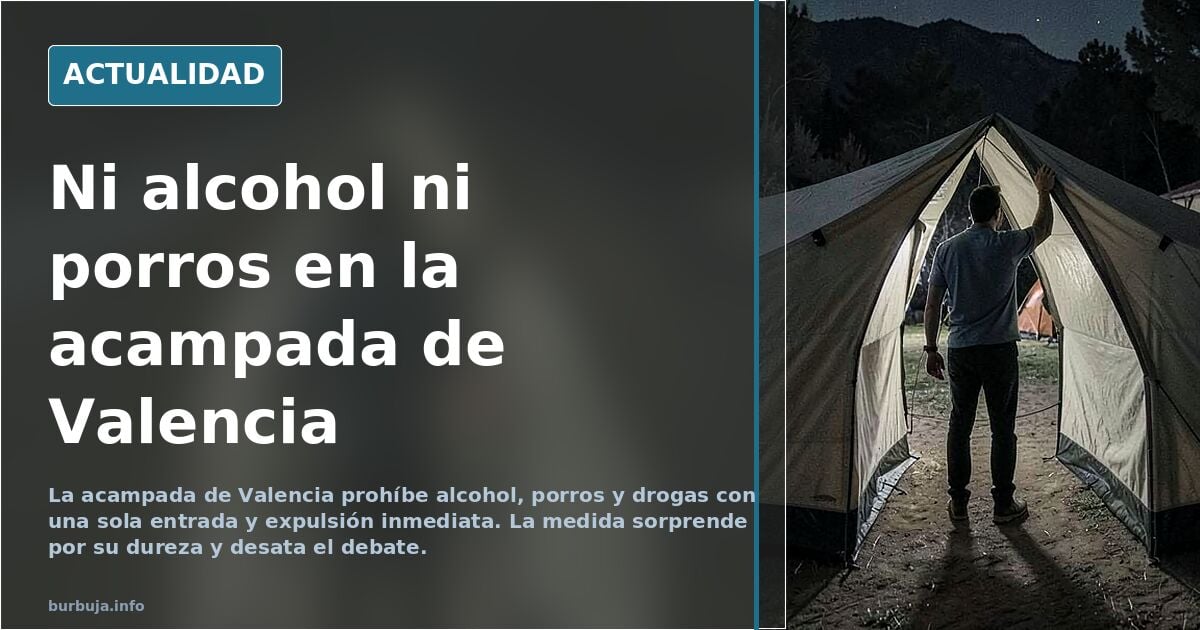
Valencia protest camp: no alcohol, no joints, no drugs
According to one participant, a young man in a zombie-like state keeps circling the perimeter and is not allowed in. The organizers of the Valencia protest camp have decided that alcohol, joints and drugs stay outside. The control is strict, according to this account: one entrance only, and if you are caught high or holding a can, you will not get back in. The measure, designed to stop the camp from turning into an outdoor drinking party with tents, has surprised people with its severity and triggered all kinds of reactions.
A cordon against street drinking
The scene repeats itself, according to that participant, around the site: people in a state of drunkenness who approach the camp and are turned away. The message is clear: no drinking inside and no arriving drunk. The rule makes no distinction between a beer and a joint; any substance is banned. The stated goal is to protect peaceful coexistence at night and prevent the camp from becoming a space of uncontrolled consumption. Those who defend the measure argue that it spares participants from having to put up with people who are only there to get high and cause trouble.
The single-entrance system works like a funnel, according to that version. There is no way to slip in around a corner. If you are caught drinking or smoking inside, you are shown the exit and not allowed back in. The practical consequence is that the perimeter becomes a border between conventional nightlife and the camp. For some, this is a victory against the scourge of consuming substances in public spaces; for others, an intrusion into individual freedom.
Who decides what is legal inside a protest camp?
One question hovers over the matter: what authority does the organizing committee have to dictate rules of this magnitude? It is unclear whether the site is considered sovereign territory or whether they are simply relying on existing law. The ambiguity is total. Some see an exercise in responsibility, others an arbitrary imposition. The debate over the limits of social control in self-managed spaces remains open.
Jokes about the regulatory zeal are also doing the rounds. People speculate that you might get beaten up for carrying cans, that there might be a Quechua-prison, or that you might be hosed down as punishment. These are exaggerations, but they reflect the perception that the rules are more befitting of a paramilitary camp than a youth encampment. The comparison with a retreat day run by the kikos — a religious group known for its strict ways — sums up the bewilderment.
Sens, the big unanswered question
The ban on alcohol and drugs has led people to ask whether sens is also prohibited. There is no official answer in the available material. Irony runs through the whole affair: if everything that could disturb the peace is banned, where does sensual freedom stand? Some comments suggest that the rules only cover substances, not personal relationships, but that is an assumption. What is certain is that the camp is defined by what you cannot do, and that leaves a trail of unanswered questions.
The single entrance and immediate expulsion create a model of control that allows no nuance. The question floating in the air is whether this rigor will end up scaring off the campers themselves. With rules like these, who wants to spend the night in a tent? For now, the answer is provided by the zombie-like young man who keeps circling the perimeter, unable to get in.
Also available in: Deutsch
Summary of a discussion on Burbuja.info - Foro de economía, actualidad y política., translated from Spanish and reviewed before publication. Read the full discussion (15 replies).
More summaries
-
Ayuso demands answers over terror-linked groups at Madrid's Sol camp
Madrid regional president Ayuso asks the Government Delegation whether a group with terrorist links runs the Sol camp and warns of risks to the Metro.
-
Spanish police officer assaulted at Puerta del Sol protest camp
A UPR officer was assaulted during an intervention at the Puerta del Sol camp in Madrid. The JUPOL union claims officers were left working without guidance.
-
This is the Level of the Sol Protest Camp
A social media post claims this is the 'level' of the Sol protest camp, but provides no data on attendance, dates, or organizers. Here is what is known and what is missing.
-
Sol Bells Ring Every 15 Minutes During Madrid Protest Camp
Debate erupts in Madrid over whether the Puerta del Sol clock chimes every quarter-hour during a protest camp, or if it is a routine sound people only now notice.
-
The danger of being born
The human body degrades from day one and needs food, water and work to keep going. Biology explains why that toll is unavoidable.
-
Europe's problem and the West's problem: a Sunday reflection
The EU keeps nearly 18,000 organisations in its transparency register and 27 commissioners nobody elects. Parliament is voted in every five years, but it cannot legislate.