
Ayuso demands answers over terror-linked groups at Madrid's Sol camp
Madrid regional president Ayuso asks the Government Delegation whether a group with terrorist links runs the Sol camp and warns of risks to the Metro.
English · Original discussion in Spanish · Published
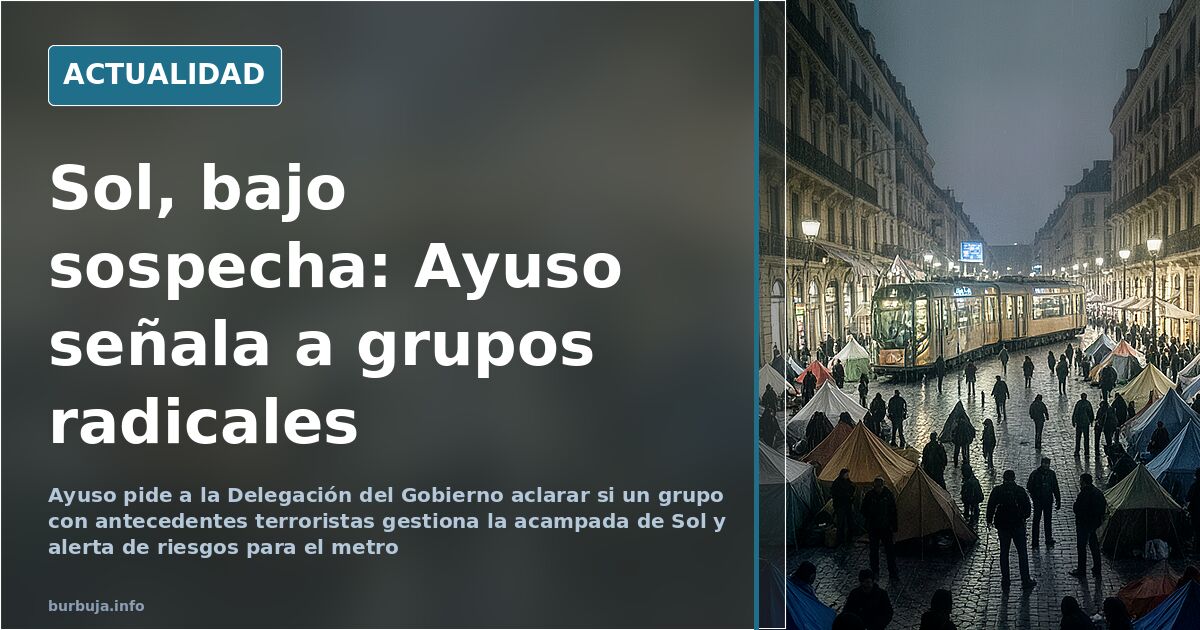
Ayuso demands answers over terror-linked groups at Madrid's Sol camp
What is really going on at the Puerta del Sol camp in Madrid? The president of the Community of Madrid, Isabel Díaz Ayuso, demanded explanations from the Government Delegation (the central government's representative office in the region) over the presence at the camp of an organisation said to have a terrorist background and ties to Hamas. She did so during the PP's «Por Fin» event at the Madrid trade fair grounds, and the warning did not fall on deaf ears: the regional minister for Housing, Transport and Infrastructure, Jorge Rodrigo, sent a letter to the Government Delegate in Madrid, Francisco Martín, to alert him to the risk the encampment poses to public transport users.
Attention focused on Sol station, closed for cleaning after a technical report which, according to the regional government, detected "highly toxic" gases and a "risk of bicho" in the underground. The regional government maintains that the camp compromises the safety of the line, while the official account speaks of maintenance work. Two versions that do not quite add up.
Who is behind the Sol camp
The visible faces of the Tenants' Union are said to have left the square, according to published reports, and the space is said to have been taken over by a constellation of far-left groups. Among them, Samidoun stands out, a pro-Palestinian network designated as a terrorist organisation in the United States, Germany and Canada, which led the boycott of the 2025 Vuelta a España cycling race. The square, according to these same sources, is covered in Palestinian flags.
The timeline is no coincidence. Three days before Ayuso issued her warning, the so-called "red church" of Entrevías hosted an event with two members of that organisation on the anniversary of the October 7 massacre. The sequence fuels the thesis that this is not a spontaneous camp.
Incidents, threats and a gun in the camp
Incidents keep piling up. A police officer noticed something strange inside the site and, on approaching, was heckled by several individuals; the scuffle led to more police arriving. A Telemadrid journalist was assaulted on Hortaleza street. And a young Spanish man of Maghrebi origin who had spent several days inside the movement was arrested for threatening several people with a gun: "I'm going to slash you and shoot you," according to testimony gathered.
Some argue these episodes prove the infiltration of violent elements; against that weighs the argument that these are isolated cases and that the police response is disproportionate. What is certain is that life in the square has deteriorated.
The precedent of Metro Line 6
Madrid Metro Line 6 is running in trial phase with driverless trains as part of the process of autonomous automation of the lines. That circumstance makes the underground an especially sensitive node: a false bomb alert already forced the evacuation of Nuevos Ministerios one day after the Charlie Hebdo attack in January 2015. The memory of that episode hangs over the current closure of Sol.
The political backdrop and the shadow of electoral fraud
In parallel, polls are circulating that give the PSOE more than 34% of voting intention and up to 152 seats, figures that some quarters read as a statistical anomaly rather than a survey. Street agitation, social discontent and distrust of institutions form a cocktail that does not invite optimism.
The question is no longer how the campers are described, but what they are doing there and who answers for whatever happens. Nobody takes responsibility for what is inside. And meanwhile, the station remains closed.
Also available in: Deutsch
Summary of a discussion on Burbuja.info - Foro de economía, actualidad y política., translated from Spanish and reviewed before publication. Read the full discussion (15 replies).
More summaries
-
Dutch Minister Prioritizes Migrants Over Youth for Housing
The Dutch Housing Minister stated that young people can still live with their parents. A tweet claims migration caused 60% of demand growth since...
-
Jordi Wild, 40 and childfree: the debate dividing content creators
Jordi Wild, aged 40 and childfree, reignites the debate over parenthood: financial risk, billion-euro divorces and a bubble of creators without children.
-
AI basic income splits opinion: handouts or population cull?
The promise of AI handouts clashes with depopulation theories. An analysis of the basic income debate, automatic IMV payments and the future of work.
-
Zapatero was no leftist, forum users argue
We discuss in the forum whether Spain's former PM Zapatero was really a man of the left, based on his economic reforms and scepticism about the current political narrative.
-
Vox leaves everyone baffled as Spain's right questions its direction
Has Vox lost its ideological compass, or is it controlled opposition? We look at the debate over its geopolitical shift and the disillusionment of its original voters.
-
Japan's decline in the face of an imported invader
An analysis of Japan's social crisis: violence, illegal immigration and the end of the Japanese exception. Data and arguments about a country in transformation.