
Sol Bells Ring Every 15 Minutes During Madrid Protest Camp
Debate erupts in Madrid over whether the Puerta del Sol clock chimes every quarter-hour during a protest camp, or if it is a routine sound people only now notice.
English · Original discussion in Spanish · Published
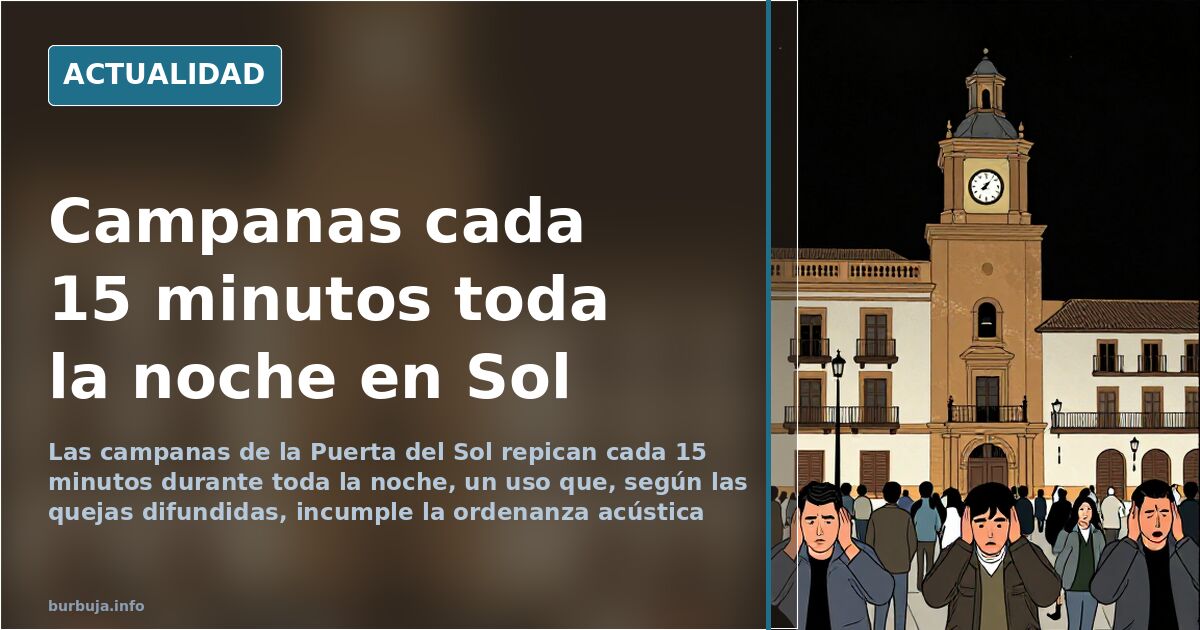
Sol Bells Chime Every Quarter-Hour at Sleepless Protest Camp
Did the Puerta del Sol bells ring every fifteen minutes all night, or have they marked the quarters for decades, requiring a protest camp to draw attention? Doubt arose after a social media complaint targeted the government of Isabel Díaz Ayuso for a nocturnal chime that allegedly abusa the Ordinance on Protection Against Noise Pollution. The square has been occupied by a protest camp, sparking the usual debate: does the noise truly bother people, or only those affected?
What is the complaint about the Sol Bells?
The accusation has appeal: a bell tower marking quarters every fifteen minutes all night, allegedly never done before, over a square full of people sleeping in tents. The text demands answers from the Madrid regional president, citing municipal noise regulations. Crucially, there is no proof that the chiming was a specific decision for that night rather than the clock's ordinary operation.
The opposing view is equally forceful. Many messages recall that the Puerta del Sol clock has marked quarters for decades, with one, two, and three chimes for the quarter, half, and three-quarter hours, and that residents have lived with this long before tourism discovered the square. The controversy, they argue, is not the bell, but the protest camp causing people to count chimes at dawn.
Have the Sol Bells always rung, or is this new?
Disagreement is total. Those defending the status quo appeal to common sense: the clock tells time day and night, and this reference time service does not stop just because someone sets up a tent below. Others add that the city has lived with similar chimes for over a decade and that the bell tower is not a recent invention.
On the other side, a psychological explanation emerges with irony: what has changed is not the sound, but who hears it. References to confirmation bias and even the term belltrails, a cousin of estela, suggest the bells were always there but only visible when sought. A middle ground suggests the novelty is not the clock, but the carillon, with some requesting it be activated "for just one day."
The noise no one disputes: camp and neighbors
Even without the bells, the square has its own life. Comments mention nocturnal batucadas, music, voices, and shouts, placing local residents as the forgotten parties: they have long endured the noise of the occupation and, additionally, the bell tower. "And the neighbors too," summarizes one response.
Not everyone agrees with this diagnosis. Some respond that there are few neighbors left in Sol, not precisely since now, so the argument of neighborly rest sounds like an excuse. The uncomfortable detail is that the original complaint comes from a social media user, not a resident, and relies on a municipal ordinance whose limits are unspecified.
From pasodobles to drones with soapy water
Much of the conversation shifts to mockery, with proposals for sonic punishment. Suggestions include playing pasodobles and Spanish discography at full volume for 24 hours a day, military anthems every hour on the hour, or limiting noise to the 6:00 to 15:00 window, assuming protesters do not wake early. Another recurring idea is releasing grapes and eating them in the Nochevieja style.
More technological initiatives include drones with soapy water or disinfectant flying over the square at night, including surveillance functions. None of these ideas describe a real measure adopted by any administration; they are bar-room fantasies turned into a thread, and should be read as such.
Who controls the Puerta del Sol clock?
The discussion itself leaves an administrative loose end: Puerta del Sol is land of the Madrid City Council, not the Regional Government. Several messages highlight this to question why the regional government is blamed for something depending on the Municipality, while others recall that the clock and its maintenance have always been under municipal control.
What is absent is proof of an order, a sanction, or a formal complaint. The accusation remains a complaint, and the chiming, a routine heard by some for the first time and by others for a lifetime. With these threads, any conclusion would be premature.
In short, the clock has marked quarters before this became news, and the only verifiable novelty is that someone has started counting them. Puerta del Sol has discovered the bells ring. Now, someone must explain why, suddenly, they are heard.
Did the Puerta del Sol bells ring every fifteen minutes all night, or have they marked the quarters for decades, requiring a protest camp to draw attention? Doubt arose after a social media complaint targeted the government of Isabel Díaz Ayuso for a nocturnal chime that allegedly abusa the Ordinance on Protection Against Noise Pollution. The square has been occupied by a protest camp, sparking the usual debate: does the noise truly bother people, or only those affected?
What is the complaint about the Sol Bells?
The accusation has appeal: a bell tower marking quarters every fifteen minutes all night, allegedly never done before, over a square full of people sleeping in tents. The text demands answers from the Madrid regional president, citing municipal noise regulations. Crucially, there is no proof that the chiming was a specific decision for that night rather than the clock's ordinary operation.
The opposing view is equally forceful. Many messages recall that the Puerta del Sol clock has marked quarters for decades, with one, two, and three chimes for the quarter, half, and three-quarter hours, and that residents have lived with this long before tourism discovered the square. The controversy, they argue, is not the bell, but the protest camp causing people to count chimes at dawn.
Have the Sol Bells always rung, or is this new?
Disagreement is total. Those defending the status quo appeal to common sense: the clock tells time day and night, and this reference time service does not stop just because someone sets up a tent below. Others add that the city has lived with similar chimes for over a decade and that the bell tower is not a recent invention.
On the other side, a psychological explanation emerges with irony: what has changed is not the sound, but who hears it. References to confirmation bias and even the term belltrails, a cousin of estela, suggest the bells were always there but only visible when sought. A middle ground suggests the novelty is not the clock, but the carillon, with some requesting it be activated "for just one day."
The noise no one disputes: camp and neighbors
Even without the bells, the square has its own life. Comments mention nocturnal batucadas, music, voices, and shouts, placing local residents as the forgotten parties: they have long endured the noise of the occupation and, additionally, the bell tower. "And the neighbors too," summarizes one response.
Not everyone agrees with this diagnosis. Some respond that there are few neighbors left in Sol, not precisely since now, so the argument of neighborly rest sounds like an excuse. The uncomfortable detail is that the original complaint comes from a social media user, not a resident, and relies on a municipal ordinance whose limits are unspecified.
From pasodobles to drones with soapy water
Much of the conversation shifts to mockery, with proposals for sonic punishment. Suggestions include playing pasodobles and Spanish discography at full volume for 24 hours a day, military anthems every hour on the hour, or limiting noise to the 6:00 to 15:00 window, assuming protesters do not wake early. Another recurring idea is releasing grapes and eating them in the Nochevieja style.
More technological initiatives include drones with soapy water or disinfectant flying over the square at night, including surveillance functions. None of these ideas describe a real measure adopted by any administration; they are bar-room fantasies turned into a thread, and should be read as such.
Who controls the Puerta del Sol clock?
The discussion itself leaves an administrative loose end: Puerta del Sol is land of the Madrid City Council, not the Regional Government. Several messages highlight this to question why the regional government is blamed for something depending on the Municipality, while others recall that the clock and its maintenance have always been under municipal control.
What is absent is proof of an order, a sanction, or a formal complaint. The accusation remains a complaint, and the chiming, a routine heard by some for the first time and by others for a lifetime. With these threads, any conclusion would be premature.
In short, the clock has marked quarters before this became news, and the only verifiable novelty is that someone has started counting them. Puerta del Sol has discovered the bells ring. Now, someone must explain why, suddenly, they are heard.
Summary of a discussion on Burbuja.info - Foro de economía, actualidad y política., translated from Spanish and reviewed before publication. Read the full discussion (115 replies).
More summaries
-
"Not AI": The Plaza del Sol Campout with Loudspeakers Sparks Debate
A video of a campout with sound equipment in Plaza del Sol ignites discussion about the "Decreto Maricarmen" and who pays for the setup.
-
Ayuso Lives Alone, Says Losantos: Behind the Rumor
Jiménez Losantos claims Ayuso lives alone after moving, reigniting rumors about her partner and pending legal issues.
-
Iberian culinary pride: Spain and Portugal's cultural clash
The cultural clash between Spain and Portugal goes beyond food. We look at regional pride, identity complexes and the competitive Iberian spirit.
-
Comet 3I/ATLAS: Cosmic Panic and Misinformation
Comet 3I/ATLAS sparks conspiracy theories about alien ships and Nibiru, while science tries to offer rational explanations. The debate refle
-
Spanish Army debate: discipline, NATO and reform
Analysis of perceptions of the Spanish Army: from internal structure and promotions to the critical debate on its role in NATO
-
The Tattoo Craze: From Rebellion to Conformity
More than half of gym-goers have ink on their skin. Fashion, identity, or existential emptiness? Data on lymph node cancer raise…