
Generic ibuprofen cheaper but often unavailable in Spanish pharmacies
Generic 400 mg ibuprofen costs €2.20 vs brand's €4.60 for fewer pills. Pharmacies claim stock shortages while pushing expensive brands.
English · Original discussion in Spanish · Published
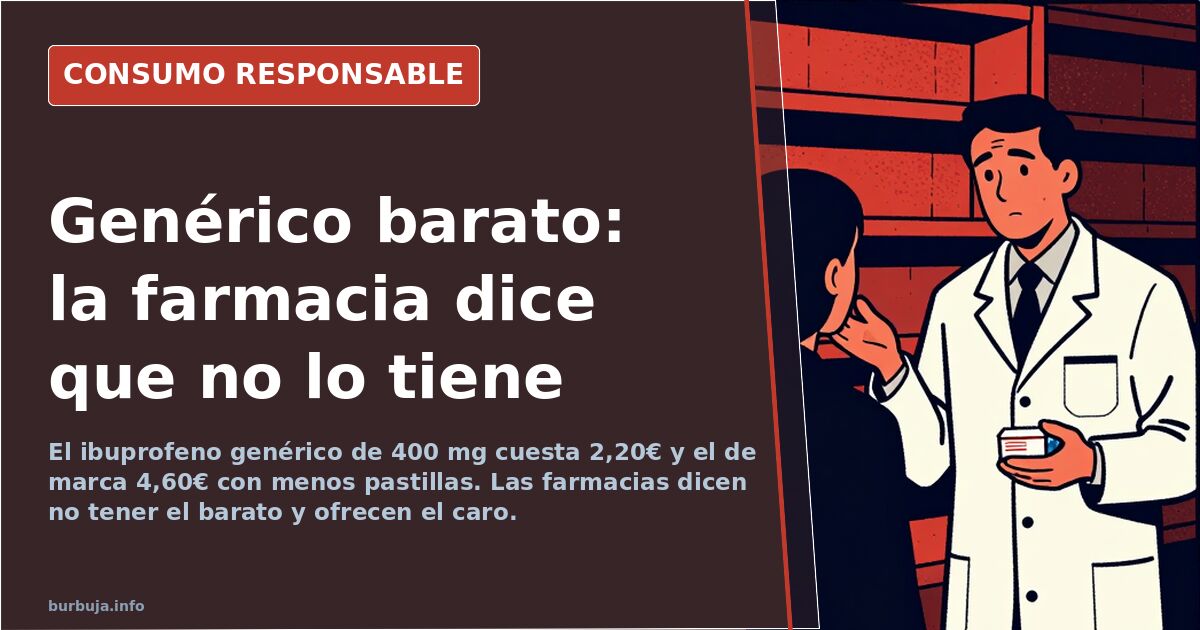
Generic costs half as much, yet pharmacies claim it is out of stock
Back pain, a handful of pharmacies, and a collection of excuses that do not hold up. Acetylsalicylic acid — the familiar aspirin — is one of the most common and affordable medicines on the market. Finding its generic version in Madrid has become an obstacle course. The same pattern repeats with ibuprofen and paracetamol, according to cases highlighting this issue.
The script barely changes from counter to counter: you cannot sell generics without a prescription; generics are subsidized only for health centers and hospitals; that concentration is banned without a prescription. All these reasons collapse when the customer points to the branded box resting on the shelf, within reach and sold without a prescription.
How much more does it cost to buy branded medication?
The price difference is hard to justify on health grounds. According to one buyer’s account, generic 400-milligram ibuprofen, in a box of 30 tablets, costs about €2.20. The branded alternative, with only 20 tablets, is around €4.60: more than double the cost for fewer units. The per-pill breakdown reveals a gap that is disorienting.
This is not an isolated case. Something similar happens with acetylcysteine, according to another participant: only the original Flumil 600 mg is available. Stopcold, one of the few cold remedies effective for congestion, is listed as out of stock while Rinoebastel is offered as an alternative for €10. Some see this as a pricing tactic sustained by the lack of real competition at the counter.
Why do pharmacies refuse to dispense generics?
Here, opinions diverge. One school of thought argues that pure opportunism lies behind it: the higher margin on branded drugs versus generics, pressure from distributors, and the convenience of selling expensive products to customers in pain. Another points to regulations: each autonomous community sets its own rules, and pharmacists can face fines of up to €3,000 for dispensing certain medications without a prescription, according to one participant.
The nuance matters. That threat applies to drugs requiring a prescription — antibiotics, 1,000-milligram paracetamol — not over-the-counter items. Those defending pharmacists note that no one risks a fine for a cheap box; critics respond that an OTC generic has nothing to do with that scenario.
Generics vary by autonomous community
The map is not homogeneous. In Valencia, some people buy acetylsalicylic acid easily at any pharmacy, even in 100-milligram presentations. In Madrid, however, visiting half a dozen stores ended without success. Regional autonomy turns routine management into a lottery depending on the postal code.
And there is a practical detail that goes unnoticed: pharmacies are not required to have complaint forms, according to one participant, though another clarifies that they are mandatory in the Community of Madrid. An extra incentive for customers to give up.
Generics only appear when there is a prescription
1,000-milligram paracetamol is no longer dispensed without a prescription. With the prescription in hand, the same pharmacy that claimed not to have the generic suddenly finds it. The doctor includes the basic version on the card, the system covers the corresponding part, and the patient discovers that the product previously denied was actually available.
That is the picture emerging: access to generics depends on an administrative hurdle costing a morning at the health center. Without a prescription, it is branded; with a prescription, the generic appears. Health pretexts and commercial logic rarely align.
Is buying generic medications online worth it?
Yes, when the product is over-the-counter. Several Spanish pharmacies with online services dispense generics without the counter explanations, with moderate shipping costs and next-day delivery. Users cite platforms selling the cheap version that local pharmacies claim not to have. Antibiotics, however, still require a prescription online too.
The underlying problem is economic. In a sector with fixed prices and no real competition — like notaries or property registries — the only lever left is deciding which reference is stocked on the shelf.
Interventionist socialism or mere opportunism?
The issue has political dimensions. Some frame it as a problem of an intervened market: with the State controlling price and dispensation, freedom to choose disappears from the counter. Others recall that healthcare management is devolved to communities, so the ideological label of the central government explains little of what happens in a local pharmacy.
Between these two extremes, the customer is left with pain and no cheap box. Neither intervention nor free market has solved the practical problem: paying less for the same thing.
With these differences, the shortage of generics should be a headache for regulators. How many boxes must a pharmacy sell for a €3,000 fine to be worthwhile?
Back pain, a handful of pharmacies, and a collection of excuses that do not hold up. Acetylsalicylic acid — the familiar aspirin — is one of the most common and affordable medicines on the market. Finding its generic version in Madrid has become an obstacle course. The same pattern repeats with ibuprofen and paracetamol, according to cases highlighting this issue.
The script barely changes from counter to counter: you cannot sell generics without a prescription; generics are subsidized only for health centers and hospitals; that concentration is banned without a prescription. All these reasons collapse when the customer points to the branded box resting on the shelf, within reach and sold without a prescription.
How much more does it cost to buy branded medication?
The price difference is hard to justify on health grounds. According to one buyer’s account, generic 400-milligram ibuprofen, in a box of 30 tablets, costs about €2.20. The branded alternative, with only 20 tablets, is around €4.60: more than double the cost for fewer units. The per-pill breakdown reveals a gap that is disorienting.
This is not an isolated case. Something similar happens with acetylcysteine, according to another participant: only the original Flumil 600 mg is available. Stopcold, one of the few cold remedies effective for congestion, is listed as out of stock while Rinoebastel is offered as an alternative for €10. Some see this as a pricing tactic sustained by the lack of real competition at the counter.
Why do pharmacies refuse to dispense generics?
Here, opinions diverge. One school of thought argues that pure opportunism lies behind it: the higher margin on branded drugs versus generics, pressure from distributors, and the convenience of selling expensive products to customers in pain. Another points to regulations: each autonomous community sets its own rules, and pharmacists can face fines of up to €3,000 for dispensing certain medications without a prescription, according to one participant.
The nuance matters. That threat applies to drugs requiring a prescription — antibiotics, 1,000-milligram paracetamol — not over-the-counter items. Those defending pharmacists note that no one risks a fine for a cheap box; critics respond that an OTC generic has nothing to do with that scenario.
Generics vary by autonomous community
The map is not homogeneous. In Valencia, some people buy acetylsalicylic acid easily at any pharmacy, even in 100-milligram presentations. In Madrid, however, visiting half a dozen stores ended without success. Regional autonomy turns routine management into a lottery depending on the postal code.
And there is a practical detail that goes unnoticed: pharmacies are not required to have complaint forms, according to one participant, though another clarifies that they are mandatory in the Community of Madrid. An extra incentive for customers to give up.
Generics only appear when there is a prescription
1,000-milligram paracetamol is no longer dispensed without a prescription. With the prescription in hand, the same pharmacy that claimed not to have the generic suddenly finds it. The doctor includes the basic version on the card, the system covers the corresponding part, and the patient discovers that the product previously denied was actually available.
That is the picture emerging: access to generics depends on an administrative hurdle costing a morning at the health center. Without a prescription, it is branded; with a prescription, the generic appears. Health pretexts and commercial logic rarely align.
Is buying generic medications online worth it?
Yes, when the product is over-the-counter. Several Spanish pharmacies with online services dispense generics without the counter explanations, with moderate shipping costs and next-day delivery. Users cite platforms selling the cheap version that local pharmacies claim not to have. Antibiotics, however, still require a prescription online too.
The underlying problem is economic. In a sector with fixed prices and no real competition — like notaries or property registries — the only lever left is deciding which reference is stocked on the shelf.
Interventionist socialism or mere opportunism?
The issue has political dimensions. Some frame it as a problem of an intervened market: with the State controlling price and dispensation, freedom to choose disappears from the counter. Others recall that healthcare management is devolved to communities, so the ideological label of the central government explains little of what happens in a local pharmacy.
Between these two extremes, the customer is left with pain and no cheap box. Neither intervention nor free market has solved the practical problem: paying less for the same thing.
With these differences, the shortage of generics should be a headache for regulators. How many boxes must a pharmacy sell for a €3,000 fine to be worthwhile?
Also available in: Deutsch
Summary of a discussion on Burbuja.info - Foro de economía, actualidad y política., translated from Spanish and reviewed before publication. Read the full discussion (134 replies).
More summaries
-
Long-term Omeprazole Use: Risks of Suppressing Stomach Acid
Omeprazole is often prescribed indefinitely, but long-term acid suppression carries risks. This article explores side effects, alternatives, and the role of surgery.
-
Daily Driver Classics: From Lada Niva to Mercedes W124
Which affordable classics over 25 years old survive daily use, and which become maintenance nightmares?
-
Downsizing: 1930 V16 matches modern 1.4L output
Cadillac's 7.4-liter V16 produced power similar to today's 1.4 engines. Downsizing reflects a century of accumulated specific power, not just crisis.
-
Beachgoers Butcher Stranded Tuna in La Manga
Swimmers carved up a dead tuna on La Manga beach, sparking debate over food safety and anisakis risks.
-
Amazon Disrupts Hardware Stores, Making Physical Shopping Less Viable
A simple nut took hours to find locally but minutes on Amazon. The shift from neighborhood shops lacking stock to online convenience is accelerating.
-
Cheap PC Power Supplies: When Savings Are Real and When They’re Risky
Second-hand FSP units at €14-20 vs. €60 models: analyzing real wattage, efficiency, and motherboard risks in consumer PCs.