
UVB-76, Russia's 'Doomsday radio', plays Swan Lake on 4625 kHz
UVB-76, the Russian Doomsday station, broadcast Tchaikovsky's Swan Lake on 4625 kHz. Some see a coded signal; others suspect a hack or simple trolling.
English · Original discussion in Spanish · Published
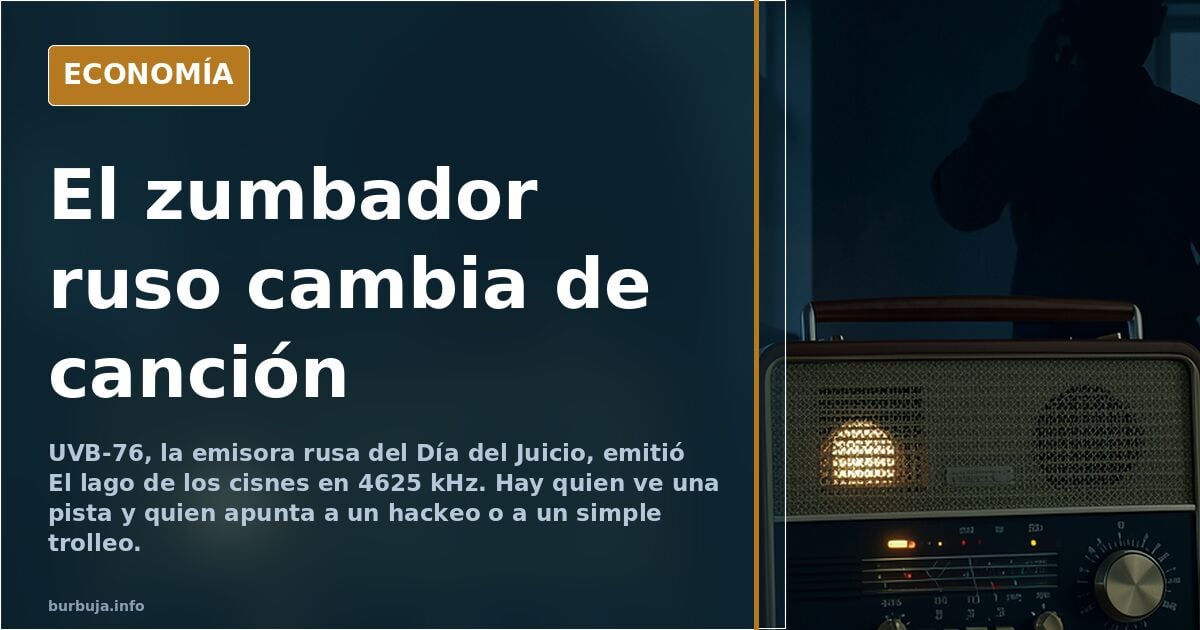
UVB-76 swaps its buzz for Swan Lake
A frequency that has been broadcasting a monotonous beep, twenty-five times a minute, 24 hours a day, 365 days a year, stopped sounding as it always has. On the radio station known as UVB-76, called the buzzer or the bell, Swan Lake began to play. The report, circulated by the Russian military chronicle and picked up on amateur radio forums, points to a clue. Or to a joke. The difference between the two is the whole story.
The station broadcasts on 4625 kHz and nearby frequencies, and has been traced to a military facility in Povarovo, forty kilometres northwest of Moscow. For about fifty minutes a day, from 7:00 to 7:50, it transmits at lower power; it is suggested that this window is used for maintenance. None of that explains why a Soviet marker beacon starts playing music.
What is UVB-76 and why nobody knows what it's for
Technical consensus is scarce. Some argue the station never had a real operational purpose and was always a Soviet psy-op, a sonic facade designed to make the adversary waste resources listening. Against that weighs the obvious: sixty years of continuous broadcasting is a considerable expense for a joke.
What is documented is its strangeness. Letter beacons are already rare and incomprehensible; the buzzer is outright alien. And it is not the first time something other than a beep has been heard on it: in its history there have been moments when songs or fragments of songs have slipped onto the frequency.
Swan Lake and the reflection of the apocalypse
The choice of piece is no accident. Swan Lake is the piece Soviet television played on a loop when a general secretary died, the musical curtain of the end of a world. Its appearance on the Doomsday frequency invites reading it as a coded message. Or as a wink.
In the same session, according to the records circulating, an electronic track with the lyrics Bam, bam, bam, we're shooting at the hohol played first, trinc by the ballet excerpt. Some point directly to a hack of the signal. The trolling theory gains ground when you check that the broadcasts were intercepted near the receiving station in the Netherlands, one of the most popular websdr receivers.
The spectral fingerprint as proof
Here the hobbyist has an edge over the armchair analyst. Any setup with a hundred-euro sdr makes it possible to record the bandwidth and compare the spectral fingerprint of the original transmission with that of an impersonation. It used to be complicated; now any nobody with a cheap receiver and a freezing antenna can do it.
Reception conditions, though, rule. With the antenna at two degrees below zero, the signal comes in weak: nothing but noise, S5-6 levels and -102dBm; even the GYA wefax station at Northwoods in the UK wasn't coming in clearly. A faint trace on 4622.5, impossible to make out. The only proof, a dot-dash on the waterfall.
The risk of the game spilling beyond the frequency
The problem isn't four nerds listening to beeps. The problem is escalation. Someone who starts trolling numbers stations may end up playing nasty pranks with naval communications, lighthouses or ambulances. The line between entertainment and an operational incident is thinner than it seems.
Meanwhile, the station remains on air. Sometimes with its trumpets of the apocalypse. Sometimes with a swan. How much of what sounds on 4625 kHz is a message, and how much is simply someone with a transmitter and a desire to see who believes it?
Also available in: Deutsch
Summary of a discussion on Burbuja.info - Foro de economía, actualidad y política., translated from Spanish and reviewed before publication. Read the full discussion (42 replies).
More summaries
-
GESOP poll: Vox eats into PP support while PSOE holds steady
October 2026 GESOP poll shows PSOE at 22.1%, PP at 17.9%, and Vox rising to 14.9%. A contentious campaign is expected in Spain.
-
Spain's Post-Covid Sedation Claims Spark Ethical Debate
Sedation in patients over 75 raises ethical and economic questions. We analyze the legal framework and private copay implications.
-
Dire Straits: Why Radio Overplay Made Us Hate Them
Radio hammered their hits until nausea, but there's more: plagiarism, snobbery and a digital milestone. Why does Dire Straits irritate so many?
-
Sol camp in Madrid: educated young Spaniards clash with migrants accepting €1,300
Educated young Spaniards are protesting in Madrid because they cannot move out of home, while migrants accept €1,300 a month and a shared room. The dispute over wages and housing is growing.
-
Gabriel Zucman's 2% wealth tax plan: will Spain's middle class foot the bill?
We analyse Gabriel Zucman's 2% levy on the ultra-rich: tax justice or a real risk to the savings of Spain's middle class?
-
.
The story of a father who left 90% of his fortune to his youngest son, based on character rather than tradition. Did he get it right?