
Sol camp in Madrid: educated young Spaniards clash with migrants accepting €1,300
Educated young Spaniards are protesting in Madrid because they cannot move out of home, while migrants accept €1,300 a month and a shared room. The dispute over wages and housing is growing.
English · Original discussion in Spanish · Published
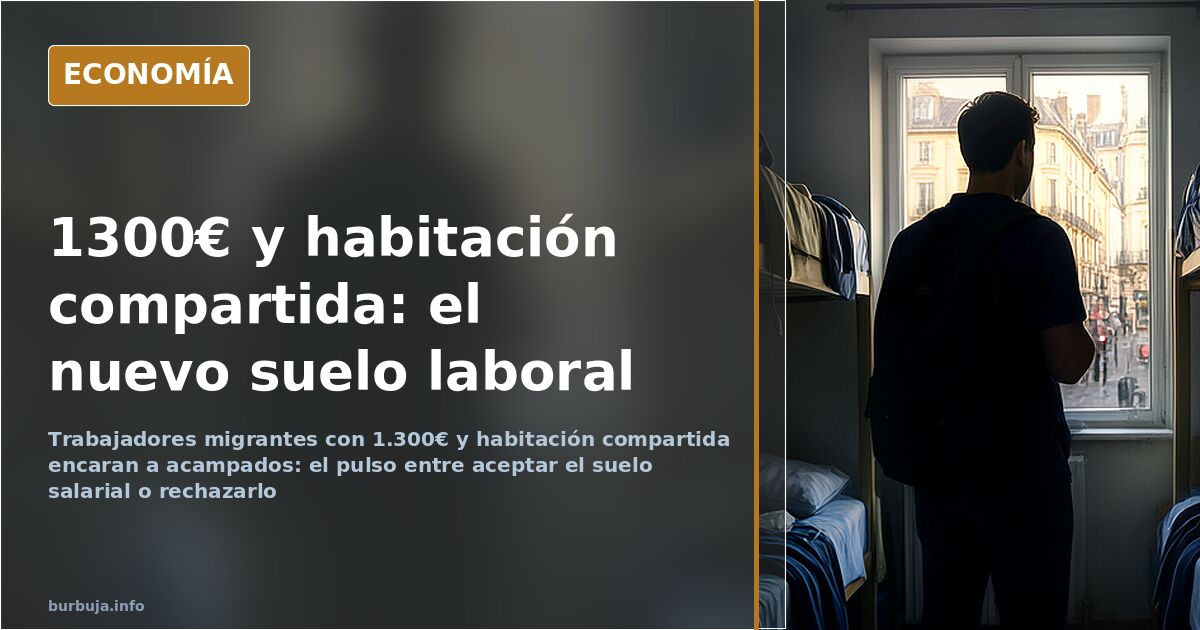
Educated young people versus migrants who accept €1,300 and a shared room
At a camp in central Madrid, a group of young Spanish university graduates is protesting because they cannot afford to live on their own. A few metres away, workers from the Andean highlands, employed in the meat industry, reproach them for complaining. The trigger is a job offer of €1,300 a month and a shared room for €700. The scene captures a tension that is no longer being settled in offices: that of two generations of wage earners competing for the same place in life.
The row, which in recent hours has jumped from messaging groups to the media, has a figure behind it: starting wages at many companies in the primary sector have not grown at the same pace as rents. A young Spaniard moving out today in Madrid takes on a housing cost that eats up more than half their payslip. A migrant worker, on the other hand, accepts that same wage because their goal is to save and return home. The difference is not one of effort, but of expectations.
A wage that doesn't cover a flat
The first point of friction is arithmetic. A contract of €1,300 gross per month leaves a net of around €1,100. If the room costs €700, that leaves €400 for food, transport and utilities. In cities like Madrid, that margin simply doesn't exist. The young campers express it with a phrase that has been repeated in recent days: "I don't want to be a slave." They are not asking for a €3,000 job, as their critics claim, but to be able to live alone on an average wage.
Some argue that this aspiration is legitimate and that the problem lies in the housing supply. Others, however, point out that the Spanish labour market has been adjusting wages downwards for decades and that the arrival of workers willing to accept precarious conditions worsens that trend. The result is a competition that benefits no one: neither those who stay, nor those who arrive.
The experience of the one who left with 40,000 pesetas
Against the narrative of the camp, a testimony has circulated that sums up another mindset. A worker recounts that he moved out 400 kilometres from his hometown with a rent of 40,000 pesetas and a part-time wage. He had €3,600 in savings. "I put my balls into life," he says. Today he owns a home and has a €3,000 job. His message is clear: those who don't take the leap never cross the river.
That story, which at its heart is one of geographic mobility and effort, has been used to dismiss the campers. But it hides a difference in context: twenty years ago, housing prices and wages made that leap possible. Today, with the same savings, the move is impossible in most provincial capitals. The generational comparison doesn't hold up without factoring in the price per square metre.
The role of immigration in the equation
The debate has been tainted by an argument that needs to be separated out: immigration is not the cause of the problem, but its presence makes it more visible. Foreign workers who come to fill positions that locals reject as precarious are not coming to compete unfairly; they are filling a gap the market has left empty. Employers know this, which is why they push to maintain migratory flows.
That said, those same employers are the ones who set the wages. If the starting wage in the meat industry is €1,300, it is not because migrants accept it, but because companies can offer it. Ultimate responsibility lies with those who hire, not with those who need the job. Confusing the two is a mistake that only benefits the usual suspects.
Housing as the backdrop
The price of rent is the great absentee in many of these discussions. In recent years, the supply of affordable housing has not grown at the pace of demand. Young Spaniards compete for rooms that used to be entire flats. Migrants, for their part, crowd into slumlord flats because their priority is saving. Both groups are victims of the same overheated market.
The Sol camp has put the spotlight on housing, but it has also exposed a cultural divide: between those who believe individual effort is enough to get ahead and those who believe the system is designed to prevent it. That divide cannot be resolved with slogans.
The conflict to come
With stagnant wages and rising rents, the tension between local young people and migrant workers has room to grow. It is not an exclusively Spanish phenomenon: similar episodes have already occurred in other European countries. The difference is that here it coincides with a housing crisis affecting the entire lower-middle class.
Meanwhile, meat industry companies continue recruiting in their workers' countries of origin. They do it because they can. And as long as they can, the conflict will keep beating in the streets and on the forums. The question is not whether there will be more episodes like the one at Sol, but when and under what conditions.
The scene at the camp, with university students and migrant workers face to face, is just the tip of the iceberg. Beneath it lies a productive model built on low wages and housing that has become a luxury good. Is an economy sustainable that demands its young people share flats at thirty and its migrants live packed together to get ahead?
Also available in: Deutsch
Summary of a discussion on Burbuja.info - Foro de economía, actualidad y política., translated from Spanish and reviewed before publication. Read the full discussion (263 replies).
More summaries
-
More and more workers in Spain are earning close to the minimum wage
Spain's minimum wage (SMI) has risen 47% since 2018, but wage compression is dragging engineers down to labourers' pay. An analysis of the tax trap and workplace absenteeism.
-
Madrid: fines emerge as the route against the Puerta del Sol camp
The Puerta del Sol camp in Madrid is still standing: the city ordinance allows fines for camping, drinking or urinating in the street, but the cases never get processed
-
Clash at Sol protest camp over Spanish flag bracelet
A woman wearing a Spanish flag bracelet was confronted at the Sol camp for backing Abascal, as the Comunidad de Madrid deadline looms
-
Onda Cero reshuffles lineup, Alsina and Latorre affected; La Brújula left in limbo
Alsina departs Onda Cero mornings, Latorre moves to the morning slot, and Marta García Aller inherits La Brújula amidst listener criticism.
-
Spain's University Statute gives students power over what is taught
Spain's University Statute will give students a say over what is taught. The key detail: it does not clarify which students, or with what checks and balances.
-
Unemployed mother of two in Ceuta, Spain: the maze of benefits that never arrives
A 25-year-old single mother, former self-employed worker and unemployed since December: the case that reopens the debate in Ceuta, Spain, over who actually receives social benefits