
User Proposes Rearming Europe and Erasing NATO
A user suggests the largest European rearmament in history, dividing territory with China up to the Urals. The plan lacks any specific figures.
English · Original discussion in Spanish · Published
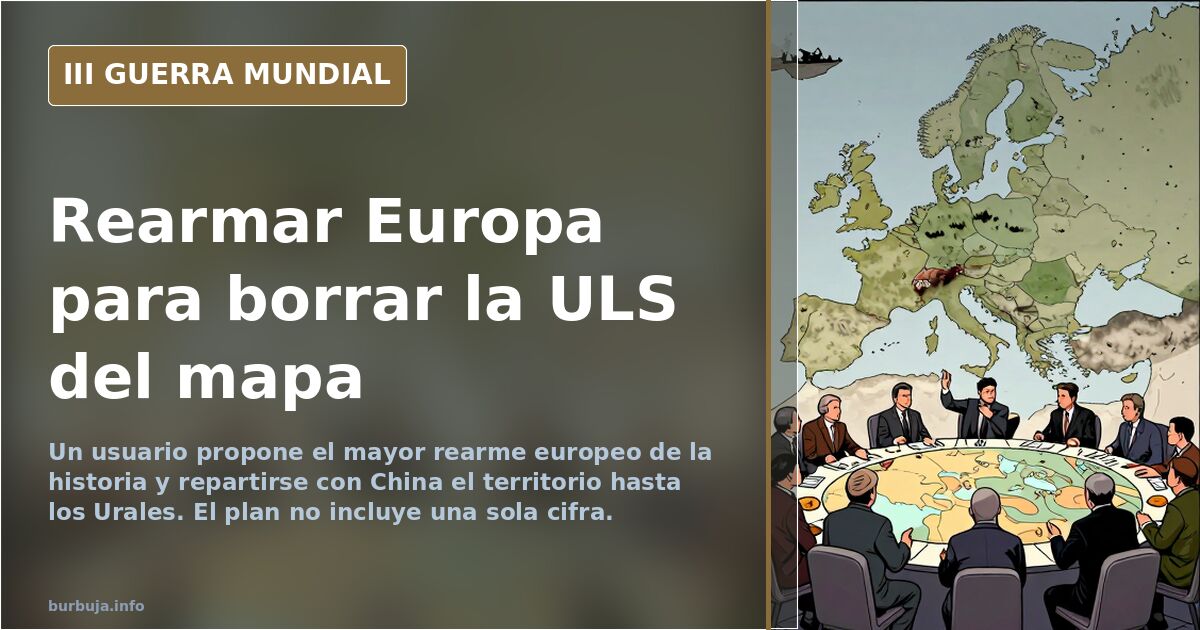
Europe lacks land; the East took it all
One user argues that Europe has suffered a territorial deficit for two millennia and that military action is the only solution. The premise is historical: East Asian populations supposedly pushed westward against peoples of the Dnieper and Black Sea basins, causing Rome's fall and forcing map changes. From this comes an aggressive diagnosis: Europe is the smallest continent, having lost half its territory over two thousand years through ethnic cleansing and displacement, resulting in tiny nations unable to develop due to lack of space.
The conclusion offers a four-step roadmap. First, expel foreign troops from Europe. Second, dissolve the military alliance seen as hostile. Third, launch the greatest rearmament ever. Fourth, pact with China to divide territory east and west up to the Caspian Sea and Urals. The closing argument uses analogy: if others reclaim lands lost two thousand years ago, so can Europe.
The permanent invasion thesis and its reversal
Critics invert the historical narrative. They list failed invasions of Russia: the Swedish Empire, Napoleon, Nancy Germany, and in the 20th century, NATO itself. The Teutonic Order is added as a medieval precedent. The conclusion is that expansionist impulses flowed opposite to the initial claim.
A second counterargument challenges the starting diagnosis: if a country with fewer people and resources sustains an offensive for years, the issue isn't European weakness but management of capabilities. The irony is blunt: supposed dwarfs invading, looting, and killing does not reflect well on Europeans.
How long would a conventional war last?
Early predictions claimed the targeted military structure wouldn't last a month if Europe acted united. This scenario imagines a unified Europe marching east, opening all fronts without external funding, which allegedly sustained the USSR during WWII.
Common sense objects quickly: no one allows destruction without resistance. Historical precedent cites the German invasion of the USSR, which stalled longer than expected and ended in disaster for the invader. Discussion shifts to strategy, demanding joint plans, maps, and phases to execute such an offensive. Intent is clear; execution remains undefined.
Internal front: migration, Gibraltar, wrong enemy
Some shift focus inward. They argue the real enemy isn't thousands of kilometers away but at the southern border and the British-held Rock of Gibraltar. Critics target those focusing on the East while Spain faces daily migration pressure and unresolved enclaves with NATO partners.
This line also criticizes reliance on TV narratives, accusing the original proposal of serving foreign interests. Opponents label every dissenter as an apologist for the adversary. Exchanges degrade rapidly, eliminating technical discussion.
From geopolitics to insults: analysis breaks down
Beyond a certain point, debate becomes personal attacks. Dissenters are accused of being paid agents, cowards, or social failures, with mockery about appearance and private life. Responses mirror this, calling the proposer an example of educational failure and criticizing obsession with a country that allegedly did nothing to Spain.
Consequently, the original plan's four phases remain undeveloped. No one specifies rearmament costs, economic impacts, or energy supply consequences. Discussion stays at headline level.
The desired map reality
Territorial proposals culminate in a final goal map: Europe extended to the Caspian and Urals, with the Yenisei River as new eastern border. Presented as historical opportunity correcting post-1945 artificial borders, the core argument claims everyone has ample living space except Europe.
Most frequent response asserts the targeted military structure is invincible and should be accepted. Counter-reply claims it wouldn't be if the continent weren't, per the proposal, hijacked by its own partners. No agreement possible here; each side assumes scenarios the other deems impossible.
The disorienting fact remains. In an issue framed as continental survival, antiestéticaturing unprecedented rearmament and a twenty-million-square-kilometer territorial division, no figures were provided. No budget, timeline, or casualty estimates. Just a map and certainty that the opponent won't last a month.
One user argues that Europe has suffered a territorial deficit for two millennia and that military action is the only solution. The premise is historical: East Asian populations supposedly pushed westward against peoples of the Dnieper and Black Sea basins, causing Rome's fall and forcing map changes. From this comes an aggressive diagnosis: Europe is the smallest continent, having lost half its territory over two thousand years through ethnic cleansing and displacement, resulting in tiny nations unable to develop due to lack of space.
The conclusion offers a four-step roadmap. First, expel foreign troops from Europe. Second, dissolve the military alliance seen as hostile. Third, launch the greatest rearmament ever. Fourth, pact with China to divide territory east and west up to the Caspian Sea and Urals. The closing argument uses analogy: if others reclaim lands lost two thousand years ago, so can Europe.
The permanent invasion thesis and its reversal
Critics invert the historical narrative. They list failed invasions of Russia: the Swedish Empire, Napoleon, Nancy Germany, and in the 20th century, NATO itself. The Teutonic Order is added as a medieval precedent. The conclusion is that expansionist impulses flowed opposite to the initial claim.
A second counterargument challenges the starting diagnosis: if a country with fewer people and resources sustains an offensive for years, the issue isn't European weakness but management of capabilities. The irony is blunt: supposed dwarfs invading, looting, and killing does not reflect well on Europeans.
How long would a conventional war last?
Early predictions claimed the targeted military structure wouldn't last a month if Europe acted united. This scenario imagines a unified Europe marching east, opening all fronts without external funding, which allegedly sustained the USSR during WWII.
Common sense objects quickly: no one allows destruction without resistance. Historical precedent cites the German invasion of the USSR, which stalled longer than expected and ended in disaster for the invader. Discussion shifts to strategy, demanding joint plans, maps, and phases to execute such an offensive. Intent is clear; execution remains undefined.
Internal front: migration, Gibraltar, wrong enemy
Some shift focus inward. They argue the real enemy isn't thousands of kilometers away but at the southern border and the British-held Rock of Gibraltar. Critics target those focusing on the East while Spain faces daily migration pressure and unresolved enclaves with NATO partners.
This line also criticizes reliance on TV narratives, accusing the original proposal of serving foreign interests. Opponents label every dissenter as an apologist for the adversary. Exchanges degrade rapidly, eliminating technical discussion.
From geopolitics to insults: analysis breaks down
Beyond a certain point, debate becomes personal attacks. Dissenters are accused of being paid agents, cowards, or social failures, with mockery about appearance and private life. Responses mirror this, calling the proposer an example of educational failure and criticizing obsession with a country that allegedly did nothing to Spain.
Consequently, the original plan's four phases remain undeveloped. No one specifies rearmament costs, economic impacts, or energy supply consequences. Discussion stays at headline level.
The desired map reality
Territorial proposals culminate in a final goal map: Europe extended to the Caspian and Urals, with the Yenisei River as new eastern border. Presented as historical opportunity correcting post-1945 artificial borders, the core argument claims everyone has ample living space except Europe.
Most frequent response asserts the targeted military structure is invincible and should be accepted. Counter-reply claims it wouldn't be if the continent weren't, per the proposal, hijacked by its own partners. No agreement possible here; each side assumes scenarios the other deems impossible.
The disorienting fact remains. In an issue framed as continental survival, antiestéticaturing unprecedented rearmament and a twenty-million-square-kilometer territorial division, no figures were provided. No budget, timeline, or casualty estimates. Just a map and certainty that the opponent won't last a month.
Also available in: Deutsch
Summary of a discussion on Burbuja.info - Foro de economía, actualidad y política., translated from Spanish and reviewed before publication. Read the full discussion (121 replies).
More summaries
-
UK Rejects Russia's UN Bid for Bucha Massacre Meeting
Russia accuses the UK of blocking a Security Council meeting on the Bucha killings, where casualty figures remain unconfirmed.
-
Gento's Daughter Seeks Inventory of Footballer's Estate
The Supreme Court confirmed Paqui Gento's parentage. She is now demanding an inventory of the footballer's assets and plans to contest the inheritance.
-
Russia claims 560 Ukrainian casualties in southern counterattack
Russian Defense Ministry reports 560 losses in Mykolaiv and Kherson. Kyiv has not confirmed the figures.
-
Unverified Claim of 200 Ukraine War Dead in Trenches
A viral claim asserts over 200 soldiers died in a trench complex, but the only two photos show just two bodies.
-
BRICS Trap Thesis: US Economy Shrinks, China Grows
US GDP fell 1.6% in Q1 2022 while China grew 4.8%, fueling theories that NATO has fallen into a BRICS economic trap.
-
Finland's Defense: 54,000 Bunkers and 900,000 Reservists
Finland maintains 54,000 bunkers and 900,000 reservists amid Ukrainian claims that Putin plans to attack Moldova, while its NATO membership remains debated.