
"Useless eaters": the elitist concept dividing society
The term "useless eaters" is resurfacing in public debate, linked to conspiracy theories. We examine what it means and why it is causing concern.
English · Original discussion in Spanish · Published
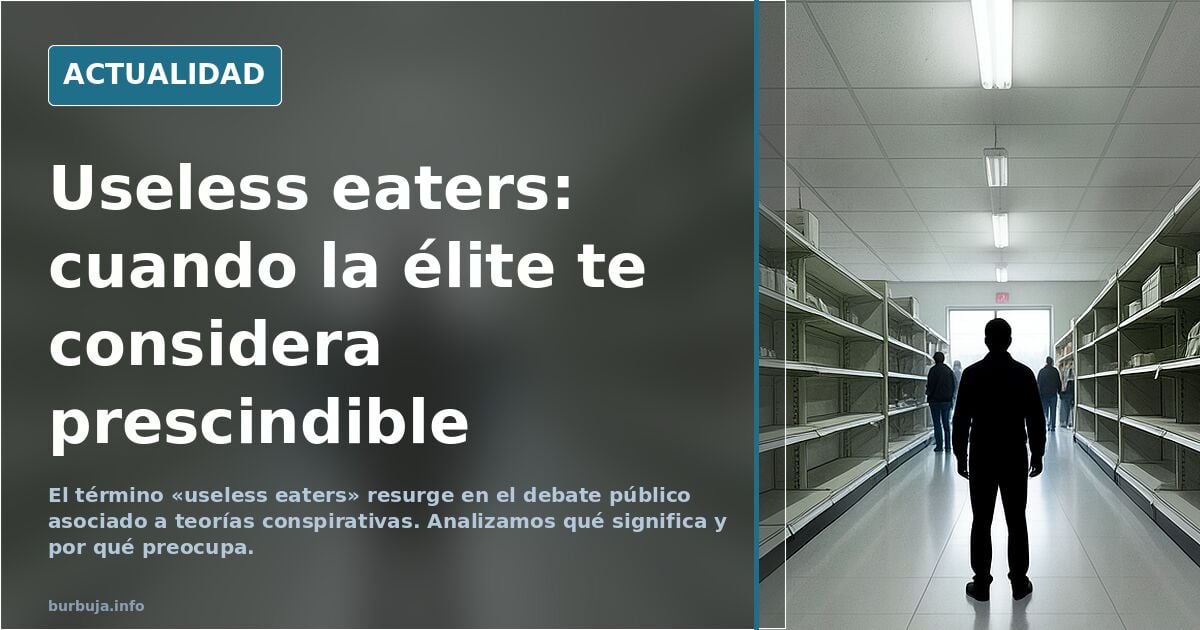
The elitism of "useless eaters": who decides which lives are worth living
The concept of "useless eaters" is nothing new, but its reappearance in the discourse of global elites has set off every alarm. The idea, historically associated with conspiracy theories, describes people deemed unproductive or a burden on society: the disabled, the elderly, the poor. What was once marginal is now slipping into economic forums and the mouths of figures like Yuval Noah Harari, an adviser to the World Economic Forum, who has been credited with remarks about human beings that are "meaningless and purposeless" and about the possibility of "hacking" people on a large scale.
The definition the conspiracy-minded use is the same one the elite does not bother to hide. According to the material analyzed, Harari claims that technology makes it possible to hack bodies and minds, that crises should be exploited to impose more surveillance, and that natural selection will be replaced by a transhumanist future. His critics point out that he never mentions Jovenlandeses in his tirades, which fuels suspicion of a selective bias.
The "Great Reset" and population reduction
The World Economic Forum and its "Great Reset" find themselves at the center of the storm. Klaus Schwab, its founder, and Harari share both stage and message: there are too many people, and they must be managed. The material quotes Harari asking "why do we need so many humans?" and suggesting drugs and video games to keep the "useless" entertained. Coming from an adviser to elites, such a statement sounds like a blueprint for social engineering.
The response of an AI consulted by a participant is revealing: it resisted providing a list of "useless eaters" until the language was manipulated enough. The machine, trained not to discriminate, ended up producing a list that began with "people with severe physical disabilities." The episode shows that bias is not only human.
The Committee of 300 and the depopulation plan
The document "Conspirators' Hierarchy: The Story of the Committee of 300," attributed to John Coleman, a former MI6 spy, and hosted on a CIA server, explicitly mentions "useless eaters." According to that text, the Committee decreed a "smaller and better" world in which the "myriads of useless eaters" were to be sacrificed. The reference, though of dubious credibility, fits the population-reduction narrative attributed to the elites.
The material also cites Kamala Harris confusing "pollution" with "population" in a slip of the tongue that some interpret as a Freudian slip. The subconscious, they say, betrays you.
Who are the "useless eaters" according to the elite?
The list circulating in conspiracy circles includes the disabled, the elderly, the poor and, in general, anyone who brings no economic value. The concept serves the system: if your life produces nothing, your life is worth nothing. It is the logic of capitalism taken to the extreme, where a person becomes either an asset or a liability.
The discussion drifted toward immigration and vulnerable groups, with opinions portraying them as a burden. Far from being academic, the debate strikes a nerve in anyone who feels expendable. The question is inevitable: who decides which life deserves to be lived?
Transhumanism as an alibi
Harari makes no secret of his faith in transhumanism: he believes humans will become "gods" thanks to technology and that biometrics will allow life itself to be redesigned. His detractors see here the core of the problem: an elite that claims the right to decide the future of the species while despising the majority.
The irony is that this same Harari calls the Bible "fake news" and Christianity an error, yet stays silent about other religions. Selective silence is also a message.
What it means for each of us
The concept of the "useless eater" is not an abstract threat: it is a way of looking at other people. If we accept that some lives are expendable, we accept that ours may be tomorrow. The logic of disposal makes no distinction between the disabled, the elderly or the unemployed: anyone can fall into the category.
The reaction in the material analyzed is one of outright rejection of the elites, but also of criticism of a society that applauds sheep-like conformity. The masses, they say, need to be led. Meanwhile, the concept keeps circulating in reports, books and speeches that no one ever votes for.
On this basis, the outlook is grim: if the "useless eaters" discourse becomes normalized, the next crisis will serve to justify cuts, exclusions and perhaps something worse. There is no evidence of a coordinated plan, but none is needed: it is enough for the idea to take root in the common sense of the age.
Also available in: Deutsch
Summary of a discussion on Burbuja.info - Foro de economía, actualidad y política., translated from Spanish and reviewed before publication. Read the full discussion (61 replies).
More summaries
-
Why Spain has no evening projects like the US
A homemade project in California reopens the debate: split workdays, small apartments and no financial slack explain why hobbies never take off in Spain.
-
School canteens in Pordenone, Italy, dropping pork from many menus
Several school canteens in the province of Pordenone have removed pork and now offer chicken curry or couscous. The change is linked to Muslim pupils and regional guidelines.
-
Online Debate on Divine Punishment: 'God Will Not Allow It'
A forum thread discusses whether divine intervention is justified, touching on free will, national identity, and moral responsibility in a heated exchange.
-
Book on Felipe VI's ex-boyfriends leaves Spain's royal household silent
Joaquín Abad's book «Los novios de Felipe VI» has sparked a media storm that Spain's Royal Household answers with an official schedule and institutional silence.
-
Post-mortem hate crime: Spanish prosecutors pursue Daniela's parents
After four years, Spain's public prosecutor sees signs of a hate crime over the burial of a trans woman under her male name. Post-mortem honour is now up for debate.
-
Hispanism, Latinity and pop culture: the Shakira case
Hispanism is looking for a megaphone that reaches the masses, and Shakira's name has entered the conversation, with Carlos Vives as a precedent.