
Why Spain has no evening projects like the US
A homemade project in California reopens the debate: split workdays, small apartments and no financial slack explain why hobbies never take off in Spain.
English · Original discussion in Spanish · Published
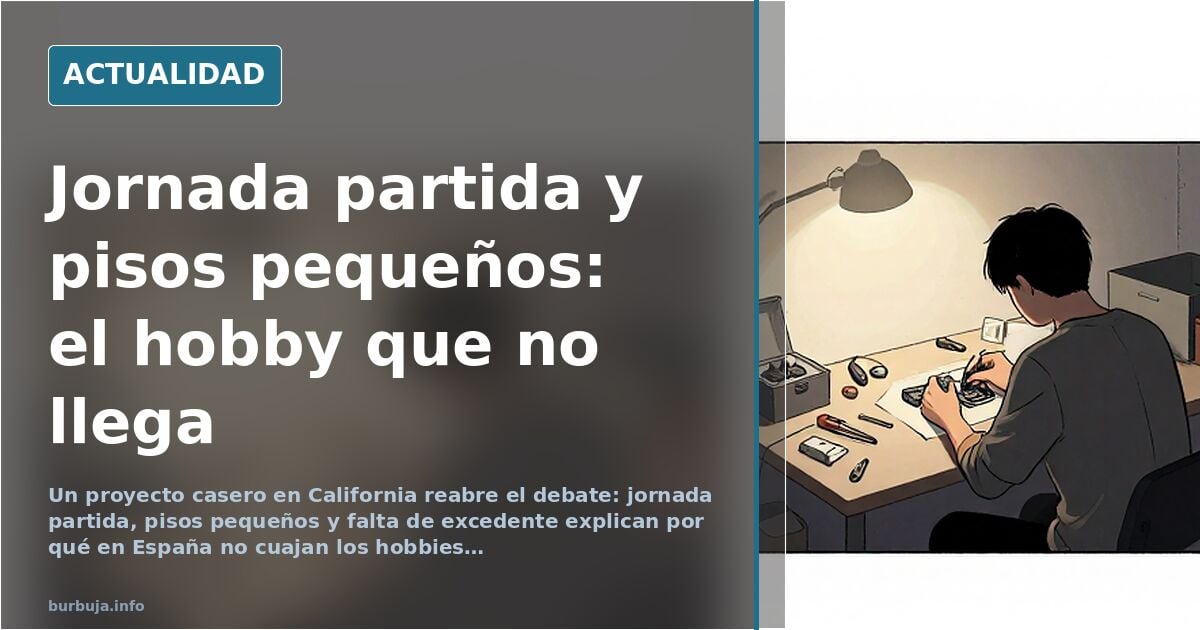
Split shifts, small apartments and zero time: the hobby that never arrives
An engineer from California posts a small homemade gadget on social media —a black hole simulation built for pure fun— and the reaction in Spain is not admiration but an uncomfortable question: why does nobody here do that? The answer that keeps coming up has little mystery and a lot to do with structure: split workdays, cramped housing, salaries that leave no surplus and a passive leisure option already set up in the living room.
The specific case is a tweet by Benji Taylor showing a personal project, summed up in a phrase that sounds provocative in Spain: "because you can make things." Someone replies that this kind of hobby just isn't a thing in Spain. And from there, the diagnosis falls into place on its own.
Split shifts and small apartments: the two obstacles nobody disputes
The first factor is the schedule. The split workday, with a two-hour lunch break, cuts the day in two and sends people home at an hour when, as one comment puts it, "most people get home at 7 pm exhausted." It's not just tiredness: the useful afternoon block simply disappears. Someone who leaves work at five has three or four hours ahead; someone who leaves at seven is hungry and ready for bed.
The second is space. Living crammed into small apartments rules out what any home workshop requires: room to pile up half-finished projects, noise without a neighbor on the other side of the wall, and a corner that doesn't have to be cleared away every night. The comparison with the American garage isn't a cliché: it's a material condition.
Some add a third element: money. Any project needs tools, materials and a surplus you can burn without guilt. If your salary goes on mortgage or rent, the hobby competes with the grocery bill and loses.
Is it just about schedules, or also about culture?
The cultural explanation also comes up, with nuances. The argument is that Mediterranean culture pushes people outdoors: full terraces, beers, socializing at the bar rather than shutting yourself at home. Against that, the counterargument is that not everyone in the United States is a garage genius: plenty of people also get home and watch TV. The difference wouldn't be vocation, but the infrastructure of time and space that allows or blocks that vocation.
Climate enters the equation too. One participant points out that the project's author doesn't live in a state with long winters, but in California, with beaches and daylight all year round, which dismantles the theory of winter boredom as the engine of domestic creativity.
Passive entertainment that's already paid for
The entertainment offer works against it. With series, streaming platforms and broadcast TV available effortlessly, building a home server or learning to play drums with a MIDI controller demands energy that at nine at night isn't always there. Those who do it describe it as a conscious choice against passive consumption, but admit it depends on having a clear head and free time, two scarce goods.
The historical comparison also creeps in: in the eighties and nineties, with the first home computers, a scene of file sharing and forums through bulletin boards flourished. That required no garage, just a computer and curiosity. The question is why that impulse wasn't reproduced with the same intensity afterwards.
The striking figure isn't how many projects get made, but how many are abandoned halfway for lack of a place to leave them. With a split workday, a small apartment and a tight salary, a hobby isn't a pastime: it's a luxury of space and time most people can't afford.
Also available in: Deutsch
Summary of a discussion on Burbuja.info - Foro de economía, actualidad y política., translated from Spanish and reviewed before publication. Read the full discussion (29 replies).
More summaries
-
Madrid reinstates split school day with two-hour break
The Community of Madrid approves a split schedule for public schools, introducing a mandatory two-hour midday break. Teachers and parents express concern over logistics.
-
Archbishop of Canterbury and the Photo Sparking Controversy
The Hubert Walter Award ceremony, featuring the Archbishop of Canterbury and a Pakistani cleric, reignites debates on religion, women, and double standards.
-
Creil, the mirror of a new France that no longer recognizes its neighbors
In Creil, a city home to 100 nationalities, a resident admits he no longer recognizes his birthplace. The Muslim vote for Mélenchon and the identity strategy of the left
-
Why people mock Hamalla: the singer who divides audiences
Hamalla fills stadiums yet is the target of ridicule. Fair criticism or envy? An analysis of the polarization surrounding the singer.
-
Burka behind the wheel: Spain's traffic authority stuck in a legal vacuum
A driver in a burka passes through a police checkpoint in Spain without being identified. The DGT does not apply road safety law to full-face veils. Fraud, fines and a legal limbo.
-
Fertility clinic mix-up: couple given the wrong baby
A Florida couple received the wrong embryo at a fertility clinic. The baby, of a different race, has triggered a legal battle over custody.