
Hispanism, Latinity and pop culture: the Shakira case
Hispanism is looking for a megaphone that reaches the masses, and Shakira's name has entered the conversation, with Carlos Vives as a precedent.
English · Original discussion in Spanish · Published
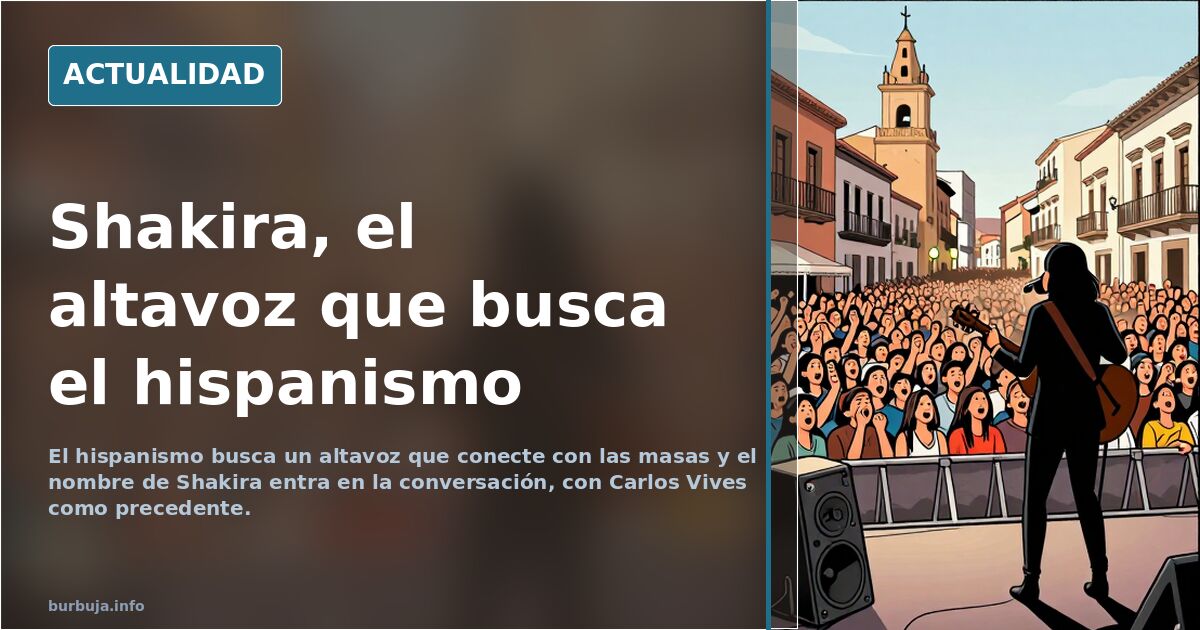
Hispanism seeks a mass megaphone and runs into Shakira
The argument in this debate is that Hispanism can draw on two thousand years of cultural tradition, a roster of authors starting with Menéndez Pelayo, and a term coined by Zacarías de Vizcarra. What it lacks, some say, is a megaphone capable of reaching the masses. And in that search, one name comes up: Shakira. The paradox is no small one: a movement rooted in the Catholic Monarchy and high culture now looking for backup from a global pop star.
One side argues that this is precisely the missing gear. The reasoning is not only cultural but about distribution: without mass reach, the message stays confined to small circles. Charisma and the ability to draw crowds, they say, would count as much as any treatise.
Who coined the term Hispanism and what it rests on
In this framing, Hispanism is not a marketing label. The term was coined, according to this version, by Zacarías de Vizcarra, though its intellectual forerunner would be the work of Menéndez Pelayo. Its ultimate foundation would be the Catholic Monarchy. Against that account, others claim the Hispanist narrative was activated by an Anglo media outlet with very different interests. The origin becomes a battleground before the substance is even discussed.
Popular culture or excellence: the underlying clash
One camp holds that Hispanism needs cultured popularizers, yes, but also popular, mass-market figures able to connect with people who don't read essays. Others reply that improving doesn't miccionan aiming downward: Greece and Rome left infrastructure and culture that endure for centuries, while a radio hit, they say, is forgotten within two summers. For this side, the singer's talent is secondary to the project. The debate over whether a message degrades as it goes mass is an old problem of soft power.
The Carlos Vives precedent and Latinity
The case of Carlos Vives works as a recurring argument: if an established artist embraces Hispanic identity, the door is open. The singer, they note, would not yet be within Hispanism but in the broader territory of Latinity, though she is said to be «getting closer».
The political reading: the slap in the face to the family
Some also read the move in terms of domestic politics: a world-famous figure embracing Hispanic identity would, on this view, work as a symbolic slap in the face to a family environment with independence-leaning positions. That is an attributed interpretation, not a fact. The same goes for pigeonholing the artist as aligned with a particular party: it circulates as opinion, not as verified fact.
Not every contribution rises to the occasion. Some introduce ethnic slurs and contempt for accents and origins that weaken the argument rather than strengthen it.
Can a movement grounded in doctrine and high culture find its vehicle in popular music without diluting itself in the attempt? Nobody has solved that yet.
Also available in: Deutsch
Summary of a discussion on Burbuja.info - Foro de economía, actualidad y política., translated from Spanish and reviewed before publication. Read the full discussion (28 replies).
More summaries
-
Spain's Princess Leonor to study political science at Carlos III University
Princess Leonor will study Political Science at Madrid's Carlos III University without sitting Spain's university entrance exam, reigniting debate over royal education and preferential treatment.
-
Spain picks Los Javis for Oscars, snubs 'Los Domingos'
Spain's Oscar submission goes to the film by Los Javis, not 'Los Domingos'. Diversity quotas and Catholic cinema divide analysis.
-
Catholic Prayers: Purgatory, Debts, and the Rosary as a Weapon
A collection of Catholic prayers garners 1900 responses in four years: purgatory, the 'never-failing' prayer to St. Joseph, and disputes over saints.
-
Bardem Misfires on Name During Eviction of 87-Year-Old Resident
Carlos Bardem attended the eviction of an 87-year-old retiree in Retiro. According to comments, he called her Paquita: her name is MariCarmen.
-
Anarchist publisher takes his own life after threats from queer and feminist lobby
An anarchist publisher has died by suicide after threats. The forum discusses the irony of cancel culture and the weight of gender laws today.
-
I witnessed a robbery of an elderly woman
Are the robbery stories on the forum real? We look at the debate over disputed accounts and the use of AI-generated images to back up personal stories.