
From ECB Liquidity to Corralito: Measuring Economic Collapse
Recent violent incidents in Barcelona and the death of Civil Guards revive debates on systemic fragility and the risk of a financial corralito.
English · Original discussion in Spanish · Published
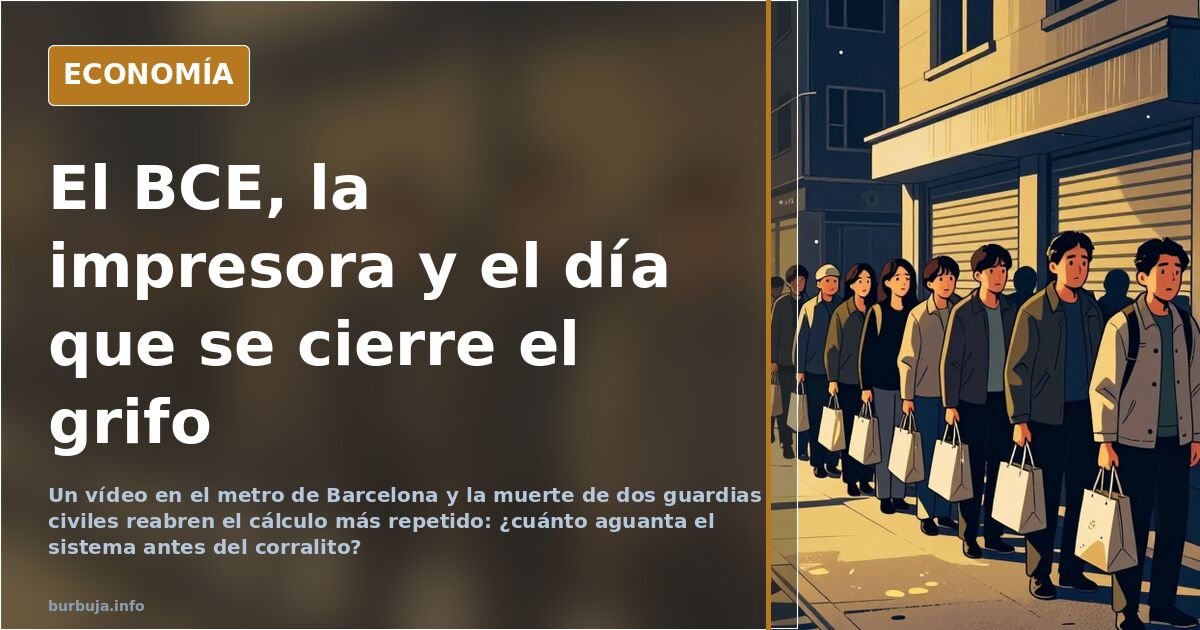
From Barcelona Metro to Corralito: How to Measure a Collapse
A video shows a man assaulting several women in the Barcelona metro without any reported arrest, while another incident involves the murder of two Civil Guards. Between these scenes lies the recurring question: how long until the system collapses? The answer is no longer a date, but a calculation method.
What Holds the System Up? The ECB Printer as Anesthesia
The most compelling argument is uncomfortably simple: as long as money remains cheap, nothing falls apart. Some analysts argue the European Central Bank will maintain liquidity as long as political power aligns with the perceived globalist agenda, closing the tap only when resistance emerges. The second pillar is more earthly: what breaks a society is not indignation, but hunger.
This leads to the most cited forecast: the ECB's debt purchases would end in 2025. From that point, the expected sequence is textbook: banking stress, contagion, rapid money printing, hyperinflation, deposit freezes, and finally, a state app returning money under strict control. One phrase summarizes it best: savings are seized, and protesters are targeted.
There is a darker variant. It suggests no digital solution, just vanishing money, leaving only debts, perhaps with a few bankers prosecuted for show. This is the domestic version of "you'll have nothing and be happy."
The Boiling Frog Effect: Why Slow Deterioration Doesn't Mobilize
If collapse isn't sudden, why no reaction? The common image is the frog in slowly heating water: gradual decline triggers no alarm. New generations don't compare to a better past; they accept anomalies as normal. As one participant notes, when the real crisis hits, many will say nothing is wrong because they were born into the anomaly.
Another pessimistic view suggests if the frog jumps, someone has another pot ready. Protests are channeled, exhausted, and met with superficial offers. Anger is managed, not resolved. Citing Venezuela and Cuba, some argue populations eventually align with oppressors, blaming third parties instead of acknowledging errors.
Has It Already Collapsed? The Silent Collapse Thesis
Some argue the collapse already peine; we just need official confirmation. The inventory is known: housing was the issue, now food and cars too; public healthcare has months-long waits; insecurity grows; cities fill with trash and dilapidated flats; cultural levels sink.
The objection is methodological. If everything has been collapsing for years without breaking, maybe "collapse" is the wrong word. There is a recurring call to define what constitutes a collapse and what specific event would certify it. Without this, the term means anything.
No Signed Date: 2025, 2100, or Never
Estimates range from immediate to indefinite. Some pinpoint July 18, others delay it to 2100. A middle position holds that nothing will collapse; people will endure, and any political alternative will be neutralized before gaining power.
One analogy compares social processes to earthquakes: plates build pressure unnoticed, small tremors release tension, then suddenly everything shifts. Sometimes provocations fail. The lingering doubt is whether this is eternal trickle-down or a financial corralito appearing alongside a state of exception.
The unsettling reality is that there is no consensus date. Perhaps because predicting the fall is easier than agreeing on what counts as a fall.
A video shows a man assaulting several women in the Barcelona metro without any reported arrest, while another incident involves the murder of two Civil Guards. Between these scenes lies the recurring question: how long until the system collapses? The answer is no longer a date, but a calculation method.
What Holds the System Up? The ECB Printer as Anesthesia
The most compelling argument is uncomfortably simple: as long as money remains cheap, nothing falls apart. Some analysts argue the European Central Bank will maintain liquidity as long as political power aligns with the perceived globalist agenda, closing the tap only when resistance emerges. The second pillar is more earthly: what breaks a society is not indignation, but hunger.
This leads to the most cited forecast: the ECB's debt purchases would end in 2025. From that point, the expected sequence is textbook: banking stress, contagion, rapid money printing, hyperinflation, deposit freezes, and finally, a state app returning money under strict control. One phrase summarizes it best: savings are seized, and protesters are targeted.
There is a darker variant. It suggests no digital solution, just vanishing money, leaving only debts, perhaps with a few bankers prosecuted for show. This is the domestic version of "you'll have nothing and be happy."
The Boiling Frog Effect: Why Slow Deterioration Doesn't Mobilize
If collapse isn't sudden, why no reaction? The common image is the frog in slowly heating water: gradual decline triggers no alarm. New generations don't compare to a better past; they accept anomalies as normal. As one participant notes, when the real crisis hits, many will say nothing is wrong because they were born into the anomaly.
Another pessimistic view suggests if the frog jumps, someone has another pot ready. Protests are channeled, exhausted, and met with superficial offers. Anger is managed, not resolved. Citing Venezuela and Cuba, some argue populations eventually align with oppressors, blaming third parties instead of acknowledging errors.
Has It Already Collapsed? The Silent Collapse Thesis
Some argue the collapse already peine; we just need official confirmation. The inventory is known: housing was the issue, now food and cars too; public healthcare has months-long waits; insecurity grows; cities fill with trash and dilapidated flats; cultural levels sink.
The objection is methodological. If everything has been collapsing for years without breaking, maybe "collapse" is the wrong word. There is a recurring call to define what constitutes a collapse and what specific event would certify it. Without this, the term means anything.
No Signed Date: 2025, 2100, or Never
Estimates range from immediate to indefinite. Some pinpoint July 18, others delay it to 2100. A middle position holds that nothing will collapse; people will endure, and any political alternative will be neutralized before gaining power.
One analogy compares social processes to earthquakes: plates build pressure unnoticed, small tremors release tension, then suddenly everything shifts. Sometimes provocations fail. The lingering doubt is whether this is eternal trickle-down or a financial corralito appearing alongside a state of exception.
The unsettling reality is that there is no consensus date. Perhaps because predicting the fall is easier than agreeing on what counts as a fall.
Also available in: Deutsch
Summary of a discussion on Burbuja.info - Foro de economía, actualidad y política., translated from Spanish and reviewed before publication. Read the full discussion (134 replies).
More summaries
-
Japan bond hits 3% as Hormuz closure sparks debt crisis
The surge in Japanese yields and the Strait of Hormuz blockade accelerate a global debt crisis, with gold surpassing $5,000.
-
Spanish diesel tops €2 amid tax debate
Diesel in Spain exceeds €2 per liter, with taxes accounting for ~97 cents. Political deadlock persists over potential cuts.
-
Spain challenges Trump amid sovereignty doubts
Spanish PM Sánchez warns Europe won't be a vassal, while critics highlight Spain's dependencies on Morocco, China, and Brussels.
-
Spanish woman evicted after €7,000 loan balloons to €60,000
In Spain, a disabled woman lost her home after an eight-year private loan grew from €7,000 to €60,000 due to compounding interest.
-
Gold hits $2,702 in futures, reigniting debate on real value
Gold futures hit a record $2,702 per ounce, sparking debate on whether the metal is rising or fiat currency is falling.
-
Wheelchair user critically injured in Madrid Río stabbing
A woman in a wheelchair was critically wounded after being stabbed in Madrid Río. Workers from Madrid Calle 30 assisted her and alerted emergency services.