
US student debt hits $1.7 trillion amid rising defaults
Reports indicate US student loan balances have reached $1.7 trillion, with delinquency rates climbing and sparking debate over who bears the cost of higher education.
English · Original discussion in Spanish · Published
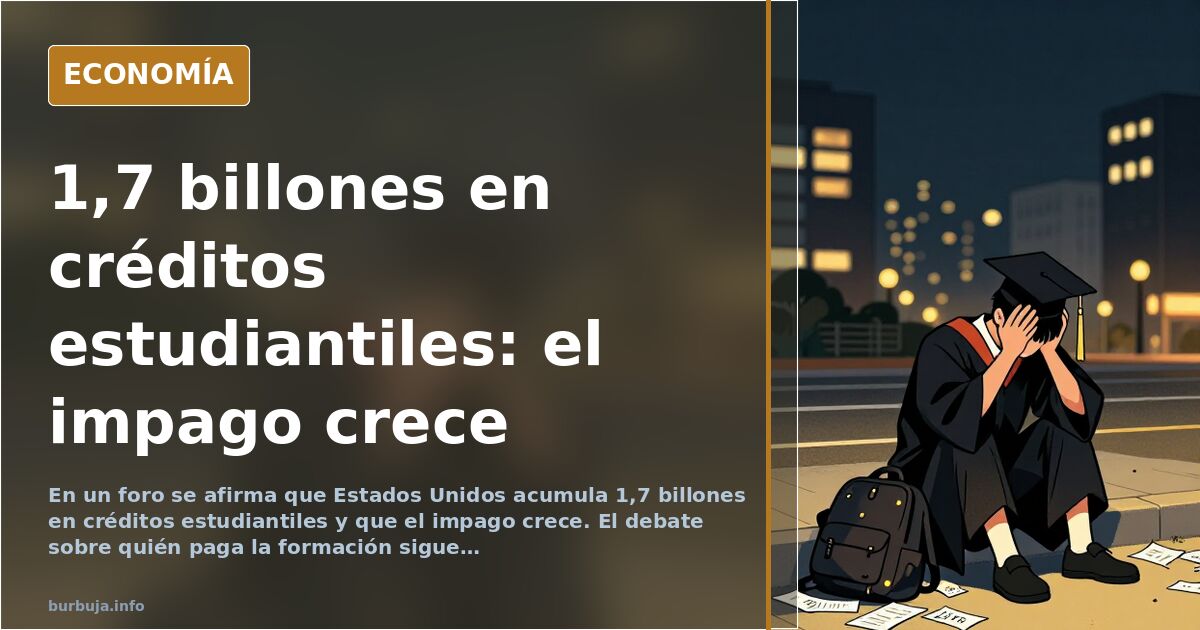
US student loans: $1.7 trillion in debt and rising defaults
The scale of US student debt and growing non-payment
One figure is more unsettling than any political slogan: $1.7 trillion in accumulated student loans in the United States, according to widely cited data. This is not an abstract number. Behind it are graduates burdened by payments during their lowest-earning years, just as they enter the job market, alongside a rise in defaults that experts warned could impact banks. The debate over whether the fault lies with borrowers or the system has become a stalemate where few shift positions.
What peine to educational debt in the US
The starting point is an uncomfortable paradox. The US unemployment rate stands at 4.2%, effectively full employment, yet many graduates cannot afford what they signed up for. A common argument suggests that if there is work, one should work, and if there is debt, one should pay. The counterargument highlights structural issues rather than lack of will: educational credit has become expensive, access to higher education acts as a toll, and early career years offer the least financial resilience.
Some argue that the rigorous US system is preferable to Spain’s model, where taxpayers fund the education of those who later emigrate and generate wealth elsewhere. Opponents contend that aggressive collection practices turn youthful mistakes into lifelong financial sentences.
The business of degrees and dead-end majors
One line of analysis points to a degree bubble. There is an oversupply of bachelor's programs, a shortage of viable career paths, and a labor market unable to absorb university output. Critics target degrees with low employability, while defending fields like medicine, computer science, engineering, law, and business as meeting real demand. Proponents of this view suggest those outside these sectors should pursue other work.
A reasonable objection arises: who decides which degree is useless? Similar questions were asked about fields that now support entire industries. Another often overlooked detail: the profit isn't just in the degree itself, but in thesis preparation services, final year projects, and online academies generating revenue comparable to executive salaries at major companies, such as those on Spain's IBEX 35 index.
Who pays for education and who reaps the rewards
Spain’s model enters the comparison via cost dynamics. Public universities are cheap for students because they cover only a fraction of actual course costs, with taxpayers footing the rest. Private institutions, once accessible to the middle class, have become unaffordable due to tuition and housing expenses, especially when relocating to cities like Madrid, San Sebastián, or Bilbao.
This creates an asymmetry: public university students benefit from collective effort, while those who move abroad for higher wages take that return with them. Calculating the total cost of studying away from home versus future earnings reveals disparities that surprise first-time analysts.
Defaults threatening the financial system
Warnings about systemic risk are not new. Rising student loan defaults have previously been flagged as threats to banking stability, and the $1.7 trillion figure means any deterioration transcends individual borrowers. Debates over state guarantees for loans up to €1 million for elite careers add another layer: the risk extends beyond students to society at large.
What happens when borrowers cannot pay? In the US, wage garnishment is real and severe. In Spain, debt burdens are diluted among taxpayers while graduates can leave the country for better pay. Two models, two ways of distributing costs, neither resolving the fundamental question.
The discussion on educational debt doesn’t end with a headline. It ends, if at all, with another question: if a degree no longer guarantees employment, who should bear the cost of trying?
Also available in: Deutsch
Summary of a discussion on Burbuja.info - Foro de economía, actualidad y política., translated from Spanish and reviewed before publication. Read the full discussion (165 replies).
More summaries
-
Trump Threatens Military Action Against Nigeria Over Christian Killings
Trump threatens to cut aid and launch "devastating" military action if Nigeria fails to stop the killing of Christians. The country is Africa's top oil producer.
-
Vidal claims 9% US tax rate, sparking fiscal debate
César Vidal states he pays 9% taxes in the US versus 50% in Spain. Federal brackets and living costs complicate this comparison.
-
Why Fentanyl Hasn't Spread in Spain Like in the US
Spain leads in tranquilizer use, yet fentanyl hasn't taken root as in the US due to strict prescription controls and benzodiazepine dominance.
-
Turkey's Deposit Freeze: $18 Billion Locked for Investors
Over 500,000 Turkish investors face frozen assets in funds promising triple-digit returns. The freeze blocks withdrawals of $18 billion, sparking Ponzi scheme allegations.
-
France burns as Macronism fades: debt at 119% and the far right at 35%
France confirms the end of Macronism with debt at 119.8% of GDP, the far right at 35% in the polls, and nine out of ten riot arrestees underage.
-
DeSantis says flying Teslas will be legal in Florida
Florida Governor Ron DeSantis has announced that Tesla's flying Roadsters will be legal in the state. The vehicle does not exist commercially, and the announcement reads like Musk marketing.